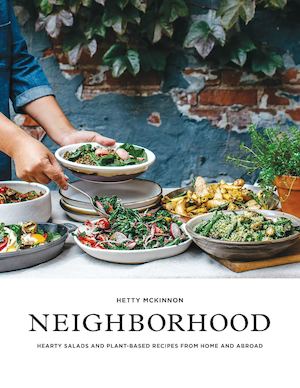
Neighborhood_PB
Neighborhood Final.indd 1 12/16/16 2:20 PM
Neighborhood Final.indd 2 12/16/16 2:20 PM
Photography by Luisa Brimble NEIGHBORHOOD HETTY MCKINNON HEARTY SALADS AND PLANT-BASED RECIPES FROM HOME AND ABROAD roost books Boulder 2017 Neighborhood Final.indd 3 12/16/16 2:20 PM
Neighborhood Final.indd 4 12/16/16 2:20 PM
For Ross, Scout, Dash, and Huck ⁓ for being the people I like to feed the most xx Neighborhood Final.indd 5 12/16/16 2:20 PM
Neighborhood Final.indd 6 12/16/16 2:20 PM
C O N T E N T S 9 I N T RODUC T IO N MAKING FRIENDS WITH SALAD 9 ALL THE WORLD'S NEIGHBORHOODS 11 WEEKNIGHT SALADS 24 FOUR WAYS TO USE LEFTOVER SALAD 26 COOK’S NOTES 31 35 DE A R A M E R IC A 63 S O F R E NCH I E 87 I N TO T H E M E DI T E R R A N E A N 10 9 E A S T, M E E T W E S T 141 TO A S I A , W I T H L OV E 163 T H IS IS AUS T R A L I A 189 JUS T BR I NG DE S S E RT ACKNOWLEDGMENTS 230 INDEX 233 Neighborhood 1-6-17.indd 7 1/6/17 4:44 PM
Neighborhood Final.indd 8 12/16/16 2:20 PM
N E IGH BOR HOOD 9 MAKING FRIENDS WITH SALAD My unconventional journey in salad-making began in 2011, when I established a community kitchen in my inner city home in Sydney, Australia. Twice every week, I would cook healthy and hearty plant-based salad boxes, stack them into my bicycle basket, and deliver them to locals. I called my adventure Arthur Street Kitchen. What started as a simple desire to share my favorite vegetable-laden salads with my local community yielded unexpected results. As I traversed the laneways and climbed the hills of my neighborhood Surry Hills, I witnessed a movement that cen- tered upon so much more than food. In the hunting and gathering of stories and his- tories with local salad-eaters, I saw the importance of food in allowing people to feel connected with others. Because of that, my neighborhood, and the people within it, have become a very big influence on the way I cook and my approach to food. In my time as a cook, sharing food has become a vehicle for establishing new friend- ships and building meaningful connections in my neighborhood. It is humbling to realize that even among the hustle of our modern lives, simple acts like cooking for others, eating together, and sharing food are sentiments that still resonate strongly. In late 2014, my husband and I packed up our three children, bid adieu to our beloved neighborhood of Surry Hills, and headed north. We landed in France and ate our way through the local Provençal markets. We introduced our children to the sights, sounds, and tastes of Italy, Germany, Finland, and our old “hometown” of London. Finally, we ended our trip in Brooklyn, New York, where the next chapter of our lives and Arthur Street Kitchen began. REINVENTING VEGETABLES Salads allow me to express my love for my other great passion—vegetables. At the heart of every one of my salads is a core seasonal vegetable—from there, the dish can venture virtually anywhere! Add a grain for heartiness, inject some herbs for freshness, incorporate some spice for intrigue, and finish with a nut for crunch. The possibilities are endless. I N T RO D U C T I O N Neighborhood Final.indd 9 12/16/16 2:20 PM
Neighborhood Final.indd 10 12/16/16 2:20 PM
N E IGH BOR HOOD 11 Introduction Having been vegetarian for over half my life, my belief in a plant-based diet as the ideal way to eat is unerring. But this book does not make statements about vegetari- anism. Rather, it is my aim to encourage home cooks to think more creatively about vegetables, understand their versatility, and cook them with more confidence and flair. In my view, when given the right treatment and thought, there is nothing more delicious or satisfying than a flavor-packed, vegetable-based salad. Neighborhood will show home cooks that you don’t have to be a vegetarian to enjoy vegetables, and you don’t have to be a chef to be a good cook. THE BIG VEGETABLE SALAD It is reasonable to say that I am rather enamored with salads. It is by far my favorite dish to eat. No matter what flavor you are pining for, or what ingredient you are craving, you can incorporate it spectacularly into a salad. For me, salads allow me to be creative, embracing the thrilling myriad of flavors, textures, ingredients, and fresh seasonal produce that come from living in a multicultural world. My salads are not the lettuce-based, leafy varieties you may be accustomed to. The recipes in this book elevate the salad from side dish to main meal. Using vegetables as their life force, my salads are the main event, not the support act. Neighborhood aims to inspire readers to look at vegetable salads in a new light, giving cooks the confi- dence to prepare delicious and hearty meals with the feel of comfort food, without the need for meat. ALL THE WORLD’S NEIGHBORHOODS Neighborhood is a collection of salad recipes inspired by “places,” journeying from Brooklyn in New York to the greater Americas, the Mediterranean, Asia, France, my native Australia, and many other places around the world for salad- making inspiration. If community is a feeling of kinship, Neighborhood is a physical compilation of the sights, sounds, and colors of a geographic area. Growing up in Australia, living in London, and traveling extensively through Europe before settling in brownstone Brooklyn, I have been continually drawn to the role of food as a social anchor in a neighborhood. No matter where you live in the world, it is the daily rituals of eating that strongly influence the way we live. It is the places I visit regularly—from grabbing a cream cheese bagel at my corner bodega, picking up fresh mozzarella from the local deli, or stopping by the greenmarket for seasonal produce—that have inspired my latest salad-making adventures, with exciting new international flavors and bold new vegetable pairings. Neighborhood Final.indd 11 12/16/16 2:20 PM
Neighborhood Final.indd 12 12/16/16 2:20 PM
N E IGH BOR HOOD 13 Introduction THE NEIGHBORHOOD It can be said that New York City is a city of neighborhoods. Each has their own unique personality, forged from history and circumstance. Often, entire neighbor- hoods are founded on the culture of food. From the Chinatowns of Lower Manhat- tan, Sunset Park in Brooklyn, and Flushing in Queens to Koreatown around 32nd Street, the Little Italies in Manhattan, and Bensonhurst in Brooklyn, the curry and spice emporiums of Murray Hill, the colorful Indian and Pakistani food in Jackson Heights, the old-world Russian delicacies in Brighton Beach, and Greek and Egyp- tian treats in Astoria, culinary neighborhoods like these are the beating heart of New York City. When we put down roots in Carroll Gardens, a charismatic neighborhood of deep-fronted brownstones and a robust Italo–American background in south Brooklyn, I was struck by the strength of history in the area. Over the last few decades, Carroll Gardens, like many Brooklyn neighborhoods, has undergone a cultural makeover. With that, many of the old local haunts have closed their doors or moved deeper into the suburbs. But still, amid the urban evolution, there remains a strong sense of neighborhood in the area. Italian flags fly alongside American ones, ubiquitous Virgin Mary statues adorn front and back yards, while old-school delicatessens, pizzerias, and enotecas still stand amongst the slick new wine bars and sleekly designed restaurants. This is an area with a strong narrative and a tenacious sense of its past, present, and future. A fundamental part of this neighborhood story is in the local food. My local Italian deli, Caputo’s Fine Foods, has been a neighborhood institution for over four decades, a family-owned store where the owner makes fresh mozzarella (several times a day!), and supplies fresh and dried pasta, antipasti, olive oils, and more. Up the street, an unrelated bakery that happens to share the same name, Caputo’s Bake Shop, has been supplying the neighborhood with baked goods since the early 1900s. The ciabatta, especially the olive-encrusted one, is my essential daily bread and their pizza dough is a family staple. Unassuming brick-fronted pizzerias owned by long-time locals still serve up crispy-based, cheesy-topped pizza pies to residents, old and new. On Sundays, the Carroll Gardens Greenmarket thrills me with the color of seasonal produce grown at farms nearby; most weeks, I still discover a fruit or vegetable that is unfamiliar to me. And in between, daily visits to my favorite local bodega, Sue’s Organics, bring me reliably sourced produce and lively conversation. In making Brooklyn home, it has been these humble, everyday neighborhood haunts that have given me a tangible sense of belonging and connection. Through the hunting and gathering of food, I am gradually becoming a local. Neighborhood Final.indd 13 12/16/16 2:20 PM
Neighborhood Final.indd 14 12/16/16 2:20 PM
Neighborhood Final.indd 15 12/16/16 2:20 PM
Neighborhood Final.indd 16 12/16/16 2:20 PM
Neighborhood Final.indd 17 12/16/16 2:20 PM
Neighborhood Final.indd 18 12/16/16 2:20 PM
Neighborhood Final.indd 19 12/16/16 2:20 PM
Neighborhood Final.indd 20 12/16/16 2:20 PM
Neighborhood Final.indd 21 12/16/16 2:20 PM
Neighborhood Final.indd 22 12/16/16 2:20 PM
Neighborhood Final.indd 23 12/16/16 2:20 PM
N E IGH BOR HOOD 24 Introduction WEEKNIGHT SALADS If I had my choice, I would always advocate slow cooking. For me, one of life’s great luxuries is to take the time to shop for the freshest ingredients, cook real food from scratch, and share meals with family, friends, and neighbors. However, I also appreciate that weeknight meals are often about being quick and easy. One of the most common questions I am asked is how to make a salad quickly. My best advice on speedy salad making: GET PREPARED! Here I’ve thrown together a few practical ideas on how to make your weeknight salad prep a bit easier and quicker. ON THE WEEKEND, STOCK YOUR PANTRY Let’s be honest, having a thoughtfully stocked pantry is your first step to simplifying your weekly cooking. My confession here is that I’m a food hoarder. I love buy- ing food items, even if I’m not in immediate need. You just never know, right? My friends used to joke that if we were faced with war and famine, they would bunker down at my house because my food stocks would keep us fed for months. But in my madness, there is some method. Getting into the habit of picking up a few essentials on a weekly basis will allow you to gradually build up your pantry stocks, inevitably making last-minute cooking a whole lot easier. On the weekends (or whenever you do your major household shop), stock up on basics you will need for the week. Here are some tips on how to stock your pantry, fridge, and freezer for quicker and easier salad making: Choose two or three main seasonal vegetables for the week Picking up many different types of vegetables can make weekday cooking confusing. Instead, just pick two or three vegetables that are in season, inexpensive, and look delicious. These vegetables can be the centerpiece of your meal, so instead of buying one cauliflower, buy two or three of them. Pick two types of soft herbs to see you through the week My favorites to have in the fridge are parsley, cilantro, mint, and green onions (see note page 32). These herbs are very flexible, can be used in a range of dishes, and will really transform your salads. Stock up on canned legumes Great choices are chickpeas, borlotti beans, butter beans, black beans, and cannellini beans. If you have a can of beans, a vegetable, and herbs, you virtually have a salad right there! Neighborhood Final.indd 24 12/16/16 2:20 PM
N E IGH BOR HOOD 25 Introduction Make grains pantry staples Stored in airtight jars, they keep for months and they are great to add bulk to your dish. I always have quinoa, pearl barley, and bulgur wheat (cracked wheat) in my pantry as I find them so versatile and, importantly, quick to cook! Stock your freezer with a few essentials My freezer essentials are edamame beans, garden peas, and lotus root. CHOP IT UP If you have a spare half hour on the weekend, chop up your veggies, ready for cooking. If you have kale, remove the stems and tear up the leaves. For vegetables like cauliflower or broccoli, cut them into florets and keep the stalks separate. Store everything in airtight plastic containers or ziplock bags and keep in the vegetable drawer of your refrigerator to keep crisp. This small step will make weekday cooking so much quicker. (Note: this only applies to vegetables that won’t oxidize and turn brown when cooked, so a definite no to vegetables like potato, eggplant, and arti- chokes.) COOK IN ADVANCE Roast, barbecue, grill, or pan-fry your vegetables in advance and keep them in the refrigerator. Most vegetables, without sauce or flavor added, will keep in an airtight container in the refrigerator for 1–2 days. MAKE TOASTED NUTS AND SEEDS A PANTRY STAPLE Toast a variety of nuts and seeds in bulk and keep them in airtight jars in your pantry. I usually have jars of toasted walnuts, almonds, peanuts, pistachios, and sesame seeds ready in my pantry. PRE-COOK A GRAIN Consider cooking one or two grains in advance and keeping them in the refrigerator, ready for salad assembly. Quinoa keeps well in the fridge for 5–6 days, and can even be frozen for up to 6 months. Other grains that you could cook in advance are pearl barley, spelt, farro, freekeh, and brown rice. FRIDGE AND FREEZER DRESSINGS Dressings can be made in advance, and either stored in the refrigerator or freezer. Vinaigrettes, flavored yogurts, or versatile Asian-style dressings are fine to store in the fridge for 2–3 days. Pesto and scented oils can be frozen for up to 3 months. Just make sure to bring the dressings back to room temperature before using. Neighborhood Final.indd 25 12/16/16 2:20 PM
N E IGH BOR HOOD 26 Introduction FOUR WAYS TO USE LEFTOVER SALAD In my house, there is often a plethora of leftover salad. The Chinese in me always has me cooking for the masses. So over the years, I have devised a few interesting, delicious ways to use up leftover salad. I thought I’d share these with you. 1. PUT AN EGG ON IT When in doubt, put a fried egg on it. Sometimes, if the salad is robust enough to do so, I like to quickly fry the leftovers in a little extra-virgin olive oil, just to add some heat, then top the whole thing off with a fried egg. Just like that, you have a hearty lunch or light dinner. 2. BLEND IT INTO A SOUP I love blending leftover salad, transforming it into a hearty soup. Simply throw your leftover salad into a food processor or blender, add a cup of vege- table broth or liquid vegetable stock and blend the whole mix up. This salad do-over is perfect for those salads without too many leaves and which are heavy on legumes or roasted vegetables. If you have a lot of leftovers, you can even freeze the soup for later consumption. 3. MAKE A GRILLED CHEESE A grilled cheese is the perfect anytime and every time meal. This type of sand- wich is serious business—especially in the United States where there is great pride taken in a perfect grilled cheese. Use a sandwich grill if you have one, but here, I show you how to make the perfect grilled cheese sandwich using your everyday frying pan: Take two thick slices of sourdough bread or ciabatta. Spread butter on both sides of both slices of bread (yes, both!). Layer one side of both slices with whole egg mayonnaise. Heat a large non-stick frying pan or griddle pan over medium-low heat and add the bread slices (mayonnaise-side down) to cook. Slide them around the pan to achieve an even golden color. Flip them both over, then pile one slice with leftover salad, and top with your favorite melty cheese—try cheddar, Swiss, gruyere, mozzarella, provolone, brie—and place the other slice of bread on the top, browned-side down (you want the uncooked sides on the outside). » Neighborhood Final.indd 26 12/16/16 2:20 PM
N E IGH BOR HOOD 27 Introduction Cook the sandwich, moving it around the pan to get an even browning, for about 2 minutes on each side. A grilled cheese sandwich is fantastic made with roasted broccoli, cauliflower, carrots, sweet potato, and, my favorite, brussels sprouts. 4. GO KUKU! Turning a salad into a kuku is perhaps my very favorite way of embracing leftovers. Kuku is a rather exotic name for an Iranian-inspired frittata, laced with a subtle hit of saffron, and perfect served at room temperature. Over the years, I have made this dish countless times using leftover salads—it is great with roasted vegetable salads, but also works wonderfully with legumes and grain salads with bulgur wheat, spelt, and barley. SERVES 4~6 3 tablespoons extra-virgin olive oil 2 onions, halved and finely sliced 1 garlic clove, finely chopped 6 eggs 2 tablespoons all-purpose flour 1 teaspoon baking powder small pinch of saffron threads, soaked in 1 tablespoon boiling water 4 cups leftover salad 3 tablespoons chopped soft herbs (parsley, dill, mint, cilantro, chives, etc.) ½ pomegranate, seeds extracted sea salt and black pepper Preheat the oven to 350˚F (180˚C). Line a 9 in (22 cm) springform pan with parchment paper. In a large frying pan, heat the olive oil and fry the onions and garlic for 7–8 minutes, or until the onions are soft and starting to caramelize. Allow to cool. In a mixing bowl, add the eggs and whisk until smooth. Add the flour, baking pow- der, saffron and its soaking water, sea salt, and a good grind of black pepper, and whisk until smooth. In the springform pan, lay out the onions, then spoon over the leftover salad. Pour over the egg mixture. Place the pan on a large baking tray (to catch any leaks) and bake in the oven for 45–50 minutes until golden and the egg is set. Insert a skewer to make sure the kuku is cooked all the way through. To serve, scatter over the soft herbs and pomegranate seeds. Serve warm, or at room temperature. The kuku will keep in the refrigerator for 2–3 days. Neighborhood Final.indd 27 12/16/16 2:20 PM
Neighborhood Final.indd 28 12/16/16 2:20 PM
Neighborhood Final.indd 29 12/16/16 2:20 PM