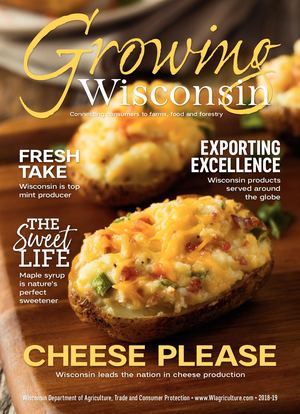
Growing Wisconsin 2018
Connecting consumers to farms, food and forestry
Connecting consumers to farms, food and forestry FRESH EXPORTING TAKE EXCELLENCE Wisconsin products Wisconsin is top served around mint producer the globe tHe Sweet LIFE Maple syrup is nature's perfect sweetener CHEESE PLEASEWisconsin leads the nation in cheese production Wisconsin Department of Agriculture, Trade and Consumer Protection • www.WIagriculture.com • 2018-19
CONTENTS 18 Future Farmers LASTING LEGACIES Generations of families take pride in farms that have been passed down 7 Ag Profile 28 Cooperatives 44 Conservation WISCONSIN AGRICULTURE BETTER TOGETHER COLLABORATING An overview of the state’s food, Cooperatives benefit FOR CONSERVATION farming and agribusiness sectors farmers, consumers Network of farms showcases successful stewardship practices 10 Top Ag Products 32 Local Products WHAT’S GROWING SPECIAL DELIVERY IN WISCONSIN? The Something Special from A glimpse at the state’s leading ag Wisconsin™ program promotes products based on cash receipts locally made products 12 Dairy 34 Agritourism 48 Peppermint COMMENDING COWS AG ATTRACTIONS FRESH TAKE PHOTOS, FROM TOP: SARA STATHAS; ISTOCK.COM/ANNA1311; COVER: ISTOCK.COM/BHOFACK2 Dairy month is full of fun, food Create new connections Wisconsin ranks No. 5 in the and education for consumers by visiting Wisconsin’s country for mint production agritourism destinations 24 Fairs 50 Maple Syrup 38 Food Safety FUN AT THE FAIR LIVING THE SWEET LIFE Wisconsin fairs promote CELEBRATING SAFETY Wisconsin maple syrup agriculture and community Meat Safety Inspection Program producers turn tree sap into provides education, support and nature’s perfect sweetener regulation for 50 years COVER STORY (page 16) 54 Trade Missions 42 Animal Health Fresh dairy products including cheese, ON A MISSION butter and sour cream are used KEEPING MARKETS OPEN Trade missions get to make Twice-Baked Potatoes. Division of Animal Health keeps Wisconsin products into producers and consumers safe international markets WIagrIculture.com |3
WELCOME GROWING WISCONSIN Greetings, 2018-19 EDITION, VOLUME 6 Thank you for choosing Growing Wisconsin. As Secretary of the Department of Agriculture, FARM FLAVOR Trade and Consumer Protection (DATCP), I am MEDIA pleased that this magazine highlights the huge EDITOR Kim Madlom impact that Wisconsin agriculture has on our ASSOCIATE EDITORS Rachel Bertone, Hannah Patterson Hill CONTENT TEAM Cara Sanders, Ashley Wright lives and our economy. CONTRIBUTING WRITERS Keri Ann Beazell, Wisconsin is known internationally for Jessica Walker Boehm, Jill Clair Gentry, Donna Gilson, Maggie Ginsberg, John McBryde, Jessica Mozo, Joanie Stiers producing quality food, fuel and fiber. The state V.P./CONTENT & MARKETING Jessy Yancey is a leader in processing cheese, growing CREATIVE DIRECTOR Laura Gallagher cranberries and ginseng, raising milk goats, ART DIRECTOR Amy Hiemstra GRAPHIC DESIGNER Emmylou Rittenour and much more. The depth and breadth of Sheila E. Harsdorf was PHOTOGRAPHY DIRECTOR Jeffrey S. Otto Wisconsin agriculture is one of the industry’s appointed Secretary SENIOR PHOTOGRAPHER Michael D. Tedesco greatest strengths. COLOR IMAGING TECHNICIAN Alison Hunter of Agriculture, Trade V.P./DIGITAL OPERATIONS Allison Davis and Consumer Protection To ensure the long-term viability of WEB DEVELOPER Richard Stevens in November 2017. She Wisconsin’s agriculture industry, the state DIGITAL ADS SPECIALIST Susanna Haynes has a bachelor’s degree is working to grow both domestic and PRESIDENT Ray Langen in animal science. international markets for our many CHIEF OPERATING OFFICER Kim Newsom Holmberg EXECUTIVE VICE PRESIDENT Jordan Moore commodities. This edition of Growing Wisconsin V.P./CLIENT DEVELOPMENT AND RECRUITER Drew Colston showcases examples of farmers and agribusinesses who have found great OPERATIONS DIRECTOR Molly Morton success marketing their products and sharing the value of agriculture. While AD PRODUCTION MANAGER Katie Middendorf some producers market their goods directly to consumers and institutions SENIOR AD COORDINATOR/DESIGNER Vikki Williams AD TRAFFIC COORDINATOR Patricia Moisan locally, others rely on processors and marketers to reach customers halfway SALES SUPPORT COORDINATOR Courtney Cook around the world. FARM FLAVOR MEDIA IS A DIVISION OF Agriculture is key to Wisconsin’s prosperity. From our multi-generational JOURNAL COMMUNICATIONS INC. CHAIRMAN Greg Thurman family farms to our innovative research facilities, Wisconsin agriculture has PRESIDENT/PUBLISHER Bob Schwartzman much to be proud of. Thank you for reading their stories. I hope you enjoy CONTROLLER Chris Dudley this edition of Growing Wisconsin. ACCOUNTING TEAM Diana Iafrate, Maria McFarland, Lisa Owens DATABASE DIRECTOR Debbie Woksa EXECUTIVE SECRETARY Kristy Giles Best regards, HUMAN RESOURCES MANAGER Peggy Blake Growing Wisconsin is published annually by Farm Flavor Media and distributed by the Wisconsin Department of Agriculture, Sheila E. Harsdorf Trade and Consumer Protection. For advertising information or to direct questions or comments Secretary about the magazine, please contact Farm Flavor Media at Wisconsin Department of Agriculture, Trade and Consumer Protection (615) 771-0080 or info@farmflavormedia.com. WISCONSIN DEPARTMENT OF AGRICULTURE, TRADE AND CONSUMER PROTECTION: SECRETARY Sheila E. Harsdorf COMMUNICATIONS DIRECTOR Bill Cosh Special thanks to all Department staff for their support. For more information about the Wisconsin Department of Agriculture, Trade and Consumer Protection, contact: Bill Cosh, Communications Director P.O. Box 8911, Madison, WI 53708 (608) 224-5020 William2.Cosh@wi.gov No public funds were used in the publishing of this magazine. © Copyright 2018 Journal Communications Inc., 725 Cool Springs Blvd., Suite 400, Franklin, TN 37067, (615) 771-0080. All rights reserved. No portion of this magazine may be reproduced in whole or in part without written consent. Please recycle this magazine. WIagrIculture.com |5
AG PROFILE Wisconsin Agriculture An overview of the state’s food, farming and agribusiness sectors I n Wisconsin, agriculture for nothing. Wisconsin is home 69,754 is a critical sector. While to more dairy farms than any the state is recognized for other state and 1.28 million dairy its powerhouse dairy industry, cows. Dairy itself contributes agriculture encompasses much $43.4 billion to the state’s more, including unique specialty products like ginseng and mink economy each year. And while Wisconsinites Total Farms pelts, food processing, fruit reap the benefits of the state’s production, ag exports, and more. agriculture industry, so does With 69,754 farms spread the rest of the world. In 2017, across more than 14 million the state exported $3.5 billion 308 acres, each averaging about in agricultural products to 147 209 acres, Wisconsin farmers countries. Prepared vegetables grow and raise some of the and fruits were Wisconsin’s most state’s top products. valuable export category, and its Wisconsin ranks first in top markets included Canada, Farmers' Markets the nation in snap beans for Mexico and China. processing, cheese, cranberries, More than crops and ginseng, milk pelts, dry whey commodities, Wisconsin’s for humans, milk goats, and corn agricultural sector includes $88.3B for silage. It’s third in the nation everything from agritourism for potato production, and also and food safety to agricultural grows a significant amount technology, conservation and of fruit, including tart cherries education. With the continued and apples. innovation and hard work of the Economic Impact The state didn’t get its industry, Wisconsin agriculture is nickname, “America’s Dairyland,” only poised for continued success. 413,500 Crops vs. Livestock Production Value Livestock: 73% Crops: 27% $9.4M $3.5M jobs provided by Wisconsin agriculture There are 33,184 women 11.9% OF WISCONSIN JOBS ARE AG-RELATED. working as primary farm Source: datcp.wi.gov operators in Wisconsin. WIagriculture.com |7
NEWS & NOTES Ag Attractions Discover more about Wisconsin’s agriculture industry at several fun and interesting events. Marsh Success As the nation’s leading producer OCTOBER 2018 of cranberries, Wisconsin is World Dairy Expo, Madison responsible for more than 60 percent of the country’s crop. The JANUARY 2019 tart cranberry – once known as Midwest Farm Show, LaCrosse the crane berry – is grown mostly FEBRUARY 2019 in the central and northern parts of Wisconsin by more than Rice Lake Area Farm Show, Rice Lake 250 growers on 21,000 acres. A Winning Process Wisconsin is a force to MARCH 2019 It’s so important to Wisconsin agriculture that it’s actually reckon with when it comes WPS Farm Show, Oshkosh the state’s official fruit. to vegetable production. In the U.S., Wisconsin Eau Claire Farm Show, Eau Claire Contrary to what most consumers think, cranberries are harvests the second-highest JULY 2019 not grown in water, but instead amount of vegetables meant Wisconsin Farm Technology Days, on low-running vines in sandy for processing. The state is the Johnson Creek marshes. During harvest, the nation’s top grower of carrots marshes are flooded and the and green beans for processing, berries float to the top, thanks and ranks third for sweet corn to small air pockets inside. and peas for processing. In fact, Rice Lake Learn more about Wisconsin’s in 2016, Wisconsin grew almost cranberry industry at wiscran.org. half – 43 percent – of the nation’s Eau Claire processing green beans. With many processing plants Oshkosh across the state, Wisconsin’s LaCrosse processing industry provides Johnson Madison Creek about 259,600 jobs, and contributes $67.8 billion annually in food-processing sales. Hot Potato Whether you like potatoes baked, fried, roasted or mashed, Wisconsin farmers know a thing or two about them. The state consistently ranks third in the PHOTOS, FROM TOP: ISTOCK.COM/BOARDING1NOW, REPUBLICA, ENTER89 country in potato production, only behind Idaho and Washington. Farmers grow several types of varieties, such as russet, blue and purple, yellow, fingerling, and more. Wisconsin researchers are also developing new varieties and the state is a leader in potato research. Learn more about Wisconsin potatoes at eatwisconsinpotatoes.com. WIagrIculture.com |9
TOP AG PRODUCTS What's Growing in WISCONSIN? A glimpse at the state’s leading ag products based on cash receipts DAIRY PRODUCTS Wisconsin is home to 1.28 million dairy cows, and each cow produces 1,830 pounds, or 213 gallons, of milk per month. $5B CASH RECEIPTS ✓ FARM Dairy cows FACTgive more than 7 gallons of milk each day, which equals 112 glasses of milk. SOYBEANS In 2017, Wisconsin farmers harvested 2.14 million acres of soybeans, which is 190,000 acres above 2016’s harvested soybean acres. $987.4M PHOTOS, FROM TOP: ISTOCK.COM/FCAFOTODIGITAL, ITHINKSKY CATTLE AND CALVES Beef cows can be found in nearly every CASH RECEIPTS county in Wisconsin, and the state lays claim to 285,000 beef cows. $1.6B CASH RECEIPTS WHAT ARE CASH RECEIPTS? Defined by the U.S. Department of Agriculture’s Economic Research Service, cash receipts refer to the total amount of crops or livestock sold in a calendar year. 10 | Growing Wisconsin
POTATOES FIND MORE Wisconsin ranks third in the U.S. for potato ONL NE i production, and several varieties of the vegetable Learn more about are grown across the state including russet, Wisconsin’s top yellow, white, red, purple/blue and fingerlings. products at WIagriculture.com. $283.2M CASH RECEIPTS HOGS The state, home to a total of 300,000 hogs in 2017, has CRANBERRIES a thriving pork production Wisconsin is perennially the top cranberry- industry that employs producing state in the nation, and cranberries are BROILERS 10,000 people. the state’s No. 1 fruit crop. Some of Wisconsin’s Wisconsin produced 54 million broilers – marshes have been successfully producing cranberries for more than 100 years. or chickens grown for meat – in 2016, earning over $108.6 million in production value. $98.8M $177.3M $108.6M CASH RECEIPTS CASH RECEIPTS CASH RECEIPTS ✓ FARM Each FACT market hog represents 371 servings of pork. CHICKEN EGGS Wisconsin hens produced 1.8 billion eggs in 2017, $79.1M and in 2016, the cutout state’s egg production was valued at CASH RECEIPTS $79 million. HAY Wisconsin farmers harvested 2.19 million acres of hay and haylage in 2017, worth $816.2 million. They fed most of that CORN Dane, Rock, Grant, Lafayette and Dodge counties produced the most corn in Wisconsin in 2016, $1.3B CASH RECEIPTS to their own livestock, and sold about when the state’s farmers harvested 4.05 million 10 percent of the crop. acres and 573 million bushels of corn. $84.4M CASH RECEIPTS CORN PHOTO: SHARON VANORNY WIagrIculture.com | 11
PHOTO: JCI STAFF 12 | Growing Wisconsin
DAIRY Commending COWS Dairy month is full of fun, food and education for consumers E very June, passionate dairy pounds of milk, second only volunteers throughout the state to California. Dairy contributes invite Wisconsinites to more than $43.4 billion annually to the Wisconsin 70 dairy breakfasts, many of them economy, contributing more to the held at daybreak on a dairy farm. Badger State than citrus does to Florida The menus are threaded with dairy and potatoes to Idaho, according to delights: waffles with fruit, whipped the Dairy Farmers of Wisconsin. cream and a pat of butter. Scrambled Undoubtedly, Wisconsin has eggs with cheese. An endless supply plenty of reasons to celebrate cows. of white and chocolate milk. Sometimes, even ice cream sundaes at 7 a.m. Cows Take Center Stage in Communities The meal often ends with a free farm Parades, community fairs, string tour or access to educational stations, cheese giveaways and even run/walk delivering a farm-to-fork experience events fill Wisconsin’s June Dairy at its finest. Month calendar. In Pierce County, “June Dairy Month has been a locals celebrate their famous cheese celebration in Wisconsin since the late curds at the Ellsworth Cheese 1930s, and the first organized dairy Curd Festival. breakfast was in Jefferson County in Over on the eastern side of the state, 1970,” says Brenda Murphy, director of Sheboygan County hosts the Dairy farmer communications and programs Dash and Stroll. The county is home to for the Dairy Farmers of Wisconsin. Addie the Cow, a life-size fiberglass cow “Wisconsin is known as America’s that milks, moos, and wears bells and Dairyland and has been since 1930. flowers. This self-proclaimed “kid and It only makes sense that we celebrate camera magnet” with her own trailer PHOTO: ISTOCK.COM/JAKUB PAVLINEC a month dedicated to dairy with travels throughout the county and numerous events and celebrations.” beyond. The Sheboygan County Dairy Throughout Wisconsin, more than Promotion Association owns Addie 8,000 dairy farms – 96 percent of them and employs a dairy ambassador family owned – care for 1.28 million cows who promotes dairy and gives free that, in 2017, produced 30.32 billion presentations in classrooms throughout WIagrIculture.com | 13
featured RECIPES GRILLED CHEESE BITES Ingredients 2 whole-wheat baguettes, ¼ teaspoon cayenne sliced thinly (to make pepper 20 pieces) 2 teaspoons mustard 1 cup Swiss cheese, 4 ounces (1 jar) chopped shredded pimentos, well drained 1 cup sharp white cheddar 1 cup fresh spinach cheese, shredded 2-3 tablespoons butter ¼ cup mayonnaise Instructions 1. Combine cheese, pimentos, cayenne pepper, mustard and mayonnaise until well blended. Distribute on 10 slices of the bread. Top with 10 more slices of bread. 2. Butter the outside-facing sides of the bread lightly. Grill until crispy and deep golden, about 3 to 5 minutes per side. 3. Just before serving, place several fresh leaves of spinach inside each mini sandwich. TWICE-BAKED POTATOES Ingredients 4 Russet potatoes, 4 ounces cream cheese about 8 ounces each ½ cup scallions, chopped ½ cup sour cream ½ cup cooked bacon, 2 tablespoons butter chopped ½ cup milk 1 ½ teaspoons kosher salt ½ cup sharp cheddar ¼ teaspoon pepper cheese, shredded Instructions 1. Heat oven to 400 degrees. 2. Bake potatoes on foil-lined baking sheet until skin is crisp and fork easily pierces flesh, about 1 hour. Transfer to a wire rack and let sit until cool enough PHOTOS, FROM TOP: JEFFREY S. OTTO/JCI STAFF; ISTOCK.COM/BHOFACK2 to handle, about 10 minutes. 3. Cut each potato in half lengthwise. Using a small spoon, scoop flesh from each half into a bowl, leaving ¼-inch thickness of flesh in each skin. Sprinkle with salt and pepper. 4. Mash potato flesh with fork until smooth. Stir in remaining ingredients, including salt and pepper to taste, until well combined. Spoon mixture into skins and return to the oven. 5. Broil until spotty brown and crisp on top, about 10 to 15 minutes. Allow to cool for 10 minutes. Serve warm. 14 | Growing Wisconsin
Sheboygan County during the year. Dairy Month with an annual Meanwhile, Murphy says breakfast that requires 5,000 half- Sheboygan County will average pints of milk, 126 pounds of ice 3,500 to 4,000 people at its annual cream mix, 110 pounds of butter dairy breakfast. Jefferson County and 480 pounds of cheese for an hosts between 1,500 and 2,000 at its estimated 5,000 hungry visitors. fairgrounds. Some breakfasts in the The breakfast has been held on state top 5,000 attendees, she says. a Green County farm for the last “We understand that consumers 38 years of its nearly 60-year want to know more about their food history to give visitors a firsthand and they want to get on the farm,” experience with a modern dairy farm. Farm tours or educational she says. “It reminds them of how stations accompany nearly every their parents, grandparents or dairy breakfast around the state, great-grandparents lived 60 to 70 Murphy says. Consumers see cows, years ago. Nowadays, most people talk to veterinarians and meet are several generations removed dairy nutritionists. the farm.” “These breakfasts on a farm give them a glimpse of what it’s like to Served with a Side of Education live the life of a dairy farmer, get The Green County Agricultural up close and personal with some Chest makes it a year-round affair of these bovine beauties and have to promote dairy products, which a great breakfast with their members call “Green County’s neighbors,” Murphy says. gold.” The group kicks off June – Joanie Stiers June Dairy Month has been celebrated since the late 1930s. The first organized dairy breakfast was in Jefferson County in 1970. $43.4B ANNUAL DAIRY ANNUAL CHEESE PRODUCTION IN WISCONSIN CONTRIBUTION TO INCREASED 37 PERCENT WISCONSIN’S ECONOMY FROM 2007 TO 2017. Dairy farmers care for 1.28 million cows that produced 30.32 billion pounds of milk in 2017.
CHEESE Wisconsin is for CHEESE LOVERS Wisconsin leads the nation in cheese production W isconsin has long 3.3 billion pounds of cheese. world. Our cheesemakers have been known for “In Wisconsin, cheese is not the awards to prove it.” its award-winning just something we do – it’s who Wisconsin produces nearly half cheeses, and for we are,” says Suzanne Fanning, of the nation’s specialty cheese good reason. Known around the vice president of marketing (47 percent) and about 27 percent world as America’s Dairyland, communications for the Dairy of the nation’s total cheese. That PHOTO: ISTOCK.COM/XAMTIW Wisconsin has ranked No. 1 in the Farmers of Wisconsin. “Our includes more than 600 different nation for cheese production for culture of innovation, combined varieties and styles of cheese – far more than a century, since 1910. In with our rich heritage, has inspired more than any other state. The top 2017, Wisconsin produced a record some of the best cheeses in the selling varieties include cheddar, 16 | Growing Wisconsin
fresh mozzarella, Parmesan, colby 3.3B WISCONSIN CHEESE PRODUCTION jack blends, string mozzarella, provolone, queso fresco, Muenster, 3.2B (Measured in lbs) Monterey Jack and havarti. 3.1B Wisconsin’s Specialty Cheeses 3B Specialty cheeses are big business in Wisconsin, too. Roth 2.9B Grand Cru Surchoix, made by Roth 2.8B Cheese in Monroe, was named the World Champion at the 2016 World 2.7B Championship Cheese Contest. “It was the first time a U.S. 2.6B cheese had won the title in 28 years, an honor we’re very proud 2.5B 2010 2011 2012 2013 2014 2015 2016 2017 of here at Roth,” says Heather Engwall, director of marketing for Roth Cheese. “We were selected as the best cheese out of more than 2,500 entries from more than 25 countries.” The company’s Roth GranQueso was an American Cheese Society winner seven years in a row, and Roth Chipotle Havarti recently won first place in its category at the 2018 World Championship Cheese Contest. “These are all honors we cherish, because they showcase the talent and passion of our cheesemakers here at Roth,” Engwall says. Roth’s signature Grand Cru along with flavored Goudas and havarti are customer favorites. “Cheeses from Wisconsin earn awards and great reputations because we have a long history of great cheesemakers who have been perfecting the craft of cheesemaking for decades,” Engwall says. “The cheese industry is a family here in Wisconsin. We all support each other and local dairy farms in order to produce the world’s best cheese.” – Jessica Mozo FIND MORE ONLiNE Learn more about Wisconsin’s dairy industry at WIagriculture.com. WIagriculture.com | 17
18 | Growing Wisconsin
FUTURE FARMERS LASTING Generations of families take pride in farms that have been passed down Legacies W isconsin residents can find plenty A Need for Family Farms to be proud of. It might be the That certainly fits the description for opportunities for higher education, the farms in Rock County owned by Kathy the beauty of the outdoors or another and Ronald Woodman and their son Joe football season with the Packers. Woodman. The older Woodmans live on But nothing exemplifies pride like the the Sesquicentennial Farm, while Joe is on family farm. the corn and soybean farm that was added “People here are so proud of their heritage,” to the Centennial Farms list in 2017. says Jill Albanese, competitive exhibits “I’m a big history guy, so obviously I think director for the Wisconsin State Fair. it’s a cool thing when a farm can get passed To that end, Albanese says, the State Fair down along the same family for so long,” Joe has been officially honoring multigenerational Woodman says. “As far as the significance farms in Wisconsin since the creation of the of it, it’s so hard to start farming these days, Century Farms program in 1948, the year to get your foot in the door. the state turned 100 years old. An astounding “We need family farms to continue for future 9,344 farms have been listed in the program, generations, and not only farms being passed with recognition occurring each August down, but also knowledge, the ways of doing during the Wisconsin State Fair in West Allis. stuff (on a farm).” The Sesquicentennial Farm and Home Woodman began learning how to farm Award was established in 1998 to honor family when he was around 8 years old, helping feed farms that are at least 150 years old, and the calves his father and grandfather were 836 have so far been added to that list. raising on their dairy farm. “To be honored, your farm has to be at “My dad would always be working with my least 100 or 150 years old and you have to have grandpa, and I showed a lot of interest in it,” kept the farm in your family continuously,” he says. “I would choose working on the farm says Albanese, who helps to oversee over going to my friends’ houses.” the two programs. Now in his late 20s, Joe Woodman is a fifth- PHOTOS: SARA STATHAS Father and son, Ron and Joe Woodman of Rock County own a Sesquicentennial Farm as well as a Centennial Farm. The family pride themselves on preserving history. WIagriculture.com | 19
Left: The Woodmans take pride in working together on their family farms. Top Right: The Woodmans receive their Sesquicentennial Farm status. Bottom Right: The John Born farm was also recently added to the list of Sesquicentennial Farms. 20 | Growing Wisconsin
generation farmer. He has two college-aged siblings who have other interests and will likely find careers off the farm, but he and his wife hope to have children who will carry on the family legacy. “We’d like to keep our farm in the family,” says Woodman, who also has a full-time job at Seneca Foods. “It’s harder and harder to find kids with an interest in farming. So that’s a goal of ours.” Pitching In Family is the backbone of the John Born farm, located in Sheboygan County and recently listed on the Sesquicentennial Farm and Home Award list. A fifth-generation farmer in his early 60s, Born oversees a total of about 215 acres of alfalfa, soybeans and corn, as well as a herd of cows in a small dairy operation. His parents are in their 80s, but still stay involved on the farm, and his siblings pitch in as well. PHOTOS, FROM TOP: BORN FAMILY; WOODMAN FAMILY “My dad is 87 years old and he still stays busy on the farm,” Born says. “He doesn’t do it because he has to, it’s just something that keeps him going. “All the family members come to help out, just because of the love for what we have. It’s a family farm. They don’t come for a paycheck, they just come to help out. This is their home, too.” – John McBryde WIagrIculture.com | 21
FARMERS’ MARKETS READY FOR Market Farmers’ markets make it easy for consumers to connect with producers and enjoy seasonal foods T hanks to many farmers’ markets located across Wisconsin, the state’s consumers have ample opportunities to purchase fresh, locally grown and produced foods – often directly from the hand of the farmer. “I think farmers’ markets have grown (in both number and popularity in Wisconsin) because more people are wanting to shake the hand and see the face of the person growing their food,” says Kietra Olson, program manager for the Department of Agriculture, Trade and Consumer Protection’s Wisconsin Foods Program. “Developing a relationship with your farmer is really a rewarding connection. People are also realizing that the carrots grown down the road and the honey PHOTO: ISTOCK.COM/RYANJLANE harvested in the next town over tastes more like ‘home.’ ” One of the state’s most prominent farmers’ markets is the Downtown Appleton Farm Market, 22 | Growing Wisconsin
a year-round market that’s held on Saturdays. The market, a local favorite since its creation in 1992, is home to more than 150 vendors from June to October – its busiest season – and includes a Kids Market where young entrepreneurs sell their handmade items every third Saturday from January through May. Established in 1972, the Dane County Farmers’ Market in Madison is also continuing to thrive, maintaining its status as the nation’s largest producers-only farmers’ market. The market’s vendors, all of whom are based in Wisconsin, are required to grow or raise the products they’re selling, which ensures everything customers come across is produced in Wisconsin. As a year-round operation, the Dane County Farmers’ Market hosts multiple markets throughout the year. The Saturday market on the Square and the Wednesday market are both held from April to November, along with a holiday market open during November and December and a late winter market from January to April. The Saturday market on the Square is the largest of the four markets, encircling the Wisconsin State Capitol and featuring about 150 to 175 vendors selling fruits, vegetables, dairy products, meats, honey, jams, jellies and more. “We have more than 20,000 visitors each Saturday at the Saturday market on the Square,” says Sarah Elliott, market manager for the Dane County Farmers’ Market. “It’s a big event, and we provide resources like recipes, because we want people to feel empowered to use local products for scratch cooking. Of course, the greatest resources of all are the producers. Customers can have conversations with farmers about how they like to prepare and eat the foods they’re selling, and that is really special.” – Jessica Walker Boehm
HORSE RIDING: JESSICA BROGLEY; CORNBOX: PIERCE CO. FAIR-ELLSWORTH; STATE FAIR PHOTOS: WISCONSIN STATE FAIR 24 | Growing Wisconsin
FAIRS FUN at the FAIRWisconsin fairs promote agriculture and community W hen you think generations removed from the of a fair, visions family farm, fairs are a great way of funnel cakes, to see agriculture showcased.” Ferris wheels Wisconsinites have many and carnival games may pop opportunities to attend a fair. into your head. In Wisconsin, The state has 75 state-aided those elements ring true, but county and district fairs, and agriculture is at the heart of it all. the Wisconsin State Fair, held “All of our fairs promote annually in West Allis. The State agriculture as the primary Fair attracts visitors from all backbone of the fair. They serve over Wisconsin and beyond. as the voice of agriculture,” says Fairs include activities ranging Jayme Buttke of the Wisconsin from animal shows and baking Association of Fairs. “Fairs contests, to live music and provide the fairgoer an entertainment, to midway rides. educational opportunity on Buttke says that in recent agriculture that you can’t get years, fairs across the state unless you visit a farm. With have embraced creative ideas our attendees being four or five to maintain their agricultural Wisconsin fairs offer a variety of fun, including activities such as carnival rides and corn boxes for kids to play in, livestock shows, tasty treats, and more. WIagriculture.com | 25
roots and educate the public about district and state fairs annually. PHOTO: ISTOCK.COM/AGUIRRE_MAR everything from dairy production More than $900,000 in awards to plant growth. is presented.” “Our fair members have realized She says that although the cash that they need to provide more prizes are enticing, they aren’t hands-on agricultural education,” the real rewards. she says. “They have created areas “Learning how to do a project, with interactive displays on how doing the work yourself and then your milk gets to the grocery store, being able to showcase that to your or how to plant seeds that produce parents, grandparents and friends a corn crop. Playing in a corn or is the real prize,” Buttke says. FREE soybean box instead of a sandbox, Each of Wisconsin’s 75 fairs hot breakfast learning how to make ice cream is unique. Buttke says that this or milk a cow are a few other is another advantage, as they FREE wi-fi hands-on examples.” help connect a community Buttke adds that fairs are not only and highlight togetherness. & FREE smiles fun, but they help teach life lessons “Fairs offer something special as well, especially for those 4-Hers, to their community and are often FFA students and others who the highlight event of the summer participate in showing livestock as an opportunity for civic and other competitions. organizations to participate and “The first county fair was held in give back to the community 1842 in Waukesha County. A total as well,” she says. of $40 in awards were presented,” Learn more about Wisconsin’s Buttke says. “Today, more than many fairs and when they’re 385,000 exhibits by 50,000 happening at wifairs.com. exhibitors are displayed at county, – Rachel Bertone 1842 Wisconsin State Fair The first county Hampton Inn & Suites Madison Downtown fair was held 6 hours 3 days 440 W. Johnson St. in Waukesha average length average days Madison, WI 53703 FOR RESERVATIONS: County. visitors stay visitors attend 608-255-0360 madisondowntownsuites. hamptoninn.com 315,000 Over 315,000 cream puffs were sold by the Wisconsin Bakers Association at the WIsconsin State Fair in 2016. 26 | groWIng WIsconsIn
FARM & FAMILY BUILDING A Place to Play with Your Food Wisconsin State Fair’s Farm & Family Building offers interactive ag I t’s move-in day at the Farm a maze before he steals from goers are mostly urban, and they’re and Family Building on the consumers. They color. All for free. often amazed at the things that we Wisconsin State Fairgrounds, “It’s important to our leaders take for granted because we grew and the truck out front is packed at DATCP that we educate our up on farms and work in as tight as a clown car in a parade. visitors, but we make it fun,” says agriculture. It’s a major investment A half dozen carnival games, Bill Cosh, whose communications of staff time, but it’s gratifying.” 40 banners, picket fences, life-size staff oversees the building. “Fair- – Donna Gilson cutouts of cows, pigs and chickens, boxes of magazines, and cases of cleaning supplies all spill out of the truck. The tarps come off overwintered equipment: patio furniture, a coloring table for a half dozen kids, and the star of the show – the Veggie 500 racetrack. For 11 days every August, this building becomes a wonderland where kids learn about farms, food and even consumer issues. The Wisconsin Department of Agriculture, Trade and Consumer Protection’s Farm and Family Building is a must-see for many families who visit the fair. The Veggie 500 has been a fixture at the State Fair since 1993, predating the building itself. The brainchild of the late Bob Williams, a long- time DATCP staffer known as Mr. Fair, the Veggie 500 gets some second-generation racers every year. State FFA officers deck out real vegetables with wheels and flashy decorations, interview racers with corn-cob microphones, and offer colorful commentary as the six veggie cars race down the slope. After the race, kids know something about vegetables. There’s the Big Wheel, where kids learn fun facts like how many glasses of milk a Wisconsin cow makes in a year. They toss bean feedbags into animals’ mouths while they learn what livestock and pets eat, they play Plinko to see if their “food” falls to a safe place, and track a bad guy through WIagrIculture.com | 27
28 | Growing Wisconsin
COOPERATIVES Better TOGETHER Cooperatives benefit farmers, consumers R unning a small farm farmers to be out in the field doing directly, we have that agreement that markets directly what they want to do while the with the farmer and also with the to customers is a big job. cooperative does the other work restaurant. We handle all the Juggling marketing, on their behalf.” marketing for our farmers and distribution, food safety, provide a guaranteed place for accounting, customer service Retail and Restaurants them to sell their product.” and growing crops can be a Most cooperative models allow Selin says the cooperative also challenge for one farmer. That’s farmers to get their products into helps farmers stay ahead of trends why many are sharing the load retail stores and restaurants that and customer preferences, and by joining a cooperative. are in search of a reliable source makes sure each farm has the “A cooperative provides farmers of locally grown products. certifications, food safety a way to pool their supply and work “We have a pretty good idea standards and other together to get their product into of what our customers want, documentation needed to be the marketplace,” says Sarah Lloyd, so we contract with our farms to successful in the retail market. secretary of the board and director grow specific products,” says Jesse of development for the Wisconsin Selin, director of sales and logistics A New Kind of CSA Food Hub Cooperative in Madison. for the Hungry Turtle Farmers Another innovative cooperative “Most farmers like to farm. Cooperative in Amery. “Just as model allows farmers to sell their They don’t want to do sales and a restaurant or retail store would products through a cooperative marketing. A cooperative allows have an agreement with a farm community supported agriculture, or CSA. Single-farm CSAs have struggled in recent years because of competition from companies like “It’s wonderful to see so many agencies all Blue Apron and Hello Fresh, says PHOTO: ISTOCK.COM/JEFFBERGEN Evan Flom, manager of Bayfield working to support new ventures for farmers.” Foods’ Lake Superior CSA, a cooperative that serves Bayfield Sarah Lloyd, secretary of the board and director of development for and Ashland counties. the Wisconsin Food Hub Cooperative in Madison “In modern agriculture, you see WIagrIculture.com | 29
Several farmers grow different vegetables for the Lake Superior CSA cooperative. Todd Rothe of River Road Farm (top left), John Adams of Yoman Farm (middle), and Chris Duke of Great Oak Farm (top right) are a few of the participating farmers. a lot of specialization – big farms that 20 producers who make up Lake all working to support new only do row crops, hogs or whatever, Superior CSA work together to ventures for farmers.” because you can get really good at decide what each member will The Wisconsin Department doing that one thing, and it’s more grow each season. of Agriculture, Trade and efficient,” says Chris Duke of Great “By doing that, we’ve built in Consumer Protection’s Buy Local, Oak Farm, a founding member some resiliency and we have better Buy Wisconsin grant program of Lake Superior CSA. “In the boxes for our customers,” Duke provided essential funding for the traditional CSA model, it’s the says. “If I have a bad year with Wisconsin Food Hub Cooperative, opposite. You’re asking one farmer carrots, we’ll have less carrots, which was founded in 2012. to be a salad greens producer and but we can put in more of Cooperatives also receive support a potato producer, and those crops John’s potatoes.” from county-level government, the require totally different skills and USDA, UW-Extension, UW Center infrastructure.” Getting Started for Integrated Agriculture Systems, A cooperative like Lake Superior Cooperatives often require UW Center for Cooperatives and CSA not only helps farmers with grant funding to get started. the department to ensure food PHOTOS: JAMEY RITTER marketing and logistics, but it also “We’ve gotten a lot of help safety. The $50,000 grant helped allows them to specialize in what along the way,” Lloyd says. “It’s Wisconsin Food Hub Cooperative they are good at growing. The wonderful to see so many agencies market its early- and late-season 30 | Growing Wisconsin
crops. This year, the cooperative is projected to hit $3 million in sales. “The purpose of Buy Local, Buy Wisconsin is to help local food producers and processors sell their products statewide and regionally,” says Kietra Olson, DATCP’s Wisconsin Foods Program manager. “Cooperatives are a natural fit for the grant, because it must be awarded to a cause that has a broad impact rather than funding a single entity. The grants fund projects that will reduce some sort of barrier or hurdle Wisconsin producers face in selling their products.” – Jill Clair Gentry WIagriculture.com | 31
LOCAL PRODUCTS SPECIAL DELIVERY The Something Special from Wisconsin™ program promotes locally made products F inding Wisconsin-made of the products they purchase,” are more likely to purchase a products has never says Lois Federman, director of product made or grown in the state. been easier, thanks to the SSf W™ program. “The highly For example, the Wisconsin Something Special from visible Something Special from Potato and Vegetable Growers Wisconsin™. Founded in 1983, Wisconsin™ brand provides a quick, Association, an SSFW™ member, the program is administered by visual verification that assures values the program’s help in the Wisconsin Department of consumers they are purchasing a promoting its Wisconsin Healthy Agriculture, Trade and Consumer Wisconsin product and supporting Grown® potatoes. Protection to promote products Wisconsin’s agriculture industry.” “The ‘buy local’ message is very important to the Wisconsin Potato and Vegetable Growers Association, Since 1983, Something Special from Wisconsin™ and we’re lucky to have SSfW™ as a partner in delivering this message,” has offered consumers worldwide a brand identity says Dana Rady, director of that represents top quality and high value. promotions, communication and consumer education for the association. with at least 50 percent of Federman says that members the ingredients, processing or of the program pay an annual fee A Sweet Certification production done in Wisconsin. based on their gross sales, ranging Along with SSfW™, Wisconsin The program has just shy of from no fee for nonprofits up to beekeepers have their own 500 members – everything from $200 per year for companies with opportunity to market local fruit and vegetable growers to pet annual sales of $500,000 or more. honey to consumers through the food companies – who all have “Membership in SSf W™ is Wisconsin Certified Honey label. permission to use the distinctive the best deal going for what you “The Wisconsin Certified Honey SSfW™ logo, allowing consumers receive in return,” she says. “A label is part of a regulation that to easily identify that the product company’s business profile on the was implemented in 2011,” says is local. Companies are also program website alone is worth Peter Haase, director of the Bureau profiled on the SSfW™ website more than the top fee cost of $200.” of Food and Recreational Business with contact information. Statistics show that member at the department. “This program “Increasingly, consumers businesses are likely to have a strong is outside of the SSfW™ program. of all types, be it households, competitive edge over those without An actual administrative rule distributors, restaurants or the SSfW™ logo, as more than 70 dictates requirements that must retailers, want to know the origin percent of Wisconsin consumers be met to use this label on honey.” 32 | Growing Wisconsin
The label requires Wisconsin beekeepers to have apiaries in the HERE ARE JUST A FEW OF THE SOMETHING state. The manufacturer of the honey must submit test results SPECIAL FROM WISCONSINTM PRODUCTS: from an accredited lab once every two years, confirming the quality. Wisco Pop! Sweet Mountain Farm in With a love for Washington, Wisconsin, is a the local food Wisconsin Certified Honey farm. movement, husband- Owner Sue Dompke obtained the and-wife team Austin certification in 2015. and Hallie Ashley “As a consumer, unless one knows launched Wisco the beekeeper, the jar marked honey Pop! in 2012. The may not be the sweet substance the bees make,” she says. “Bees collect Jim’s Cheese whimsical sodas are nectar from numerous plants and Jim’s Cheese has been distributing certified organic and honey can vary from one region to delicious Wisconsin cheeses since 1955. include flavors such the next. These differences have Located in Waterloo, the company as grapefruit, ginger, created an entirely new customer serves more than 2,000 customers cherry, strawberry, who wants to taste each location’s in 12 Midwest states. lemon and lime. honey since everyone has a different mix of floral sources.” Dompke says the Wisconsin certified label has helped her sell Trainor’s Maple Essence Farms to corporate customers, who want The Trainor family has been making maple syrup on their to send local Wisconsin products farm every year but one since the early 1950s. They started across the country, as well as with with 300 taps, and as of 2013, the company had about 9,000 those who are willing to pay more taps. They now boil in a state-of-the-art facility on the home for high-quality, local honey. farm, producing high-quality maple syrup. Learn more about the Something Special from Wisconsin™ program at somethingspecialwi.com. It takes about 43 gallons of sap from – Rachel Bertone trees to make 1 gallon of maple syrup. Chip Magnet Honey Founded in 2011, Chip Magnet is a Several honey producers across Wisconsin family-owned company committed are part of the Something Special from to providing the best tasting, highest Wisconsin TM program. Members include quality salsa, hot sauce, barbecue PHOTOS: JIM’S CHEESE; WISCO POP!; JEFFREY S. OTTO/JCI STAFF; ISTOCK.COM/VALENTYNVOLKOV Honey Grove Apiaries, Hank’s Honey Acres, sauce and other condiments. The Kickapoo Honey, Liberty Honey, Patz Eau Claire-based company verifies Maple & Honey Farms, Wisconsin River all of its products through the Honey, LLC, and many more. Visit Non-GMO Project. somethingspecialwi.com for a listing of all member companies. Chip Magnet began offering products in 17 more states in spring 2017. WIagrIculture.com | 33
AGRITOURISM Ag Attractions Create new connections by visiting Wisconsin’s agritourism destinations PHOTOS, CLOCKWISE FROM TOP: ISTOCK.COM/YINYANG; DAIRY: MICHAEL D. TEDESCO/JCI STAFF; ORCHARD: STEVE WOIT Agritourism destinations across Wisconsin, including orchards, creameries, U-pick farms, wineries and more, offer a fun and 34 | groWIng WIsconsIn educational experience for visitors.
F armers and producers across Wisconsin are opening their doors to the public and offering a glimpse into their operations. As a result, agritourism Wisconsinites to our agricultural heritage,” says Kietra Olson, program manager for the Wisconsin Department of Agriculture, Trade and Consumer state’s population is removed from farming and agriculture than ever before, and agritourism offers people a way to reconnect to the land and potentially their own is on the rise, and it’s continuing Protection Wisconsin Foods family history.” to create unique opportunities for Program. “Many people remember the general population to see what visiting a relative’s farm as a child Farms Offer Tours, Educate Visitors agriculture is all about. and often want to pass those Northern Wisconsin’s James “Agritourism is important experiences on to their children Lake Farms, an organic cranberry to the state because it connects and grandchildren. More of the operation with marshes in Three PHOTOS, CLOCKWISE FROM TOP: ISTOCK.COM/HORSCHE; MICHAEL D. TEDESCO/JCI STAFF; ISTOCK.COM/VIDEO1 WIagrIculture.com | 35
Lakes, offers free tours at 2 p.m. Berry Delightful and today, the third generation on Saturdays during its harvest In Bayfield, also known as is carrying on the tradition, adding season in October, as well as group the Berry Capital of Wisconsin, new and exciting expansions to tours by appointment throughout Erickson’s Orchard offers visitors keep the farm thriving. the year. delicious, homegrown produce. Along with U-pick fruits, According to John Stauner, who Beginning in late June, guests can Erickson’s offers pre-picked owns James Lake Farms with his pick their own fresh strawberries, produce throughout the season, wife, Nora, each tour begins with move on to raspberries and and in the fall, they have a presentation that discusses the blueberries in July and August, pasteurized apple cider and cranberry industry and the farm’s and finish with crisp, juicy apples Muriel’s famous apple cider donuts. history. Afterward, visitors have in September and October. They also hold an annual apple the opportunity to go out in the The family-owned farm has been festival, bringing visitors from fields, and see how the in operation since 1954 with Jim near and far to Bayfield. cranberries are cleaned and and Muriel Erickson at the helm, – Jessica Walker Boehm prepared for shipping in the farm’s packaging facility. “We see these tours as an opportunity to get our message out and educate the public while establishing relationships,” Stauner says. “It’s very important for us to connect with the consumers of our products, and we encourage everyone to come out, bring their kids and see where our cranberries are grown.” In Columbus, Sassy Cow Creamery is another popular agritourism destination. Owned by brothers James and Robert Baerwolf and their families, Sassy Cow Creamery includes a farm with two dairy cow herds that produce two lines of milk – traditional and organic – as well as farm-made ice cream. Tours take place on Fridays in Wine and Cheese Trail Draws Residents, Tourists June, July and August. Along with getting a look at the cows, visitors Wisconsin lays claim to the Sip families as well as enjoy tours, can peek into the creamery and see & Savor Driftless Wisconsin Wine and fun activities, discounts and more how the milk is processed and Cheese Trail, which is headquartered at each location. bottled. In addition, each tour at Branches Winery in Westby. This Therese Bergholz, owner of Branches includes a stop at the creamery’s marks a new collaboration between the Winery and director of the Sip & Savor PHOTOS, FROM TOP: MICHAEL D. TEDESCO/JCI STAFF; ISTOCK.COM/GEORGEDOLGIKH on-site ice cream shop, and everyone state’s renowned dairy industry and its Driftless Wisconsin Wine and Cheese goes home with a pint of milk. growing wine industry. Made possible Trail, says the trail offers “a chance “Even here in America’s through a Buy Local, Buy Wisconsin Grant to learn what it takes to grow Dairyland, people are so removed from the department, the trail winds and produce award-winning and disconnected from the farm, through southwestern Wisconsin and products while meeting and we want to change that,” says includes seven estate wineries and seven Kara Kasten-Olson, Sassy Cow the families you support internationally recognized creameries. when you shop local” – Creamery’s sales and marketing manager. “Being so close to Consumers can traverse the trail a perfect combination Madison and having a unique throughout the year, but during special for creating operation with our own farm and event weekends, visitors can meet the a lasting processing facility gives us a great winemakers, cheesemakers and their impression. opportunity to share with others.” 36 | groWIng WIsconsIn
CSAs It Takes a Village Community Supported Agriculture connects farmers and consumers F or those who want to feel close example, celebrated 24 years in CSA as a model is that it connects to the land without digging in 2018. Besides offering vegetable me directly with the people who the dirt, community supported share options and worker shares eat my food and I am able to tailor agriculture offers a rich, (that let consumers trade labor for my planning and growing to sustainable option. In community produce), Vermont Valley provides them,” says owner-operator supported ag, or CSA, consumers recipes and farm news and Katrina Becker, who has managed sign up for a weekly or biweekly hosts fun events like the annual the 150-acre diversified organic share – a rotating harvest of corn boil, pesto fest, pumpkin Stoney Acres Farm with Tony vegetables, fruit, meat, cheese, pick and tomato U-picks. Schultz since 2005. With the new eggs, flowers, honey and more, “Most Wisconsinites are CSA option, Becker hopes to PHOTOS, CLOCKWISE FROM LEFT: DREAM LENS MEDIA; CATTAIL ORGANICS; MICHAEL D. TEDESCO/JCI STAFF depending on the local farm – several generations removed from educate members with recipes and and producers gain cooperative farming, but CSAs help consumers videos, as well as improve her own investors who help absorb risk understand all it takes to produce practices based on their feedback. while reaping the rewards. the food that feeds a community,” “CSA is unique, in that by “CSAs are created through a Olson says. “You learn the placing money directly in farmers’ community of people who pledge hardships and the rewards hands at the start of the season, to support a farm by purchasing alongside the growers themselves. consumers help spread out the produce before it’s even grown,” Soon they start watching the risk and eliminate the need for says Kietra Olson, manager of the weather and thinking about what seasonal debt,” Becker says. Wisconsin Foods Program at the it might be doing to the crop, and “This means farmers can focus Department of Agriculture, Trade farmers feel more supported.” on being excellent farmers first and Consumer Protection. There Marathon County’s Cattail and foremost, and can grow are now about 85 CSAs in Organics is a new CSA in the more challenging but desirable Wisconsin, some of which have field. It is certified organic, and crops for consumers, and it been around for decades. Vermont is an offshoot of nearby Stoney creates a more stable farming Valley Community Farm in Dane Acres Farm. and rural community.” County’s Driftless Region, for “One of my favorite things about – Maggie Ginsberg WIagriculture.com | 37
FOOD SAFETY Celebrating SAFETY Meat Safety Inspection Program provides education, support and regulation for 50 years R aising animals and foods, such as honey and cheese, meat and three that processing meats is directly from local producers. process poultry.” something humans have Cedar Road Meats has been done for centuries, but evolving since the 1940s, when Balancing Regulation as we learn more about pathogens Marc’s grandparents bought their and Education and new ones evolve, food safety land in Iron Ridge and began Wisconsin’s Meat Safety is an ever-increasing priority. In farming. Marc’s parents, Barb Inspection Program began Wisconsin, farmers and processors and Marvin, raised hogs for many in September 1968, and has have worked alongside the years. After new meat processing made locally produced meats Department of Agriculture, Trade standards were put into place in easily accessible across the state. and Consumer Protection’s Meat 2004, they saw the need for a state- “We work with the plant owners Safety Inspection Program for 50 inspected meat processing facility to help them meet standards years to provide consumers in the in their region. The Malterers and strengthen their food safety state and beyond with delicious began processing their own systems, so they can provide the and safe meats. animals, in addition to serving producer with services they need other local producers. to serve the local consumer,” Cedar Road Meats “It was a win for all the local Klug says. Three years ago, Marc Malterer farmers in that area when Cedar In addition to inspecting and bought his parents’ popular Iron Road Meats opened,” says Cindy regulating facilities, the Meat Safety Ridge meat processing facility Klug, director of the Wisconsin Inspection Program provides and retail storefront, Cedar Road Bureau of Meat and Poultry outreach to help producers stay PHOTOS: MICHAEL D. TEDESCO/JCI STAFF Meats. The retail store offers fresh Businesses. “Producers succeed ahead of new rules and trends. cuts of meat as well as smoked through these state-inspected “We partner with UW-Extension finished products, such as hot plants. Of the 27 states with and the Wisconsin Association of dogs, sausage and bacon. It is also meat safety inspection programs, Meat Processors to do trainings known for its commitment to Wisconsin has the most inspected for our facilities,” Klug says. helping customers buy other facilities – 96 that process red “We explain compliance changes, 38 | Growing Wisconsin
Marc Malterer of Cedar Road Meats in Iron Ridge owns a meat processing facility as well as a retail store, selling fresh, safe meats, and aiding other producers as well. WIagriculture.com | 39
allergen labeling, and help them Cooperative Interstate now approved to ship out of state. ensure their products support the Shipment Program We’ve gotten a lot of new business claims made on labels, like organic, because of it.” When Marc purchased his all-natural or grass-fed.” CIS was passed in the 2008 family’s business, he saw an The meat safety inspection farm bill. Since then, only four opportunity to further expand program is committed to helping through the cooperative interstate states have implemented the producers and processing facilities shipment program (CIS), which program. Wisconsin has 15 CIS succeed because it means more allows state-inspected facilities facilities, and five more in the Wisconsin-grown products can to ship across state lines, as application process. get onto the dinner tables of federally inspected facilities do. “It’s a voluntary program Wisconsin consumers, Klug says. “I realized to grow, we needed that benefits meat and poultry “We have an extremely to be able to ship across state processors,” Klug says. “It committed staff that has mastered lines,” Marc says. “We had five gives them the same abilities the balance between education and competitors within a 20-mile as federally inspected facilities, regulation,” Klug says. “Sometimes radius, so I knew being able to do but they still continue to work that’s hard, but I’m so proud of this business outside the state would with the state personnel they group. They all have a very good set us apart. The options were to already know, and they don’t have understanding of the impact they go federal or get CIS approval. So to start all over with the federal have on agriculture in our state. we worked with our inspector to inspection process.” We are really lucky to be part of it.” become a CIS facility, and we are – Jill Clair Gentry featured RECIPE PHOTO: JEFFREY S. OTTO/JCI STAFF MAPLE APPLE PORK MEDALLIONS Ingredients ¼ teaspoon ground black pepper 1 ½ cups apple cider or 100% apple juice ½ teaspoon cinnamon 3 tablespoons cornstarch ¼ teaspoon allspice ¼ cup pure maple syrup 1 pork tenderloin (1-1 ¼ pounds), cut into 8 medallions 2 tablespoons apple cider vinegar 1 tablespoon canola oil 2 teaspoons stone-ground mustard 2-3 apples, cored and sliced Instructions 1. In a medium bowl, whisk apple cider or juice with cornstarch. Add maple syrup, vinegar, mustard, pepper, cinnamon and allspice, and whisk until thoroughly blended. Set aside. 2. In a 12-inch skillet over medium-high heat, heat oil. Add pork medallions and brown on each side for 2 minutes. Continue cooking for 4 to 6 minutes, or until pork reaches 145 degrees when checked in the middle with a meat thermometer. Remove medallions to plate and cover to keep warm. 3. Add spiced maple mixture to skillet and bring to a boil, stirring frequently. Add apple slices, stir well, cover and reduce heat to medium-low. 4. Cook 4 to 6 minutes, stirring occasionally, until apples begin to soften but are still firm. Add pork medallions back to skillet and warm additional 1 to 2 minutes. 40 | groWIng WIsconsIn
MASTER MEAT CRAFTER PROGRAM MEAT Masters Nationwide Master Meat Crafter certification calls Wisconsin home A s if 20 years behind the meat and wholesale meats. “I think project, homework assignments counter didn’t make Tim the certification is a big value, and a mentorship to attain Brueggen a master of his craft because it makes our state more accreditation. The next class already, the owner of Falls Meat progressive. It gives Wisconsin begins in March 2019, says Service in Pigeon Falls is one a leg up. We have close resources. Jeff Swenson, livestock and of only 89 meat processors who We have other plants that partake meats specialist with DATCP. holds a Master Meat Crafter in these programs, which makes “It’s the only program of its kind accreditation from the University the whole industry better.” in the nation. Really we have found of Wisconsin-Madison. This Brueggen started working a lot of value to the industry, based program, highly regarded among at Falls Meat Service at age 15. on the people who have gone meat processors nationwide, offers He was employed there part time through the program and become intensive training intended to through college and returned to leaders within the industry,” advance even the industry’s most the meat processing business after Swenson says. “We’ve seen them renowned, award-winning meat college and deployments in the make changes to affect the bottom processors. The University of National Guard. Brueggen held line of their facilities, as well. This Wisconsin-Madison Meat Science multiple management roles, then Master Meat Crafter program here Program, UW-Extension and was a part owner and eventually in Wisconsin highlights the meat Wisconsin Department of bought the entire business in 2017 processors we have in the state, Agriculture, Trade and Consumer when the co-owner retired. the excellent job that we do, takes Protection collaborate to offer the The Master Meat Crafter class it to the next level and announces two-year certification program, accepts only experienced meat it to the world.” right here in Wisconsin. processors like Brueggen from – Joanie Stiers “The Master Meat Crafter anywhere in the United States program gives you an idea of what and some nearby foreign countries. other people do and gives you new For the length of the two-year ideas of how to improve your own program, Brueggen made lasting FIND MORE ONLiNE production and make different connections with counterparts products,” says Brueggen, whose from New York, Massachusetts, business specializes in custom Arkansas, Canada and Illinois. The Learn more about food processing for pork, beef and wild program costs $7,500 and requires safety in Wisconsin at game, retail meats and sausages, six multiday courses, a research WIagriculture.com. Tablet Edition The digital magazine is available for tablet and phone viewing. WIagrIculture.com | 41
ANIMAL HEALTH Keeping Markets OPEN Division of Animal Health keeps producers and consumers safe F rom inspections and licensing “Any of these diseases would inspection accompany all animals to awareness and education, be detrimental to our business and imported into Wisconsin. Wisconsin Division of Animal could close markets. As a partner, Another way the division helps Health (DAH) helps protect we are kept informed of new contain disease threats is by the state’s multibillion-dollar potential disease risks by State requiring licenses for animal livestock industry so markets are Veterinarian Dr. Paul McGraw markets, animal dealers, animal open for farmers and agribusinesses and his team at the division. truckers, deer farms and fish farms. – not to mention, its important role Trusting that they always have The division also administers the protecting human health. The our back is one of the reasons livestock premises registration division is part of the Wisconsin we are successful,” says James program, which significantly Department of Agriculture, Trade T. Meronek, DVM, MPH, health increases ability to respond and Consumer Protection. A closer assurance and supply chain rapidly to a disease incident. look at how division operations director with ABS Global. On the poultry side, Bill benefit both producers and As State Veterinarian, MacFarlane, the owner and consumers shows why this Dr. McGraw works closely with president of MacFarlane Pheasants regulatory body is pivotal to members of the livestock industry in Janesville, understands the maintaining the state’s thriving statewide, and routinely meets with widespread concerns for avian agriculture industry. industry representatives to discuss influenza and participates in a DAH program changes, diseases of emergency group that discusses How the Producer Benefits concern and reporting protocol responses to disease outbreaks. Based in DeForest, ABS Global for foreign animal diseases. “We want to have a plan in Inc. is a leader in bovine genetics, “The division relies on advance on how people within reaching roughly 68 countries several tools, including disease the industry are going to work with their product. To ensure each surveillance, record-keeping together. We have also taken our importing country’s requirements requirements, quarantines and own farm veterinarian to meet are met, ABS Global works controls on movements of animals with Dr. McGraw to discuss how to diligently with the division, within the state and across state handle different problem scenarios. including routine testing for lines,” Dr. McGraw says. For He has always treated us with a lot animal diseases like tuberculosis, example, the division requires of respect and acknowledges our brucellosis and vesicular stomatitis. that a certificate of veterinary concerns,” MacFarlane says. 42 | Growing Wisconsin
SAFETY FIRST DAH manages many disease programs such as: • brucellosis herd certification for bovine, swine, farm-raised deer and goats • tuberculosis herd certification for bovine, farm-raised deer and goats • pseudorabies herd certification for swine • brucella ovis-free flock certification for sheep • chronic wasting disease herd status program for farm-raised deer • Johne’s disease certification for bovine and goats Furthermore, MacFarlane feels cooperative attitude and the desire “Wisconsin has a rich history of this open-door policy has helped to help businesses comply with leading in U.S. animal health. We grow business: “We have been regulations, which helps them get can be sure DAH will do what is expanding into export markets and into markets and maintain a good right for Wisconsin agriculture and Dr. McGraw and his staff have been public image. protect consumers,” Meronek says. very helpful in communicating with MacFarlane confirms that “there us to acquire certain permits and How the Consumer Benefits are a lot of safeguards in place with health certificate requirements.” Without the division working the inspection of poultry and the Although relationships between hand in hand with producers to goal is always that the product the business and regulatory bodies are prevent, diagnose and control consumer gets is something they often portrayed in a negative light, animal disease, there’s no doubt can trust. DATCP and DAH are both Meronek and MacFarlane that the welfare of consumers well-positioned to make sure the PHOTOS: JCI STAFF agree that this has not been their would be at stake. But thankfully, food supply is safe. There’s no experience. Instead, the animal this is a responsibility that has doubt about that.” health division extends a long been upheld. – Keri Ann Beazell WIagriculture.com | 43
CONSERVATION COLLABORATING FOR CONSERVATION Network of farms showcases successful stewardship practices L ee Kinnard’s ancestors settled on a northern 10,000 acres of farmland and 8,200 cows in Casco. Kewaunee County hilltop, where Kinnard There, the family adopted cover crop and no-till today can view the sunrise over Lake conservation methods before their popularity, Michigan and sunset over Green Bay developed an innovative recycling and drying system from behind the barn. for bedding sand and now shares its conservation He doesn’t take that view, or the quality of those approaches through the Door-Kewaunee Watershed waters, for granted. Demonstration Farm Network. “What we do on the land can have an impact The Kinnard family exceeds legal requirements on the waters on either side of us and beneath us,” to protect soil and water, and firmly believes in a dairy says Kinnard, fifth-generation owner of Kinnard cow’s ability to feed the world in a sustainable and Farms. “I think that’s a reason my ancestors were regenerative manner. staunch conservationists.” “We absolutely believe a cow is the world’s best The family-owned dairy and crop farm cares for recycler,” Kinnard says. “We live in an area ideal for growing forages only digestible by ruminants like cows, which take that whole plant and turn it into milk and meat for humans. That is the basis for everything we do here.” “If agriculture is to thrive to Farm Network Showcases Conservation Practices survive, it starts with soil health The Door-Kewaunee Watershed Demonstration and water quality. I was pretty Farm Network was formed in 2017 by the Wisconsin Department of Agriculture, Trade and Consumer excited to work with other PHOTO: MICHAEL D. TEDESCO/JCI STAFF Protection, USDA-Natural Resources Conservation farmers who discovered Service and Peninsula Pride Farms, a farmer-led conservation group in Kewaunee and southern the same thing.” Door counties. From field days to online resources, this network Lee Kinnard, owner, Kinnard Farms of farms showcases their established best practices 44 | groWIng WIsconsIn
Lee Kinnard of Kinnard Farms in Kewaunee County has adopted several conservation practices to preserve soil health and water quality for future generations. WIagrIculture.com | 45
BUY Local, BUY Wisconsin Wisconsin ranks first in the nation in the production of green beans for processing, beets for canning and cabbage for kraut. We rank second in the nation in the production of carrots and peas for processing and third in the production of potatoes, sweet corn and cucumbers for pickles; and are a top-ten producer of onions. Specialty crop production and processing account for $6.4 billion in annual economic activity and nearly 35,000 Wisconsin jobs! wisconsinpotatoes.com 46 | groWIng WIsconsIn
to protect local water. Water quality ranks as a top priority in this region of Wisconsin, which contends with shallow, fractured bedrock that provides a direct path for water contaminants. “I’m really impressed with how much leadership these farms demonstrate and how much they want to make a difference, increase conservation and get other farmers on board,” says Rachel Rushmann, nutrient management coordinator for DATCP. “Farmer-to-farmer education is so much more effective because it’s your neighbor saying it’s working, versus a government regulator. That’s what makes this program and this network successful.” Farmers Committed to Conservation The Door-Kewaunee Watershed Demonstration Farm Network comprises four farms, including Kinnard Farms, Brey Cycle Farm, Augustian Farms and Deer Run Dairy LLC. Duane Ducat owns and operates Deer Run Dairy, a 1,500-cow family farm in Kewaunee, with his son, Derek, and friend, Dale Bogart. In the mid-1980s, the farm bought one of the area’s first no-till planters, which allowed them to plant into the prior year’s crop residue as opposed to tilling the soil. The family farm worked with consultants who considered micronutrients in soil fertility before the practice was commonplace. They also became an early adopter of cover crops, which cover the ground with plants between cash crops to reduce soil erosion, improve soil quality, enhance water infiltration and control weeds. In fall 2017, Deer Run Dairy LLC hosted the kick- off field day for the farm network. More than 100 attendees learned about different types of low- disturbance manure injection. They viewed a soil pit, dug to facilitate a discussion on soil health, and witnessed a rainfall simulator to show precipitation’s impact on various tillage practices. This year, Ducat plans to install a bioreactor that filters nitrogen from water in drain tiles. Meanwhile, he is investigating an innovative process intended PHOTOS: DAIRY BUSINESS ASSOCIATION; CORN PHOTO: PATRICK FLOOD PHOTOGRAPHY LLC to compost liquid manure. “We’re committed to conservation because it’s the right thing to do,” Ducat says. “You want to leave the land better than what you found it. If you have healthy soil, you have healthy crops. It’s good for the land, it’s good for us and it’s good for the community.” – Joanie Stiers FIND MORE ONLiNE Deer Run Dairy and Kinnard Farms are both part of the Door-Kewaunee Demonstration Farm Network, which aims to use best conservation practices to protect the Learn more about the importance of Great Lakes and preserve land. conservation at WIagriculture.com. WIagrIculture.com | 47
PEPPERMINT Fresh TAKE Wisconsin ranks No. 5 in the country for mint production W isconsin is certainly I never realized,’ ” says Anfang, but does not produce seeds. It’s known for its beer and who pulled his first weeds on a propagated by the root and favors cheese, its cranberry Delavan mint farm at the age of 12 rich, wet muck – sometimes up to marshes and cherry and never stopped. Raised as one 65 percent organic material. While orchards – but mint? Sullivan of 11 children on an 80-acre family 90 percent of commercially grown producer Tom Anfang says it still farm, he bought his first 40 acres mint is distilled to a concentrated surprises his fellow Wisconsinites while he was still in high school. oil used for confectionary and to learn that their state is a global Although he’s dabbled throughout pharmaceutical flavoring – one leader in mint production. the years in sweet corn, peas, drum of oil can be used to flavor According to the Wisconsin potatoes and beef cattle, the 5 million sticks of chewing gum mint industry, the United States constant has always been mint. He or 400,000 tubes of toothpaste – is responsible for more than 70 now farms about 1,500 acres worth it is also a refreshing herb used in percent of the world’s supply of of the thirsty, aromatic perennial cooking and drinks, and believed mint – and Wisconsin ranks fifth across parcels from Janesville to have digestive and antiviral in the nation for production of mint to Sullivan. “Mint was always properties. With only about oils. Most Midwestern mint oil different, that’s probably what 80,000 acres cultivated in the U.S. goes to companies such as Colgate I like about it,” he says. “And it each year, mint is still a small player and Wrigley’s, which means when brings a little diversity to in the grand agricultural scheme, PHOTO: ISTOCK.COM/SCISETTIALFIO you chew gum or brush your teeth, Wisconsin’s agriculture.” but those who farm it, love it. there’s a very good chance you’ve “More of my neighbors tasted Wisconsin mint. How It’s Grown appreciate me when we’re “I get that all the time. Ninety Mint, specifically peppermint harvesting mint,” laughs Richard percent of them say, ‘Wow, mint, and spearmint, starts as a row crop Gumz, a fourth-generation mint 48 | groWIng WIsconsIn
featured RECIPE One drum of mint oil can be used to flavor 5 million sticks of chewing gum PEPPERMINT or 400,000 tubes of toothpaste. CHOCOLATE BARK Ingredients 5th 80,000 12 ounces high-quality semisweet chocolate chips 12 ounces high-quality white chocolate chips (not almond bark) WISCONSIN RANKS acres of mint ¼ cup peppermint candy, crushed 2 tablespoons vegetable NO. 5 IN THE NATION FOR MINT cultivated in the shortening or coconut oil, divided PRODUCTION. u.s. each year Instructions 1. In a microwave-safe bowl, melt the semisweet chocolate with 1 tablespoon shortening. Stir every On average, Wisconsin 30 seconds or so, just until the chips begin mint farmers yield about to lose their shape. 50 to 60 pounds of oil 2. Stir them until chocolate is very smooth, and spoon per acre. into a parchment-lined 9-by-13-inch baking dish. Set aside to cool. Let set completely. 3. Combine the remaining shortening with the white farmer in central Wisconsin and letting them dry in the field, chocolate chips, and and one of only three 2017 Top they chop mint into fully enclosed microwave following the Producer of the Year finalists in the wagons and inject it with steam. same instructions above. nation, according to Top Producer A two-hour distillation process 4. When smooth, spread the magazine. The Gumz family began extracts the oil and condenses the melted white chocolate growing mint in Wisconsin 70 years vapor. Wisconsin’s state average over the semisweet layer. ago on land the government yield is about 50 to 60 pounds of Evenly sprinkle crushed deemed too wet for farming or oil per acre – highly potent, highly peppermints on top. Let developing. Modern irrigation concentrated and high in demand. set 1 to 2 hours. Break practices have since made more “I like growing mint because it’s into pieces when ready land amenable to mint. Mint also a specialty crop that ends up in to serve. needs rotation every five or six products we’re all familiar with years to ward off a disease called that we all enjoy,” Gumz says. “It verticillium wilt. Gumz Farms smells good, it’s unique and it adds PHOTO: JEFFREY S. OTTO/JCI STAFF raises onions, red potatoes, carrots, to our diversification because we’re corn and soybeans along with its harvesting in July and August 900 acres of peppermint and 300 when we’re not harvesting other acres of Scotch spearmint. After crops as heavily.” cutting the 3-foot-tall leafy plants – Maggie Ginsberg WIagrIculture.com | 49
MAPLE SYRUP LIVING THE Sweet Life 50 | Growing Wisconsin
Jesse Wagner and his wife, Margo, own Inthewoods Sugar Bush in Manitowoc. The third-generation maple syrup producer says visitors can stop for tours of the operation in March and April. Wisconsin maple syrup producers turn tree sap into nature’s perfect sweetener J Wisconsin-Made Maple Syrup im Adamski of Antigo has that aid in the collection of sap been turning tree sap into in early spring. Some trees can The Adamski family is one of sweet maple syrup for as take two taps if they are large about 270 licensed maple syrup long as he can remember. enough, while smaller trees producers in Wisconsin. Maple “Back in the 1980s, my can support only a single tap. syrup is big business here – grandfather made syrup just for Adamski’s Sugar Bush is a Wisconsin ranks fourth nationally our family, and it was a 4-H and family-owned business that in its production, and producers PHOTOS: MICHAEL D. TEDESCO/JCI STAFF FFA project for me growing up,” produces between 5,000 and 6,000 in the state harvested about he recalls. “We started with about gallons of maple syrup annually. 235,000 gallons of syrup in 25 taps, and it just snowballed from Jim’s parents, Gary and Vicky, are 2016. Together they tapped there. Today, we have 10,000 taps.” co-owners in the business, which approximately 765,000 trees. The “taps” Adamski refers to are also involves his wife, Sara, and “We’ve seen increasing interest small tubes driven into maple trees 10-year-old son, Jacob. in maple syrup production,” says WIagriculture.com | 51
Steve Ingham, administrator of the system with a vacuum to collect get an awesome product from it,” Division of Food and Recreational the sap. They haul the sap to Wagner says. Safety at the Wisconsin their “sugar house” where it is Wagner owns Inthewoods Department of Agriculture, Trade processed. The sap is pumped Sugar Bush with his wife, Margo. and Consumer Protection. “These through an osmosis machine to His father, John, helps with the producers have a great deal of skill remove 85 percent of the water. business. The Wagner family gives and scientific knowledge that goes Then, it is passed through the tours of their maple syrup into making high-quality maple evaporator and boiled to operation on weekends in syrup, and their passion for their condense further. The final March and early April. product is impressive.” product is filtered and hot “Visitors can see every aspect packed into 55-gallon barrels of the process – the sap coming How Syrup Is Made before being bottled to order. out of the trees, being taken into The process of maple syrup “It takes 43 gallons of raw maple the sugar house and boiled into production begins in late winter sap to make one gallon of maple syrup,” Wagner says. “In 2017, we or early spring, when the days syrup,” Adamski says. “Real maple boiled 42,000 gallons of sap and are above freezing and the nights syrup is Mother Nature’s super made 1,100 gallons of syrup.” are below freezing. food – a sweetener with potassium, Wagner enjoys the seasonal “We look for that freeze-thaw zinc, antioxidants and a lot of work of maple syrup that gives process each year, because it healthy elements not found in him a break from his full-time moves the sap inside the maple white sugar.” job in road construction. tree and encourages the sap to “It gets me into the woods. flow,” Adamski says. “A tree draws Inthewoods Sugar Bush It’s peaceful with the sap flowing, the sap up from the root system at Fellow producer Jesse the smell is amazing,” he says. night to protect itself from the cold, Wagner agrees. He’s a third- “If you’ve never been inside a and during the day, the opposite generation maple syrup sugar shack during maple syrup happens and the sap is forced back producer in Manitowoc. production, I strongly encourage down to the roots. That’s when we “It’s very satisfying to take you to visit one. I look forward see the run of sap.” something from Mother Nature, to it 11 months out of the year.” The Adamskis use a tubing add absolutely nothing to it and – Jessica Mozo Wisconsin ranks fourth nationally in maple syrup production. 270 Licensed maple syrup producers in Wisconsin In 2016, wisconsin maple syrup Real maple syrup producers tapped about 765,000 trees. contains zinc, 765,000 antioxidants and a lot PHOTO: ISTOCK.COM/ALBLEC of healthy elements not found in white sugar. 52 | groWIng WIsconsIn
BUYERS MISSIONS WISCONSIN GOES GLOBAL Buyers missions connect Wisconsin goods, foreign buyers the Madison-based World Dairy consultant. “It provides our Expo that connects significant businesses with an opportunity for international buyers with quality face-to-face contact with foreign Wisconsin feed suppliers. The buyers. These events have proven Wisconsin Department of highly successful for many local Agriculture, Trade and Consumer businesses and opened the door for Protection, Food Export long-term trade relationships.” Association of the Midwest USA Lu and fellow economic and various interest groups development consultant Enrique sponsor the feed buyers mission Gandara recorded 173 international and similar ones for other introductions to 24 Midwestern Wisconsin goods, such as suppliers (12 from Wisconsin) cranberries, dairy products, at the 2016 Value-Added Feed baking ingredients and processed Ingredients Buyers Mission in foods. All seek the same result: Madison. The three-day event new exports and a wealth of assisted with $1.2 million in opportunities for Wisconsin export sales. businesses. That’s good for But the impact reaches far W heaton Grain’s relatively Wisconsin’s economy. beyond these dollars and those young export venture has Jennifer Lu and her colleagues three days. already spurred its at the department make it their “A lot of these feed companies expansion, thanks to a buyers mission to connect Wisconsin sell to dairies and feedlots in their mission, a meet-and-greet event businesses with international countries,” Gandara says. “Any that introduces international buyers. Over the year, they have time they do this, they bring a customers to Wisconsin suppliers. worked with buying delegations wealth of referrals for livestock “Without the export business, from more than 15 countries in genetics and equipment and we wouldn’t have been able to Southeast Asia, South America different products manufactured in expand and purchase another facility,” says Darryl Custer, a grain merchandiser at Wheaton Grain, Inc., a family-owned grain “We love to present the best of Wisconsin elevator with affiliated trucking to the international market. There is such and farming businesses in Chippewa Falls. “It just got a large population around the world that to the point where we couldn’t depends on American farmers to feed originate enough soybeans and corn in the fall to support our them. We want to help with that.” export business, so we had to reach out and expand.” Jennifer Lu, economic development consultant, DATCP Since 2014, Wheaton Grain has exported corn, soybeans and distiller’s dried grains – a feed and the Middle East. the state. It’s like a domino effect. product from local ethanol plants – “Buyers missions are cost- They take this wealth of PHOTO: ISTOCK.COM/MAERZKIND to China and Thailand. The Custer effective ways for exporters knowledge back to their countries family credits their export to build relationships with and directly or indirectly share business to the Value-Added prequalified international buyers information about available International Feed Buyers Mission, without traveling overseas,” says Wisconsin products.” an orchestrated event during Lu, an economic development – Joanie Stiers WIagriculture.com | 53
TRADE MISSIONS ON A MISSION Trade missions get Wisconsin products into international markets F orging business relationships with customers president and CEO of The Stone Group, Inc., which in other countries is not a simple task. markets and sells Wisconsin products domestically Cultural and language barriers, different and internationally. “If I want to sell in Japan, I’m consumer preferences, regulations, and many wondering, ‘How in the world do I start?’ Trade other factors can make exporting products overseas missions put you in front of customers.” seem impossible for small and midsize businesses. But Stone has traveled to Korea, Japan and Mexico thanks to trade missions organized by the Department through trade missions, and contacts he made on of Agriculture, Trade and Consumer Protection’s each trip have become customers. International Agribusiness Center, more Wisconsin Trade missions are often planned through a products are showing up on shelves all over the world. partnership between the International Agribusiness Center and Food Export Association of the Midwest Ahead of the Curve USA, a nonprofit organization that promotes the “What’s great about these trade missions is all of export of food and agricultural products from the the pre-work is done for you,” says Michael Stone, Midwest. Then trade experts visit the target country in advance to perform market research, build relationships and promote Wisconsin Top 5 agricultural exports for 2017 products. By the time company representatives arrive in the country, vetted buyers already know about their products and are ready to discuss business. At the same time, International Agribusiness Center staff makes sure Wisconsin companies are ready to do business overseas when an opportunity arises. “There are different processes, documentation and regulations when selling products internationally,” says $341M $331M $310M $297M $254M Jack Heinemann, director of the Wisconsin Vegetables, Miscellaneous Oil seeds, Dairy, eggs, Wood International Agribusiness Center. “This fruits, nuts food misc grain honey program is organized so if you’re new to exporting goods or new to a particular 54 | Growing Wisconsin
TOP EXPORT MARKETS FOR WISCONSIN IN 2017 Netherlands Canada United $84 million $1.4 billion Kingdom China Germany $80 million $77 million $299 million Japan Italy $146 million $86 million Mexico Korea $412 million Hong $178 million Kong $51 million Wisconsin currently ranks 12th among U.S. states in agricultural exports. country, the team makes sure you have the correct Closing the Deal information, gets you the right meetings and helps While trade missions are effective at introducing you overcome the learning curve very quickly.” Wisconsin companies to potential international customers, it’s essential to follow up after returning Affordable and Efficient from a trip. Alex Zwilgmeyer is vice president of international “Companies who are active and aggressive in their at Gehl Foods, a company that makes private label and follow-up are going to be successful,” Hamilton says. branded cheese sauces as well as beverages. He says “Buyers are busy, so you want to stay on their radar. visiting Argentina and Mexico on trade missions was You have to push to make the sale.” affordable and efficient. Zwilgmeyer says trade missions are just the start “The people you meet with are vetted and have of a relationship and require visits, negotiations and a positive record in the community, so you’re sitting conversations to close a deal, just like any other sale. down with solid people,” Zwilgmeyer says. Making contacts and putting in the effort to close Suppliers receive a briefing of the market and visit the deal reaps huge benefits for the companies selling retail stores on the first day of each trade mission. Day products, as well as for the producers who make them. two consists of one-on-one meetings with potential “My producers are so proud their cheeses are being buyers, along with a reception to encourage further sold in other countries,” Stone says, adding that it may relationship building. On the third day, there are seem intimidating to venture into international follow-up meetings, and suppliers have the option business, but it’s worth it. to tour potential buyers’ facilities. “Success creates more success,” he says. “Once you “It’s get in, meet buyers and go home,” says Tim crack one international market, you’re probably going Hamilton, executive director of Food Export to get in somewhere else. It just grows and grows.” Association of the Midwest USA. – Jill Clair Gentry WIagrIculture.com | 55
AG RESOURCES Keep up with WISCONSIN AGRICULTURE Want to stay in touch with Wisconsin food and farmers? Here are a few ways to get started: Shop at a Farmers Market Keep Learning With more than 300 farmers markets across the state, Ag in the Classroom provides agricultural education it’s easy to buy fresh, local produce, meats and other to students across the state. For more information, foods in Wisconsin. Find a farmers market near you visit wisagclassroom.org. at wifarmersmarkets.org. Share Infographics Visit a Farm Download shareable graphics featuring the state’s top Picking berries, exploring a corn maze, sipping delicious 10 ag products, seasonal produce calendars and more wines – these are just some of the fun things to do on at WIagriculture.com. farms. To learn more about Wisconsin agritourism, visit visitdairyland.com. Stay in Touch Buy Local Products Keep up with the wide-ranging efforts of the Want to support producers in your state? Discover Wisconsin Department of Agriculture, Trade products made in Wisconsin at somethingspecialwi.com. and Consumer Protection at datcp.wi.gov. Visit Our ADVERTISERS Learn more about the organizations that support Wisconsin’s agriculture. AgCountry Farm Credit Services Southwest Wisconsin Technical College Wisconsin Farm Bureau Federation agcountry.com swtc.edu/ag wfbf.com Compeer Financial University of Wisconsin-Madison Wisconsin Pork Association compeer.com School of Veterinary Medicine wppa.org animalsneedheroestoo.com GreenStone Farm Credit Services Wisconsin Potato & Vegetable greenstonefcs.com University of Wisconsin-Platteville Growers Association uwplatt.edu/agriculture wisconsinpotatoes.com Growmark Wisconsin Cranberry Discovery Center growmark.com discovercranberries.com Wisconsin State Fair Park wistatefair.com Hampton Inn & Suites Wisconsin Department of Tourism Madison–Downtown travelwisconsin.com Wisconsin Technical College System madisondowntownsuites.hamptoninn.com wistechcolleges.org Wisconsin Economic Organic Valley Development Corporation World Dairy Expo organicvalley.coop inwisconsin.com worlddairyexpo.com 56 | Growing Wisconsin