Read
Chicago News | September 25 - October 1 Issue
Chicago News | September 25 - October 1 Issue | Local News | Chicago News newspaper | Crime | Car video | Breaking News | Car review | Travel |
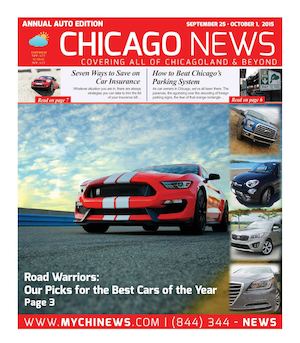
How to Beat Chicago’s Parking System Seven Ways to Save on Car Insurance As car owners in Chicago, we’ve all been there. The paranoia, the agonizing over the decoding of foreign parking signs, the fear of that orange rectangle ... Whatever situation you are in, there are always strategies you can take to trim the fat of your insurance bill ... Read on page 7 Read on page 6 Road Warriors: Our Picks for the Best Cars of the Year Our Picks for the Best Cars of the Year Page 3 COVE R I N G A L L O F C H I C AG O L A N D & B E YO N D SEPTEMBER 25 - OCTOBER 1, 2015 CHICAGO NEWS 74°F | 62°F SUNDAY 76°F | 65°F SATURDAY ANNUAL AUTO EDITION WWW.MYCHINEWS.COM | (844) 344 - NEWS SATURDAY
EDITOR’S NOTE 2 | CHICAGO NEWS | AUTO EDITION | September 25 - October 1, 2015 David Malone It’s Back! Our Annual Auto Edition has arrived. The automobile is an interesting thing. Sure, it was a game changer as far as personal transportation goes, but it has become so much more than that. While many people still view cars from a strictly practical standpoint (i.e. how many people can it haul to where I want to go and at what cost?), if a car is comfortable and fits their needs, that is all that matters. Performance, styling, and especially heritage and pedigree mean nothing. This is how the majority of people view cars (how else would mini vans still be a thing?), which is great. But there are also people where performance, styling, and pedigree mean everything. People who are fascinated by cars and can’t seem to get enough of them. Within this edition you will find 40 pagesofreviews,carnews,interviews,editorials, car advice, and much more! Perhaps you are one of those ‘practical-minded’ drivers I mentioned earlier. Perfect! We have some stories just for you. Read up on how to prepare your car for a snowy, cold, and all-around brutal Chicago winter (Is there any other kind?). Or take a look at some of the best ways to save money on your car insurance. Maybe you are a prospective buyer and you have no idea where to start. Well, this is as good a place as any. You will find reviewsforover20differentcarsofalldifferent makes and models. From tiny electric cars to large luxury SUV’s, we’ve got you covered. If you are a car enthusiast, then we have editorials that might just be the catalyst for a few debates between friends, in addition to exclusive interviews with some prominent people in the automotive world. And finally, you will find our picks for five of the best cars of the year, as selected by us here at Chicago News. These selections were based on our own experiences driving and spending time with the vehicles. Regardless of if you are one of those people who views cars from a strictly practical viewpoint or if you are a person who loves cars and had posters of various exotic models plastered all over their wall as a kid, you are sure to find something interesting in the following pages. And don’t forget to check our website for even more content related to this week’s Annual Auto Edition that we just weren’t able to fit in the paper you are currently holding. Enjoy, and let us know on Facebook and Twitter what your favorite cars are! David.M@mychinews.com
David Malone Best Sedan: Hyundai Genesis The Hyundai Genesis has the lowest starting price of any mid-size luxury sedan (with the exception of the Lexus ES that starts at a couple hundred bucks lower). But don’t take that to mean it is of lower quality to match its lower price. In fact, the Hyundai Genesis competes with cars that start at $10,000 to $20,000 more. How does it manage to do this? Well, it plays a pretty shameless game of imitation. The Genesis has cherry picked all of the best parts of other cars in its class and combined them into a Frankenstein’s monster-type car. But, with using what I can only assume was some type of witchcraft, Hyundai has made everything come together into one attractive, cohesive bundle. The amount of features Genesis provides is on par with the more expensive offerings from Lexus and BMW. The Hyundai Genesis offers a luxury atmosphere without the luxury price. Best SUV: Kia Sorento No one here at Chicago News expected what we got with the Kia Sorento. I mean, Kia vehicles are supposed to be used cars, right? You are supposed to find them littering shady-looking used car lots, not challenging the likes of Ford, Nissan, and Volkswagen for the best mid-size SUV on the market. But here it is. Not only is it challenging those other cars, but at least in our humble opinion, it came out on top. Much like with the Hyundai Genesis, Kia has decided to provide oodles of luxurious features with an ambiance to match while not jacking up the price to outrageous levels. It is still hard to believe this is a Kia. This is a perfect example of a company that has tried to rework its image, and has gone about doing it in the best way possible. You might not see the Kia name badge quitesooftenonusedcarlotsnow,aspeoplearegoingtowanttoholdontothesefor a while. Best Subcompact Crossover: Fiat 500X Hold on a second. Are you telling me you have a car other than the Mazda CX-3 as the best subcompact crossover? Why yes, yes we are. Here’s the deal, Mazda’s dictatorial like rule in the segment of subcompact crossovers is well documented. And deservedly so, it is a great car. But the charm of Fiat 500X won us over. That Italian soul, that just makes cars feel special, is evident throughout this offering from Fiat. Like any car, it has its shortcomings, but it is kind of like a puppy in that way. Sure, it might relieve itself in your slippers, but when it looks at you with those puppy dog eyes, you can’t help but forgive it. But don’t get the wrong idea here, the 500X has more going for it besides its Italian charm. It has a sporty, attractive appearance and a nice tight steering feel that can give the illusion you are going fast and driving more nimbly than you actually are. And that is sort of what makes a good subcompact crossover; there is no such thing as one that is fast. It is all about the illusion of speed, and the 500X provides that in spades. Best Sports Car: Shelby GT350 Back in 2013, Ford introduced the Shelby GT500, the first Mustang ever to have a top speed of 200 mph. Fast forward to the 2016 Ford Mustang Shelby GT350. It might not reach 200 mph (setting in at the 170-180 range), but it is as track-focused asaMustanghaseverbeen.Ithasgonebeyond just a muscle car and into the realm of a full-on sports car. The 526 horsepower and 429 poundfeet of torque will get you from zero to 60 in about 3.7 seconds and a standing quarter mile time of right around 12 seconds flat. But what makes this car special isn’t the straight-line speed, it is the fact that Ford took a serious approach to the handling. The magnetic suspension and crossdrilled brake system, in addition to the Michelin superstick tires give this car a cornering ability never before seen in something bearing the Mustang name. It really is a special car that is looking to provetheCorvetteisn’ttheonlyAmerican sports car that is comfortable competing with sports cars from Europe. Best Truck: Ford F-150 The Ford F-150 is constantly the best-selling truck in the country, and as we experienced first-hand this year, it is not without warrant. The 2015 model, sporting a brand new aluminum body, has managed to shed over 700 pounds, which means its towing and load capacity, plus its fuel economy, is going to be improved. What it really came down to, though, was that over the past year, we just really haven’t driven anything anywhere close to being as good of a truck as the Ford F-150. From looks, to fuel economy, to the quality of the interior to the engine, the F-150 has proven itself to be the peak of the mountain to which all other trucks are still trying to ascend to. Don’t expect Ford’s dominance in the category of fullsize pickup trucks to waiver anytime soon. David.M@mychinews.com Road Warriors: Our Picks for the Best Cars of the Year CHICAGONEWS| AUTO EDITION |September 25-October1, 2015|3 BEST CARS of the YEAR Design and contents of all the pages are the intellectual property of Chicago News Media Group. Any use of these materials without editor’s permission is prohibited. Chicago News is not responsible for published advertisements and advertising articles. Editors do not review and return manuscripts. © All rights reserved. Published By: Chicago News Media Group Editor-in-Chief: Vera Sauchanka Proofreader: Jim Vail Contributing Writers: David Malone Lauren Stevens Sam Smith Vera Sauchanka Dennis Bindarau Video Editor: Jarold Molo CHICAGO NEWS 415 E.Golf Rd.Suite 106 Arlington Heights,IL 60005 844 - 344 - NEWS (6397) info@MyChiNews.com www.MyChiNews.com www.Facebook.com/ MyChiNews www.Twitter.com/ MyChiNews SEE ON THE WEB: www.MyChiNews.com VIDEO: 2015 Shelby GT350 & GT350R Review VIDEO: 2016 Mazda CX-3 Review VIDEO: 2015 Kia Soul EV Review VIDEO: 2016 Scion iM Review
AUTO NEWS 4|CHICAGONEWS | AUTO EDITION |September 25-October1,2015 Ford ‘Farm to Car’ Looks to Replace Petroleum-Based Plastics with Plants Honda Creates Beautiful Ad that Celebrates Company History V6s Might be Coming to Ferrari, Manual Transmissions on the Way Out Ford seems to be liking their aluminum-bodied trucks, and the 2017 F-Series Super Duty line of pickups is going to be moving from steel bodies to aluminum ones as well. The F-150 made this same change just recently as well. But don’t worry, this switch from steel to aluminum won’t have any effect on the toughness of the truck. “It is the toughest, most capable Super Duty we’ve ever done,” said Ford’s head of global product development, Raj Nair. Production of the 2017 Super Duty lineup of trucks is scheduled to begin in the fall of 2016. The conversion from steel bodies to aluminum bodies will not require any downtime so there will be no delay in production. There is a risk associated with the switch to an all-aluminum body, though. It will be the first truck in the segment that uses an aluminum body and it is also the first new cab for the truck since it was first introduced 17 years ago, according to vehicle engineering manager Dennis Slevin. Because of the lighter material, the truck is able to use larger axels, brakes, and hitches as well as stronger driveline and transfer cases while still eliminating 350 pounds from the previous model. The truck has become stronger in some of the areas where it counts most. Ford is hoping their gamble with this new truck pays off, as they control 43 percent of the heavy-duty truck segment and do not want to alienate those customers with the change. The best part about modern-day television has to be the ability to record a specific show and then fast forward through the commercials. No one likes commercials, they are typically obnoxious, unfunny attempts at humor that just end up making you never want to buy the product they are selling. But if you have one of last Sunday’s early NFL games recorded, you might want to watch it back and take a close look at the commercials for an offering from Honda. From boats to lawn mowers to race cars, Honda has created a new ad celebrating the history of their engines and has chosen a beautiful stop-motion video constructed from thousands of paper illustrations as the vehicle (no pun intended) for this ad. In the ad, you see nothing but illustrations on pieces of paper and hands. The two-minute ad takes you on a journey from some of the earliest combustion engines the company offered to engines fitted in motorcycles, race-winning vehicles, robots, and, yes, even lawnmowers. What makes this ad so impressive, however, is the stop-motion animation style in which it is displayed. The paper with the illustrations are a flip book on your TV screen and the entirety of the commercial is made up of thousands of different shots. Instead of the typical shiny car on a winding, beautiful road, Honda has decided to take the time to honor the designers and engineers with this commercial, an admirable move by Honda. The Auto News Covered by David Malone Ford Introduces 2017 Ford Super Duty Did you know that every single one of Ford’s new North American vehicles contains soy beans? Well, now you do. Ford is ramping up their ‘Farm to Car’ movement in an effort to appeal to the more eco-minded buyer of today’s market. Fifteen years ago in 2000, Ford began working on a project to replace petroleum based plastics in cars with plastics and foams made from plant by-products. “You can grow plants in 90 days. Petroleum is made over millions of years. Why are we using petroleum?” said Debbie Mielewski, the Senior Technical Leader of Materials Sustainability at Ford. In the 1930s, Henry Ford himself seemed to have a similar thought. “I foresee when industry shall draw its raw material from the fields,” he said. “If you can make it out of petroleum, you can make it with soybean oil.” Ford has done just that. But it didn’t happen overnight. “Literally thousands of failed attempts. The initial foams smelled like rancid popcorn. They had terrible structure,” said Mielewski. Ford has now perfected the process and has shared it with other industries in an attempt to multiply the environmental benefits. “I remember standing in front of a camera and holding up the first soy foam and saying, ‘It can be done.’ It was pretty amazing,” Mielewski said. Everyone knows about the efforts to reduce emissions of cars with plugin electric and hydrogen vehicles. But not many people think about the other places in a car where petroleum is used. Maybe now you will. Ferrari is beginning to feel the squeeze from increasing fuel economy and emissions restrictions, and it has them looking at smaller engines. At a private event at the Frankfurt Auto Show, a journalist asked Ferrari if V6 engines were in their future. The answer was a pretty big clue that V6s might indeed be on their way to Ferrari. “What we are doing right now is following a path to reduce emissions,” Amedeo Felisa, Ferrari’s CEO, said. “For sure, the downsizing of the displacement is one of the ways you can get to that result. [As for] the six-cylinder, will it be beneficial? Probably yes, but I think we have a good path before going to that specific solution.” A smaller engine means a smaller car as well. “Why would you reduce the engine and make a bigger car?” Felisa said. Felisa was also asked about the possibility of manual-transmission models being offered by the Italian automaker. “Never say no, but today we’ll say no,” Felisa said. “We have the fastest automatic gearbox in the market. We are not thinking of a manual gearbox.” The last time Ferrari offered a manual gearbox was on the California, and sold three Ferrari California’s with manual gearboxes. It makes sense, if there isn’t a demand, why would Ferrari continue to supply them? However, it certainly seems like Ferrari isgoingtohaveatleastafewofferingsthat you might not have expected from them just a few years ago. But they are being forced to adapt to a new market and are trying to do so while still retaining what makes a Ferrari a Ferrari.
David Malone Sure, maybe cars aren’t quite so complicated to start up and drive nowadays as they were, say, 90 to 100 years ago. But today’s world offers up its own challenges. Yourkidsareinthebackseatscreaming, oneofthemhastogotothebathroomand the other just ate He-Man’s Power Sword and is scrounging around to see what else from Castle Grayskull looks delectable. Meanwhile, your phone is ringing, the stop-and-gotrafficishorrible,andyouhaven’t had to go to the bathroom so badly since you drank that Big Gulp just before hopping onto a Ferris wheel moments before it got stuck with you at the top. With all of this happening, it’s easy to lose your concentration. But losing your concentration is never a good thing while driving. Thankfully, many auto makers are coming out with safety technologies to help in those moments of distraction, and Ford is right at the front of the line. “Ford currently has the most driver-assist features in four U.S. vehicle segments and offers more nameplates in the United States with active park assist, rear cross-traffic alert, lane-departure warning with lane-keeping aid, and blind-spot monitoring than any other mainstream manufacturer,” said Scott Lindstrom, driver assisttechnologiesmanageratFordMotor Company. These technologies help to make sure that, regardless of what is going on inside the car, what is happening outside is always being monitored. The Lane-Keeping Aid will use the car’s front-view camera and detect when you are drifting out of your lane and alert you. Active Park Assist uses ultrasonic sensors to detect suitable parking spots and will even help steer the vehicle into the open space. All you have to do is control the shifting, accelerator, and brake. The Blind Spot Information System uses radar to help detect when other vehicles are present in your blind spot and will alert you to them with a light on the side view mirror. Now, you might be thinking, “Sure, all of these things sound great, but at what cost? I can’t afford a luxury car.” But that is the good news, you don’t need to get a luxury car to get these features. “Ford uses its global scale to develop these features, which allows economies of scale,” Lindstrom said. “This allows us to work with our supply base to bring down the cost for our customers. Most of our driverassistfeaturesareofferedinNA,Europe, China, and other countries.” So let’s look at the next logical step after all of these technologically advanced safety features; a completely autonomous car. Carmakers like Tesla are working out the kinks and companies like Apple and Google are working on autonomous vehicle technology as well. But what about Ford? “We’removingclosertotherealityofautonomous driving with these features that include semi-autonomous capabilities to assist the driver,” Lindstrom said. “We have fully autonomous vehicles in development for the future and already have research vehicles on the road.” Ford is currently in the advanced engineering phase of its quest for an autonomous vehicle and it believes it has the goods to make it a reality, many of these goods are already included on Ford vehicles. “Our goal is not to be the first-to-market with a full autonomous vehicle, but that autonomous vehicles, coupled with vehicle connectivity, will be accessible for everyone,” Lindstrom said. Autonomous cars for everyone? We are getting closer and closer to science fiction becoming reality every day. What’s next? Lightsabers and teleportation? On second thought, that probably isn’t a good idea. The whole Star Wars vs Star Trek debate could get really ugly if those things become a reality. David.M@mychinews.com Ford Looks to Keep Drivers Safe with a Bevy of Safety Technologies CHICAGONEWS| AUTO EDITION |September 25-October1, 2015|5 AUTO NEWS
As car owners in Chicago, we’ve all been there. The paranoia, the agonizing over the decoding of foreign parking signs, the fear of that orange rectangle on the windshield, the boot or, worst of all, the entire car towed away completely. I’ve been right there with you. I’ve agonized over the street signs. Wait. What time is it? No parking from 6 p.m. to 8 a.m. except with permit 114, except on Sundays 9 a.m. to 4 p.m., tow zone when snow is two inches or more. Street cleaning Tuesdays 6 a.m. to 8 a.m. April through November. It’s all a lot. What do we make of it and how do we survive in the city without getting ticketed or towed? While I’m most definitely not a perfect example, I’ve done my best to avoid tickets and, more importantly, avoid Chicago’s famously high parking rates at meters and garages. WhilethehowIavoidtheseparkingfees is no secret and involves you getting more creative and often times more walking, it can save you a lot of money at the end of the day. A prime example I’ll give you is parking aroundSecondCityinOldTown. Parking in the area is beyond ridiculous, similar to most areas flocked with tourists. Being the comedic staple that it has been for Chicago,touristsandlocalsalikeswarmto Second City to get their comedic fix. This causes a surge in parking rates and as a student of the training center I can’t afford to pay $24 for 3 hours in their parking garage. Nobody has time for that. Committed to being frugal, the first week of class back last October, I decided to circle the areatoseeifallofthestreetsweremetered. Alas, they weren’t on Sedgwick or about a block and a half away on Goethe. This is the dedication and perseverance you have to have when I talk about saving money on parking. Here are just a few tips to help you save or score free parking no matter where you are in Chicago. 1. Do your research: The first time I went to United Center I thought to myself, “Man, parking is going to be such a nightmare.” The Bulls and Blackhawks stadium, I knew that the area is busy and didn’t want to pay for valet parking or any of those lots in the surrounding areas, because I know how event parking situations can be and they’re never cheap. So you know what I did? I literally googled, “free parking around United Center” and a street map of the surrounding streets pulled up with highlighted roads that didn’t require permit parking around the stadium. Simple enough. When traveling to other destinations I like to get there early to scope out if there are streets near the location that aren’t metered or require a permit. More often than not, you can score a free space. 2. Practice patience: At my old apartment in Uptown I learned thevalueofpatienceandpersistencewhen it comes to parking. I also learned the value of reading signs carefully as I was ticketed more than once for parking on the side of the road for street cleaning days. Most of the times finding a free parking space isn’t going to come easily and nearly all of the time you’re going to have to walk an extra block or two to save $15 – 20. Is it worth it to you? Many choose convenienceovercostandthat’showfrugalfolks like myself end up paying minimal prices for parking in the city. 3. When in doubt, Spot Hero: I will admit that I have yet to master a plan that works in downtown Chicago and the Loop. WhentravelingdowntownIalmost always take the train, but when I must drive I’ve recently taken a major liking to Spot Hero. I didn’t really understand Spot Hero initially and I’ll admit that I do get held up at times at the gate reading my booking number to security, but it has saved me so much money. Most recently I’ve taken advantage of the app to park downtown near Tribeca Flashpoint Media Arts Academy where my Second City class has been held since the fire. I can’t avoid driving because of my commute from work, and Spot Hero saves my about $6 a week on parking. It doesn’t seem like much, but adds up over time. Happy parking, Chicago! Lauren.S@mychinews.com Lauren Stevens How to Beat Chicago’s Parking System BEHIND the WHEEL 6|CHICAGONEWS | AUTO EDITION |September 25-October1,2015
BEHIND the WHEEL CHICAGONEWS| AUTO EDITION | September 25-October1, 2015|7 Commercials are always telling consumers that they can save money on car insurance by joining a specific company. Everyone wants to decrease their car insurance costs, but the television rarely tells us practical ways that we can do so. Prices of insurance can vary drastically based on the people, vehicles and companies involved. Whatever situation you are in, there are always strategies you can take to trim the fat of your insurance bill. While not a comprehensive list by any means, here are a few beginner steps. 1. Keep track of your credit rating: This is the most basic of tips, but also the most important. By maintaining a good credit history, you can ensure that your costs stay down since insurance providers largely look at credit scores to determine auto policies. Generally speaking, insurance companies view people with solid credit standing as less likely to have accidents. Whether accurate or not, this means that good credit almost always means lower insurance premiums. Make sure you pay your bills on time and keep credit balances as low as possible to keep a high credit rating, but just as importantly, check your credit rating to make sure that you can quickly correct any errors on your record. 2. Shop around, then shop around again: Prices are rarely the same, so get a lot of quotes from different companies. Insurance exists to provide you with financial peace of mind, so scrimping on your policy is not necessarily the right move. Make sure that you find a company that does not only provide affordable insurance, but is also financially stable themselves. Look around at different types of companies. Some companies have their own agents, some sell through independent agents and others have no agents at all. Ask people you trust about their insurance preferences and communicate with insurers that can answer all of your questions. Once you find the right provider for your needs, the work does not end. Some companies gauge their policy-holders and determine some as more likely to hang on to their current policy for years, and thus they can justify hiking up rates. Every year or two, take a look at different policies again. This does not necessarily mean leaving your current company. Rather, it just means always covering your insurance bases. 3. Examine your driving habits: The longer you are behind the wheel, the more likely you are to get in an accident. As such, most auto insurance companies take the number of miles drivers typically drive per year when determining policy costs. Some providers offer discounts to drivers who have a lower-than-average mileage per year, yet most people reveal their driving habits when they first obtain the policy and then never reassess their habits. If your driving has drastically decreased as of late, report it to your insurance provider and you could end up paying less each month. Additionally, insurance companies usually encourage fuel efficiency, so be sure to report it if you carpool on a regular basis. 4. Seek out other discounts: Aside from low mileage and safe driving discounts, many insurance providers offer a wide range of discounts. Most notably, you could get a discount for something as simple as periodically taking defensive driving courses or having a young driver with good grades. Some other discounts that are commonly offered include: students away at college, students in drivers education courses, long-time customer, multiple cars, safety features, extended accident-free periods and extended violation-free periods. It is as simple as asking your provider what discounts you qualify for. 5. Give higher deductibles a try: Higher deductibles mean decreased coverage costs. By increasing your pre-policy payments by $300, you could cut your costs by as much as 30 percent. Check your budget and figure out what deductibles you are able to pay and consider what an increase could do for you. 6. Combine insurance costs: Many insurance providers will decrease coverage costs if you buy multiple types of insurance from their company. Similarly, some will give multi-policy discounts if you insure multiple vehicles with the same company. Having both homeowner’s insurance and auto insurance from the same provider does not necessarily guarantee savings, however, so once again, be sure to shop around. 7. Reduce coverage of older cars: Find out what your car is worth. You can get an evaluation of your vehicle by taking it to an auto dealer or bank, or by looking it up online with Kelley’s Blue book. If the premiums you are paying on the vehicle are more than 10 percent of the value of the car, chances are your current auto insurance policy is not cost effective. Down the road, it is possible that the comprehensive/collision premium will exceed the value of your vehicle. When it comes time to renew your coverage, take a look and see if your needs have changed. Sam.S@mychinews.com Sam Smith Seven Ways to Save on Car Insurance
BEHIND the WHEEL 8|CHICAGONEWS | AUTO EDITION |September 25-October1,2015 Preparing your car for winter, or “winterizing” your car is a very real and necessary step to take in a city like Chicago. The winters here are brutal, but the people of Chicago are stronger and more resilient than any other group of people I’ve ever met. I remember the first time I drove past an auto repair shop that said, “Winterize your car here” on their marquee. I thought, “Winterize? What does that even mean?” Well, it means a lot here in the Midwest. How your car runs and operates, or even the tools you need to get your car out of the snow all deal with different ways that your car can be winterized. Lucky for us, winter season is just around the corner and the time to prepare yourself and your vehicle for winter is now. Here are some helpful tips and tricks to keep you and your car safe this winter. 1. Check your fluids: Of course, it’s important any time of the year to make sure that your fluids are up to standard, but it’s especially important in the wintertime when the weather has a pretty dramatic impact on the fluids. For instance, your engine oil may need to change to thinner oil than you regularly use. This being that when the temperatures drop to below zero, the oil will be less likely to freeze. Not only oil, but engine coolant is also important when maintaining your vehicle in the winter. The coolant not only keeps your engine cool and from overheating in warmer weathers, but it also protects your engine against corrosion. Coolant with ethylene glycol helps to protect your engine more effectively in the winter. Consider getting that type of coolant in your vehicle before it gets too cold. It’s also important to keep your winter coolant ratio at 60% coolant to 40% water. This will protect your vehicle against risks of freezing. 2. Snow tires: Consider getting snow tires. My first winter in Chicago my brother kept getting on me all season to get snow tires and I really wish I had. Not because I suffered some severe accident or anything too dangerous, but because there were times when I slipped and swerved on the slick streets of Chicago and I’m sure that could’ve been avoided had I had better tires. The reality is snow tires allow your vehicle to get a better grip on the road and provide much needed traction when it can be just ice, snow and danger. If you make a daily work commute or travel often in the winter by car, then snow tires could really be a significant investment. 3. Pack an emergency kit: My grandma’s first advice to me when I moved to Chicago was pack an emergency kit. Hers was very practical - snacks, money, water (I think that’d freeze, but practical in theory) and blankets. She then told me a story about how she’d heard of people being stuck in blizzards on freeways and stuck in their cars on Lake Shore Drive and how it’s important to be prepared. I took these words to heart and made my own version of an emergency kit. The things that must be in your car at all times during the winter are: blankets, a flashlight, snacks, boots and a radio. I know it all seems so old school, but the fact of the matter is when blizzards and snowstorms happen you must resort to old-age ways to save yourself. Technology does little good against the fight of 3-feet of snow. 4. Pack tools for snow removal: One of THE most important things you can possible do for yourself and your car is pack tools you can use to remove your car from the snow. During the winter, I carry a small shovel, cat litter and one of those windshield brush and ice scraper combos in my trunk at all times. I don’t care if the weather reports say it’s snowing or not going to snow, you never know and getting in and out of a parking spot can be a real headache. Parking in the city normally can be a pain, but when you add the snow a whole other layer of torture is added. I highly recommend all of these tools, as they’re all important, even the kitty litter that you can sprinkle under your tires to gain traction. The most important message about preparing your car for winter is to just be prepared and kind to one another. I’ve had so many strangers help me out when I thought I’d be stuck in the snow forever, so be a good Samaritan and people will help you when you’re down and out. Lauren.S@mychinews.com Lauren Stevens Preparing For Winter – Car Edition
BEHIND the WHEEL CHICAGONEWS| AUTO EDITION | September 25-October1, 2015|9 It’s no secret that we live in a day and age of constant gas-price influxes and drops. Where it could be $3.30 or $2.56 for gas, you really can’t be too sure these days. What you can be sure and be aware of, however, is how you utilize the fuel your vehicle intakes and making it really go that extra mile. Not all of us have or want a hybrid vehicle, so in order to make the most of our purchases at the pump, here are a few helpful tricks to keep your vehicle running smoothly and for longer between fill-ups. 1. At the pump: Many of you may not know this, but when you purchase gas you’re actually buying it by volume rather than density. So purchasing your fuel at night or early morning when temperatures are coolest will actually give you the most fuel per dollar because gas is more dense in cooler temperatures. Another good thing that I recently learned is to not overfill your tank. Obviously no one sits at the tank continuing to fill up as gasoline drips down your car and onto the street, but it’s actually best to stop fueling once the pump gives that first click. I always thought the more gas the better, but you learn something new everyday. Another small, but sort of inconvenient trick is only fueling your tank half-full. I know this again seems like an oxymoron, but the lighter your car is the more fuel efficient it will be. 2. On the road: Your driving habits are what impact your fuel efficiency most directly. The way that you drive really is what makes or breaks how many miles per gallon (MPG) you really earn at the end of the day. Ways you can really save on gas (and stress to say the least) is by giving yourself plenty of time to get somewhere. Feeling rushed is never a good feeling and it actually can negatively impact your fuel efficiency. When you’re rushed you tend to drive faster, but driving slower increases your MPG. Another driving habit that’s a fuel guzzler you might not even realize is driving with open windows at higher speeds. When you drive at higher speeds, the wind drag caused by open windows actually consumes more gas than driving with the AC on. On the same token, gas mileage can decrease when you use your AC at lower speeds. So drive slowly with the windows rolled down, or turn on the AC when you’re speeding off in a hurry. Either way these options will be more gas efficient than any other choice. Also, avoid slamming on your brakes. Not only is that a really dangerous and annoying habit, it’s also one that can cost you at the pump. Every time you hit the brakes you must accelerate which causes your vehicle to consume more gasoline. This is a no-good habit and you should avoid it when possible. Another good idea is to limit your storage in the trunk. I know this is a little hard to do in the wintertime in Chicago with all of the tools and supplies you need to keep with you, but keeping a clean and empty trunk will reduce the weight put on your vehicle and in turn will save you more gas in the end. It’s always a good idea to try and plot your route when you’re driving. Avoiding heavily congested areas as well as construction zones will allow you to better serve both yourself and your vehicle. 3. At the shop: No matter how annoying or senseless it may seem, maintaining your car is one of the best ways you can keep it running smoothly and most fuel efficient. Keeping up with your vehicle’s scheduled maintenance such as oil changes and keeping all air filters clean will keep your vehicle running smoothly and without any bigger issues in the future. Another important thing to make sure you keep an eye on is the air pressure in your tires. Now I’ll admit I didn’t even feel the need to check my tire pressure until recently when my pressure light came on. I’ll also admit this was the first time I’d seen the air pressure light come on and had to look it up in the manual to discover the root of the problem. Unfortunately, the fix for me was a little bigger than simply putting a little air in my tire as I had a nail in my left front tire. However, the point of the story is under-inflated tires reduce your total MPG and that’s just not good. Lauren.S@mychinews.com Tricks to Make Your Car More Fuel Efficient Lauren Stevens
10 | CHICAGONEWS | AUTO EDITION |September 25-October1,2015 OPINION American vs European Sports Cars: Who Rules the Roads? David Malone The knowledge most people have about cars is that they are a means of transportation and Al Gore says they are killing our planet. When these people look to purchase a car, practicality is paramount. How many people can it fit? How many miles per gallon does it get? If I’m texting Becky and rear end a truck at 45 MPH, how many airbags are going to deploy in an attempt to prevent me from being on the wrong end of natural selection? But what about the people who believe a car can be a work of art? That when beauty, power, and speed are combined in just the right way, magic happens. That magic usually takes place in two forms, the European sports car and the American sports car, and they have been doing battle against each other for decades. The stereotype of the European sports car driver is that of a suave good-looking man where the only thing bigger than his car’s 500 horsepower engine is his ego. His personality has undergone more fabrication than the hull of the Titanic and he probably has a vanity plate that reads “BtrThnU.” Whereas the stereotype for the American sportscardriverisadivorcedmiddle-aged man with a 20-year-old blonde girlfriend named Kiki and a bachelor’s degree in overcompensation. The thing is, these stereotypes are just that, stereotypes. It is time for those of us who see beauty in cars to rise up against the impotent Corvette driver (no pun intended) and send Fabio out of the driver’s seat of the Ferrari. It is time to send Al Gore to take a serious look at the American sports car versus the European sports car in an effort to determine who truly rules the roads. For our purposes, this story of the American sports car versus the European sports car begins at the 24 Hours of Le Mans. It was the stage for the first instance of an American sports car proving it could run with the ‘big boys.’ It was the 1960s, and to this point, the American sports car consisted of inexpensive huge-engine muscle cars. Muscle cars come with their own merits, they have a style that would make Stevie Wonder look twice and produce a noise that would cause Beethoven to plug his ears. But they were not true sports cars. With a team consisting of Lee Iacocca and Carroll Shelby, Henry Ford decided to prove America was capable of creating a car worthy of competing against the likes of Ferrari. The result was the Ford GT40, a car whose sole purpose was to defeat Ferrari at Le Mans. And in 1966, history was made. The Ford GT40 became the first American car to ever win at Le Mans. In fact, it won four years in a row, completely cementing the now fully blossomed rivalry between American and European sports cars. A rivalry that is still the source of debate today. Now you might be thinking, that’s all great, but a race car and a sports car are not the same thing. So how does the racing history translate into present-day discussion of the American versus the European sports car? Fast forward to 2003. Ford releases the Ford GT, a road-legal tribute to the historic GT40. Also, around this time Ferrari had introduced the Ferrari 360. Thirty seven years after Ford hit Ferrari’s pride with a crushing blow, the two companies are still competing. At this time,theFordGTandtheFerrari360were near the pinnacle of American and European sports cars. They were both great representatives for their respective sides. Comparing them from the standpoints of history and performance will help draw us closer to an answer in the debate of the American versus the European sports car. History is a tough place to start because both Ford and Ferrari are about as historic a name as you can get in the world of cars. Ford has more history on its side in the sense that it can date back to 1908 with the famous Model T, a car in which over 15.5millionweresoldintheUnitedStates. But Ferrari has the racing heritage, and that is more pertinent to this discussion. Enzo Ferrari, the creator of Ferrari, was a man where racing was not just his hobby. It was not just his passion. To him, racing was life. Telling Enzo Ferrari to walk away from the sport of racing would have been like telling Wayne Gretzky to walk away from hockey in his prime or telling Tiger Woods to walk away from picking up loose women. It just was not going to happen. So when it comes to the history, the Ford GT obviously comes out ahead. No, that is not a typo. You might be thinking to yourself, Wait, what? But...huh? What about Enzo and Tiger and the loose women? Well, here is the thing. Yes, Ferrari has more racing heritage and prestige overall than Ford, but God is in the details. The Ferrari 360 is just another Ferrari model. It carries the Ferrari heritage with it, but hasnoneofitsown.TheFordGTisthedirect ancestor of the GT40. This is a chance for anyone, (well, anyone with a couple hundred grand of disposable income) to purchase this sports car and immediately be transferred back to the triumph at Le Mans in 1966. It is not just a car, it is a time machine, and it doesn’t even need a flux capacitor to work. Driving the GT is the next best thing to driving an actual 60s era GT40 around a track. The 360 does not carry any of that type of model specific history. So I say again, Point: Ford GT. Now we come to the meat and potatoes of what a sports car is all about, the performance.TheFerrari360isaV8mid-engine car with 400 horsepower and four-wheel drive. The Ford GT is a front-engine V8 that produces 550 horsepower with fourwheel drive. This means they are fast. The Ford GT has a lot more horsepower than the Ferrari 360, but horsepower is not everything. If that were the case muscle cars wouldhavebeenseriouscompetitorsatLe Mans. It’s what you do with the horsepower, how it is harnessed and controlled, that matters. Both these cars were featured on the British motoring show Top Gear. The Ferrari 360 went around the Top Gear test track in 1:22.3, a very respectable time. The Ford GT went around the track in 1:21.9. Only four tenths of a second difference. On paper the GT should have been much faster than the Ferrari. But that was not the case. Ferrari’s extensive racing heritage comes into play here. They understand how to get the most out of their cars. They know how to perfectly balance the car’s power with the car’s handling so that it can take a corner effortlessly. The Ford GT might have a case of too much power and not enough handling. This can lead to some oversteer in the corners and that costs precious time. Due to the fact that the 360 seems to be getting more out of the car as a whole than the GT, Ferrari takes this point. The score is all tied up. We need some tiebreakers. Let’s take a quick look at some other cars, such as a Corvette ZR1 versus a Porsche 911. The Corvette gets the nod in the history category because of the fact it has become an American icon. Since its introduction in 1953, the Corvette has never taken a year off and has grown into one of the best American sports cars money can buy. The Porsche has plenty of history as well, but can get overshadowed even in its home country of Germany, let alone all of Europe. The Corvette is almost a full two seconds faster around the Top Gear track than the Porsche, which, in racing, is an eternity. Ok, so American sports cars are actually better? Again, in this instance of a Corvette ZR1 and a Porsche 911, yes. But this is my point. Deciding between American versus European sports cars is completely dependent on the specific cars being compared. For every instance the European car is better, there will be a counter exampleofanAmericancarbeingbetter.But,in a way, this also leads to an actual answer to the question of which group of cars is better overall. Eventually, when comparing two cars, one American and one European, side by side, you will run out of American sports cars to use. European sports cars outnumber American sports cars five to one. The well of American sports cars will run dry long before the European one does. Not only that, but once that American well is dry, Europe will still be running out top contenders such as Lamborghini, Mercedes, BMW, and Maserati. And therein lies your answer. European car makers have sports cars down to an art form, a science. They have small factories where employees work like Keebler elves to continue to push the envelope of what a sports car can be. The American sports car has come a long way since the Ford GT40landedthefirstblowtoEuropeback in 1966. The fact that there are American sports cars out there that can go head to head against some of the European heavy hitters and come out on top is quite a victory in itself. But it is just a drop in the bucket. Right now, the European sports car is Batman, and the American sports car is Robin, which is not a bad place to be considering where it was just a few decades earlier. The European sports car still retains its crown as the ruler of the roads. David.M@mychinews.com
OPINION CHICAGONEWS| AUTO EDITION |September 25-October1, 2015|11 David Malone Top Five Reasons to Buy an Electric Car Many people are still on the fence about electric cars. And while these vehicles are still in their infancy, there are already plenty of reasons to at least take a look at a few models if you are planning on buying a new car soon. Below, you will find five of the best reasons you should consider an electric car with your next vehicle purchase. You Will Save Money At first this might seem a little bit counterintuitive. Electric cars tend to cost more for what you get than their gas-drinking counterparts. But that is before you factor in a couple of different perks that come with owning an electric car. First, let’s say you are looking to buy an electric car that costs $30,000. Right away you can subtract $7,500 from that cost. This is because there is a federal tax credit for buying an electric car. This already bringsthetotalofthecardownto$22,500. In addition, depending on what state you live in, there might be another $2,500 to $7,500 tax credit for getting an electric car. Meaning right away, you can take $10,000 to $15,000 of the cost of the car. But that’s not all. Most people probably spend between $2,000 and $3,000 on gas for their car per year. In order to charge your electric car for a year, if you drive around15,000milesperyear,isonlygoing to cost you around $500. There is another $1,500 to $2,500 in your pocket. It Helps the Environment I know, a lot of people out there don’t want to be labeled as a tree-hugging environmentalist and its true, electric vehicles still have a bit of a self-righteous tag associated withthem,butitistimetobreakthatlabel. Just drive the car like you would any car. Just because it is electric doesn’t mean you have to squeeze it into every conversation you have, regardless of how some of the early adopters behave. “When did I graduate college? Well, let’s see. I bought my plug-in electric vehicle three years ago. So... minus twelve... carry the two... In 2008.” We’ve all seen people like that, you don’t have to be one of them. Plus, regardless of if you consider yourself an environmentalist or not, driving an electric vehicle is a small way to help make a positive difference. They Require Less Maintenance The more complicated the machine, the better chance there is for something to go wrong. Just look at an F1 car, those things routinely break down and are unable to evenfinisharace.Butdon’tworry,anelectric car is nowhere near that complicated. In fact, an electric car has 10 times fewer moving parts than gas cars. Electric cars don’t have an engine, transmission, spark plugs, valves, fuel tank, tailpipe, distributer, starter, clutch, muffler, or catalytic converter. Now think about the last three or four times something went wrong with your car. How many of those times was it something that was just mentioned as not existing in an electric vehicle? Oh yeah, if you hate having to head in for an oil change every couple of months, that is out the window as well with electric cars.Electriccarsneverneedanoilchange because electric cars don’t require oil. As an extra perk, that means they won’t try to swindle you into buying things for your car you don’t need at the shop anymore. It might be funny to take an electric car in and see if they still try to tell you you need a new radiator hose or spark plug, though. The Infrastructure is Already in Place, and Growing The United States is already set up and fully wired to handle the demand for electricity produced by electric cars. Currently, it is just a matter of improving the public charging infrastructure. Many urban areas have public charging stations and more and more campuses and workplaces are putting public chargers in their parking lots. Some of these chargers are even free to use. Imagine showing up to work in the morning and getting a day’s worth of free gas. The somewhat limited infrastructure isn’t too much of a problem right now, though, because the best charging station is at home. Most people will be able to plug their cars in overnight and have a full charge by morning. As long as you don’t drive more than your car’s battery range in asingleday,youmightnotevenhavetogo to public charging stations. However, home charging might still be a bit of a problem for anyone who lives in an apartment or in the city. Having an extension cord running out your window and across the sidewalk probably isn’t the best idea. But there are ways around this! Especially in the city, there is probably a level 3 quick charger that can get you an 80% charge in about half an hour within a few miles of home. They Eliminate Dependency on Foreign Oil Our electricity is produced right here in the United States. I know, it seems obvious, but this is often overlooked. When you turn on the news, how many issues do you see there that are linked to oil? Wars, terrorism, and geopolitical issues all have connections with oil. And the transportation sector in the United States accounts for a whopping 70 percent of petroleum usage. If we are able to lower our dependency on foreign oil, and replace it with electricity we are able to create in our own country, the benefits would be immeasurable. Sure, buying a Tesla or a Nissan Leaf is obviously just a drop in the bucket when it comes to this topic, but you gotta start somewhere, right? David.M@mychinews.com
12 | CHICAGONEWS | AUTO EDITION |September 25-October1,2015 INTERVIEW Volo Auto Museum: A Cabinet of Curiosities David Malone The Volo Auto Museum is tucked away in the northeastern corner of Illinois in the city of Volo. There is a good chance you haven’t ever been to Volo before. Heck, there’s a good chance you’ve never even heard of Volo before. It’s understandable, with a big, bustling city like Chicago dominating the area, some of the more distant suburbs fall to the wayside. Sometimes this can be because they don’t have all that much to offer in the way of tourist attractions. That, however, is not the case with Volo, thanks to the aforementioned Volo Auto Museum. Now, I know what you are thinking, when you first picture an auto museum, the image that pops into your head is probably that of a bunch of middle-aged men walking around and talking about blowers, piston rods, and dip sticks. And, sure, you’ll see some of that at Volo, it is a car museum busting at the seams with American muscle and cars of a bygone era, after all (Also, it should be noted, just about all of those beautiful cars of yesteryear are for sale. Think of it as a museum and a dealership). But you probably wouldn’t expect to walk into an auto museum in Volo, Illinois and see a giant, drivable roller skate, a cartoon-like Charlie Chaplin car crafted entirely of steel, a large Disney and Looney Tunes exhibit, and an armed forces exhibit. Oh yeah, you are also going to find a Duesenberg exhibit ... in Volo. Strange but true. But these oddities are sort of the charm of the Volo Auto Museum. If you love cars, you are going to have fun prowling through the five showrooms of vehicles muttering about blowers and piston rods to your heart’s desire. If you are looking for a nice little family outing, the Volo Auto Museum fits that bill as well. Or, if you are just looking to be creeped out by a life-sized wax figure of Nic Cage, well, you’re in luck, because you can find that too (just don’t stare directly into his eyes for too long). We sat down with Brian Grams, the museum director, and talked about the history of the museum and how it grew into the five-showroom cabinet of curiosities it has become today. Tell us a little bit about the history of the museum and how it came to be. Well, the museum as you see it today was never intended to be. My grandfather bought this property back in 1960. It was an old dairy farm. So they had the farmhouse, the barn, and there was a couple other maintenance buildings that were built in the mid-1800s. The family was living out of the house and they were selling resale items out of the barn. That eventually spawned into the antique malls. The way the cars came to be is my dad and his brother were both teenagers, and, teenagers like cars. They didn’t have a lot of money but they would go to the farmers in the area and look out back and see if there was an old junk car sitting out back. Usually five bucks, ten bucks, or sometimes here take it free, you know, just get it out of here. They would bring it back to one of the storage sheds here and after their job at the resale shop they would tinker on their cars. That eventually led to fixing one up, selling it, and making a little bit of money. Then they’d take that money, and reinvest it in another car, fix it up, and sell it. It got to the point where my grandfather asked them, “Are we in the resale business or the car business?” My dad and his brother looked at each other and were like, ‘We’re in the car business. We made more money on that one car than in a whole month over there.” Eventually they kept buying and selling cars, and they got a reputation for having these old cars and people wanted to come and see them with no interest in buying them. So eventually the buying and selling grew into the dealership, which has come a long way since then. Now, we have about 400 cars on hand and they are all restored in five different show rooms. But it also spawned the museum. We did start charging admission. Back then in the late 60s I think it was a dollar a person and it was only open on weekends, but people would come and look at these old cars. But that eventually grew too. The only cars that were in the museum were the old cars that were for sale. That is how it was for numerous years until around the late 90s, we started getting into some of the Hollywood cars for display. That is kind of what I brought to the table. I grew up with these old cars for my entire life. So a ‘57 Chevy, a Model A, they did nothing for me. I was just so bored with cars. So I needed to get my interest back into the business. And that is where my interest came in. The first cars that we got were the General Lee, we had that here on display for a while on loan and we ended up buying a Knight Rider car and one of the TV series Batmobiles. So those were the three first cars that we had for our Hollywood collection. And they proved to be a draw for the general public, so we started expanding on that. From the Hollywood cars we
CHICAGONEWS| AUTO EDITION |September 25-October1, 2015 | 13 INTERVIEW expanded on a whole variety of different things. Cars of the rich and famous and bizarre cars, like a 14-foot roller skate that actually runs and drives. Just all kinds of weird stuff. We have a snowmobile collection, motorcycles, a vintage arcade, boat memorabilia; we just started in on all this different stuff from a museum aspect. That has drawn in a whole different crowd of people for us. It used to be just a guy and his buddy, just strictly men. And today we see so many moms coming pushing strollers and bringing their kids out here. What it spawned onto we never would have predicted. It’s a little unusual for so many cars to be on sale at an auto museum. Is that just something that has stuck since it did start with that buying and selling? Right. The buying and selling is our main business. The auto museum part is just because people do love to come and look at the cars. Car sales are what makes us money and allows us to have the museum collection. Are the main cars that you have for sale 70s muscle and stuff like that? Right. It is production cars, mainly domestic. We do dabble in a little bit of foreign, but mainly domestic production cars. ‘57 Chevys and Camaros, Chevelles... There are a lot of museums that will have ‘57 Chevys and all these production cars on display, but our museum is more for entertainment. The movie cars, cars that were owned by the rich and famous. Just a little bit more on the entertainment side for that. Speaking of TV cars, and the General Lee, specifically, what are your thoughts on Bubba Watson saying he is going to paint over the Confederate flag on the top of the General Lee that he has? Do you think that is something that should be preserved at the time or do you understand where he is coming from? We actually got quite a bit involved with that. Because we have a General Lee here and we were not covering up the flag, our stance is it’s a part of history and it is to be preserved. It is television history. The show didn’t represent anything bad. When we heard Bubba Watson was going to paint the flag over we actually made a public offer to purchase that car from him. We never heard from him and I think he just kind of disappeared and ignored that subject and hoped it went away. He got a lot of backlash when he said he was going to do that. Is there any specific car or exhibit here that you see as being a big draw or is your particular favorite? There are cars where you can just walk up and say, “Hey, that’s from Mad Max. Hey, that’s the General Lee. That’s the Batmobile.” All those cars draw people. They are famous. What is upkeep like for some of the real old cars as far as preserving them and keeping them running? Well, the older cars, like pre-1950 or so, all those are for sale so they aren’t here long enough to have a scheduled maintenance. They are here for like two, three months. If they were on display we’d drain the fuel and disconnect the batteries. We sell about 1,200 cars every year, so the stuff that’s for sale, 60-90 is kind of the lifespan. Which is nice for the museum, too. Every 30 days you are going to get something new to show. Is there anything you want people to know about the museum that they might miss on first glance? A lot of people walk in the door and think there is one small showroom with a handful of stuff. But you can spend the whole day here. A family can come and spend the entire day here. Everything outside is groomed and there are playgrounds for the kids. People just don’t really understand what truly is here. David.M@mychinews.com
To place an ad, call us at (844) 344 - NEWS (6397), ext. 2 CLASSIFIEDS JOBS REAL ESTATE LEGAL SERVICE GUIDE 7061 N Kedzie Ave. #1408, Chicago Rarely available “08” tier. 3br 2ba 2100sf w/35ftbalcony.Beautifulviewsofthecity,suburbs, pool & park. Only tier w/private entry to laundry room. Completely upgraded, featuring red cherry wood Thomasville kitchen cabinets, kitchen-aid stainless steel appliances, geos countertops, renovated bathrooms and a whirlpool tub in master bathroom. A must see!$259,900. CALL NOW: (773) 796 - 4766 Civil Litigation Personal Injury Call attorney Benjamin C. Butler (312) 372 - 7813 FREE CONSULTATION SERVICES 1929 N Hicks Rd. #212, Palatine Investment opportunity! Great complex w/pools/clubhouse! 2nd floor 2-bedroom 2-bathroom w/fireplace! Hardwood floor, master bedroom w/walk-in closet. Laundry in unit. Sliding doors to patio & extra storage, exercise room in complex. Quick access to Rt 53! Low association. The property is currently rented; lease expires on April 3th, 2016. $105,900. 332 Station Park Cir Unit E, Grayslake, IL 60030 Adorable 2 bed + loft, 2.5 bath townhome in excellent condition. Hardwood flooring, 42” cabinets & solid surface countertops in kitchen, upgraded kight fixtures, ceramic floors in baths. Finished lower level provides extra living space for whatever new owners may need. Spacious walk-in closet in master bedroom; Metra is min away. JUST $179K! RENT CHICAGO: 525 W. Hawthorne Pl. Enjoy gorgeous lake, Hawthorne, Wrigley views from spacious corner unit. Stainless/ Granite kitchen with cherry cabinets, tile backsplash, space to cook and breakfast bar. Fabulous upgrades, frosted interior doors & incredible marble tile flooring. Master bedroom has walk-in closet. 1 block from lake, groceries, coffee & the best of E. Lakeview. $2,100/month. Property also available furnished for $2,450. MOUNT PROSPECT:209 Riverfront Dr. Great luxury townhouse w/9” ceilings throughout 1st floor. Open kitchen w/42’ maple cabinets, oak hardwood floor & railings. Italian ceramic tile foyer & baths. Magnificent master ste w/Jacuzzi, separate shower w/matte glass door. English finished lower level w/storage. 2-car attached garage. $2,300/m VERNON HILLS: 17 Parkside Ct. #7 Rare on the market! 2-bed, 1.5-bath appt in excellent condition. 2nd floor, in-house laundry, incredible view from the balcony! Lots of parking outside. Close to the park and the lake! $1,250/m includes heat, gas and water. Can rent under Section 8. This one is too good to miss. Call now! 541 Shaker Ln., Lake Zurich, IL 60047 Charming home in the popular Sparrow Ridge neighborhood is ready to move in & enjoy. A MUST SEE! *Price cut - now $324K! We’re looking for experienced professionals in upholstery. Call now to schedule your interview today: (847) 537 - 8009. Growing granite company located in Elmhurst is looking for employees to work with granite. Will train the right person. Call now: 630 – 888 – 1838 (8 am – 4 pm) 630 – 888 – 2711 (After hours) 8345 N New England Ave, Niles Fabulous custom built 2-story 3,000 sf home in the desirable Niles location. 2-car tandem garage, heat & A/C, newer roof, water heater, furnace. Gorgeous large sunken family room w/fireplace! First flr full bath. Luxurious master suite w/skylights, walk-in-closet, large bathroom with granite floor and walls, whirlpool, custom built-in cabinets. Great neighborhood, quiet no thru traffic street! (847) 595 - 1388 97 E Garden Ave, Palatine Absolutely gorgeous, completely remodeled 3 bed + 2 baths + 2-car attached garage + attic! Newer eat-in kitchen, spacious living room w/cozy wood-burning fireplace. Formal dining room, newer baths, large master suite with walk-in closet! Beautiful hardwood laminate floors! Newer roof, windows, doors, high efficiency furnace; large & fenced backyard. Resort style living! (847) 595 - 1388 9707 E Shore Dr, Oak Lawn GREAT INVESTMENT! Fantastic value! 3-bedroom ranch on oversized lot. Open kitchen, wood flooring throughout the house with nice brick yard. Easy access to shopping and expressways. Call today to schedule your appointment! (847) 595 - 1388 1143 Lawrence Dr , Mundelein Split level home in great location! Just a few blocks away from the beach at Diamond Lake! Redone to perfection. Great floor plan with hardwood flrs. Beautiful kitchen w/custom cabinets. Crown moldings. New windows, new trim & doors, bathrooms, siding, garage door. Home backs up to Hickory Park! (847) 595 - 1388 Elmhurst: 338 E Yorkfield Ave. Move in and enjoy! Freshly painted super spacious brick 4-level split home with new laminate and carpet flooring, large kitchen with eating space and pantry. Upper level features full bath and three bedrooms, while lower level features extra bedroom with full bath and spacious family room with door to back patio. Full unfinished basement with washer and dryer. Top-rated Elmhurst schools! $2,500/m YOUR SERVICES ARE NEEDED Let our readers find you! For as low as $30 a week your customer will find your ad in this section. Call now: (844) 344 - 6397 Ext.2 Pricing: 2” x 1 column wide: $30 a week 4” x 1 column wide: $50 a week 4” x 2 columns wide: $80 a week 8345 N New England Ave, Niles Fabulous custom built 2-story 3,000 sf home in the desirable Niles location. 2-car tandem garage, heat & A/C, newer roof, water heater, furnace. Gorgeous large sunken family room w/fireplace! First flr full bath. Luxurious master suite w/skylights, walk-in-closet, large bathroom with granite floor and walls, whirlpool, custom built-in cabinets. Great neighborhood, quiet no thru traffic street! (847) 595 - 1388 Campanella Children’s Choir is holding auditions for the 2015-2016 seasons. www.CampanellaCenter.org 3025 Walters Ave., Northbrook, IL 60062 Call now: (847) 361-7989 Woman with excellent references looking for come and go position companion caregiver for old person for 5 – 6 days a week. (773) 937 – 9372. REAL ESTATE Adorable 2 bed + loft, 2.5 bath townhome in excellent condition. Hardwood flooring, Adorable 2 bed + loft, 2.5 bath townhome in excellent condition. Hardwood flooring, 42” cabinets & solid surface countertops in kitchen, upgraded kight fixtures, ceramic 42” cabinets & solid surface countertops in kitchen, upgraded kight fixtures, ceramic floors in baths. Finished lower level provides extra living space for whatever new owners floors in baths. Finished lower level provides extra living space for whatever new owners JUST $179K! JUST $179K! 14 | CHICAGONEWS | AUTO EDITION |September 25-October1,2015 Great luxury townhouse w/9’ ceilings throughout 1st floor! Open kitchen w/42’ maple cabinets, SS appls & granite counter top, oak hardwood floor & railings. Italian ceramic tile foyer & baths. Magnificent master ste w/jacuzzi, separate shower w/matte glass door. English finished lower level w/storage. 2 car attached garage. Unobstructed forest preserve view! $2,300/m. Italian ceramic tile foyer & baths. Magnificent master ste w/jacuzzi, separate shower Italian ceramic tile foyer & baths. Magnificent master ste w/jacuzzi, separate shower w/matte glass door. English finished lower level w/storage. 2 car attached garage. w/matte glass door. English finished lower level w/storage. 2 car attached garage.
CHICAGONEWS| AUTO EDITION |September 25-October1, 2015|15 COUPONS TRAIN YOUR BRAIN The objective is to fill a 9x9 grid so that each column, each row, and each of the nine 3x3 boxes (also called blocks or regions) contains the digits from 1 to 9. A cell is the smallest block in the game. A row, column and region consists of 9 cells and the whole game consists of 81 cells. Issie #89 Puzzle Level: Hard Level: Medium COUPONS | COUPONS | COUPONS | COUPONS
CAR REVIEW 16 | CHICAGONEWS| AUTO EDITION |September 25-October1,2015 2015 Shelby GT350 & GT350R: A New Breed David Malone “CarrollShelbyusedtosay,‘Youhavetogo fast.Stop.Andturntowinarace.’Andthis car does all of those things through great advanced technology,” said Jim Owens, Ford performance marketing manager. “This car” is the 2016 Shelby GT350, the fastest road course Mustang Ford has ever produced. It isn’t enough nowadays to just offer a few models of a new muscle or sports car that are deemed the normal ones. Carmakers are constantly going beyond their normal offerings and presenting something a little bit more... ridiculous (in the best way possible). Dodge has the 707-horsepower Hellcat editions, Chevrolet has the Z/28 version of their Camaro, and Ford has offered up what might just be the best of the entire bunch, the track-focused Shelby Mustang GT350. And if that isn’t enough, you can stepuptotheGT350R,acarthatcanchew up a race track without even breaking a sweat. But let’s focus on the slightly more attainable GT350 right now. The Shelby GT350 starts at just under $50,000. You are probably thinking that this is a bit on the expensive side for a Mustang, but what you are getting is unparalleled at that price point. First, you get an aluminum block V8 that produces 526 horsepower and 429 pound-feet of torque. This is going to give youatopspeedrightaround170-180mph and a sub-four second zero to 60 time that will settle in right around 3.7 seconds. But don’t think that Ford just merely placed a more powerful engine in the GT350, slapped a Shelby badge on it, and said, “Here. Have fun at the track.” The car has been tweaked and tuned to give it better handling and stiffness in the corners. For example, surrounding the front grille is injection-molded carbon-fiber composite that helps to increase the stiffness of the entire vehicle. When you think of something with the label ‘muscle car’ attached to it, you are most likely going to think of a big, good-lookingcarthatwasstyledthewayit wassimplybecausetheywantedtomakeit as badass looking as possible. But that isn’t necessarily the case with the GT350. Sure, it still looks mean with the personality of a bad-tempered jungle cat, but the GT350 has been designed by engineers. In other words, the GT350’s form follows function. If you buy a Lamborghini you might get some flames shooting out of the tailpipes or some nice suicide doors perfect for showing off, but that stuff isn’t integral to the car’s performance. When it comes to the Shelby, you aren’t going to find anything of a superfluous nature on the car. That is exactly how the best track-day cars should be designed; if it doesn’t make the car perform better, it doesn’t need to be there. Even the black wheels serve a purpose. The brake pads used on the car created so much dust that after just a short drive with regular wheels they were incredibly dirty. The simple solution was to make them black, and so that is exactly what Ford did. ButwhatabouttheGT350R,theversion that is going to provide even better track performance? What do you get for the $61,000 base price? Well, for starters, you are not going to get a different engine or more power. So how does the GT350R provide better performance with the same power? Well, it shed some weight, for one. The GT350R is about 130 pounds lighter. It did this by getting rid of the air conditioning, rear seats, an audio system, the trunk lining, and basically anything that could be labeled as a ‘luxury.’ In addition to this weight saving, one of the biggest additions that allows the GT350R to scamper around tracks like a rabbit being chased by a pack of greyhounds is the new suspension. The GT350R marks the first time Ford has ever used the MagneRide continuously adaptive magnetorheological damping system. In a nutshell, what this system does is optimize the damping at each corner in real time by controlling the steering angle, lateral acceleration, pitch, and yaw. There is also five separate performance settings in which you can control the active suspension. These different performance settings tinker with the car’s throttle response, traction and stability control intervention, and ABS program. That all sounds very technical, but just know that you don’t need to understand what that all means, it is pretty obvious what it means when you are out on the track attacking a corner like a cobra on a mongoose. Everything Ford has done to make the GT350 and the GT350R as exceptional on the track as possible can be immediately felt the moment you hop into the car and take it around the track. Everything about thiscarisinperfectsymbiosisandyoucan really feel it from behind the wheel. The Ford Mustang has a pedigree that stretches the length of the Nürburgring, but this track-focused offering, bearing the Shelby badge, might just be the best of them all. “Having taken this one [GT350] around the track,” Owens said, “I can tell you how proud Carroll would be on how fast this car actually gets around a road course.” David.M@mychinews.com Special thanks to Ford Motor Company for providing the car for review. VIDEO: mychinews.com/cars/2015-shelby-gt-350-review VIDEO: mychinews.com/cars/2015-shelby-gt-350-review
CHICAGONEWS| AUTO EDITION |September 25-October1, 2015 | 17 CAR REVIEW
CAR REVIEW 18 | CHICAGONEWS | AUTO EDITION |September 25-October1,2015 | VIDEO: mychinews.com/cars/2015-ford-f-150-supercab-review | Dennis Bindarau Dennis Bindarau I do like how Ford redesigned the new Mustang, and some of you might be surprised right now, but that’s not the main launch of this year. Within a year Ford sells six times more F-150’s than Mustangs, so let me introduce you to the all-new 2015 model, the best-selling truck in the U.S. for over 38 years. First of all, you see the new aluminum body, and it is actually the first truck built from aluminum. Overall, the new F-150 has lost more than 700 pounds, which helped to improve its towing and load capacity. Perhaps the only disadvantage is that the aluminum body is more expensive to repair. Now this is the time to tell you why we love this truck and why it is the best-selling truck in America for almost four decades. Let’s start with the basics. Buying the new F-150, you will have three body styles to choose from: Regular Cab, SuperCab and SuperCrew Cab. They all have different towing capacities and pickup loads. Also, all of the “super” cabs can fit up to six passengers and feature plenty of space inside and out. The new generation also features four different engine types, and buying this truck you will have an option to go with either the rear-wheel drive or the all-wheel drive option. The model we’re reviewing is the 2015 F-150 SuperCab XLT with the 2.7-liter V6 ECOBOOST engine. The price starts at $37K MSRP and there are lots of options available, such as a Chrome package, Spray-in Bedliner and much more, which can bring the total price up to $43K. For this truck there are almost no limits: it can tow up to 9,000 pounds and carry up to 1,700 pounds of cargo. At the same time, it’ll bring you lots of fun, and 0-60 that is faster than your average sedan. The engine will give you 325 horses and 375 pound-feet of torque, which is not just good, it is perfect for any occasion. You’re going to get decent MPG for a truck - 18MPG city and 23MPG highway. In a few words, it’s a smooth, very quiet ride. For some of you, the steering wheel might seem a bit soft, but that’s just a matter of preference. I do like the interior. There’s an unlimited number of spots where you can carry different kinds of small things, and all of the interior space is very organized, easy to clean and very practical for a daily use. There are a few things that are essential to highlight: • Start-stop engine function is shutting down the engine when you’re waiting for a red light. Partly because of this you’re getting such a great MPG for a truck; • Another very practical thing is auto-dimming mirrors; • Spray-in bedliner is the option to go with, which will help to avoid scratches and scuffs. We’ve tested this truck on city and country roads, as well as “The Badlands,” an off-road track nearby in Attica, Indiana, and it handled each and every task perfectly. No doubt, this is the best truck I’ve ever driven. If you’re currently looking for a new truck, take a look at the new 2015 Ford F-150 – it can suit all of your needs, from carrying heavy materials from point A to point B to fun family getaways. Dennis.B@mychinews.com Special thanks to Ford Motor Company for providing the car for review. 2015 Ford F-150 SuperCab
CHICAGONEWS| AUTO EDITION |September 25-October1, 2015|19 CAR REVIEW David Malone | VIDEO: mychinews.com/2015-ford-mustang-convertible-review | The 2015 Ford Mustang might not have this type of silver screen pedigree yet, but it definitely carries the Mustang badge, as well as Ford puts the pedal to the metal and speeds into the future. So let’s start with something you already know. I’m not Steve McQueen (I just can’t seem to pull off the turtleneck/sport jacket combo the way he does), but when behind the wheel of the Mustang, I feel like him. You can see people checking out the car as you drive along. The styling of the new Mustang is definitely the sleekest a Mustang has ever looked. It has dropped a bit of the classic muscle car angularity and bulkiness and, instead, has a bit of a softer feel to it. Don’t get me wrong, it’s still a muscle car (I found this out the hard way as I tried to maneuver through a cramped Chicago parking garage), as it has a pretty meaty front end and a low, wide stance like an NFL lineman waiting for the ball to be hiked. The daytime running lights look nice, and at night as you get out and lock the car, two mustangs are projected onto the blacktop, giving you a showroom feel wherever you are. While exterior styling is always a subjective thing to car lovers, the Mustang’s interior is much more objective. It feels grown up and mature, but never boring. The quality of the material has been improved from past generations and nothing feels cheap. The steering wheel is wrapped in leather and all of the knobs and dials on the center console feel sturdy and like they can handle everyday use. The infotainment system is controlled by using the center console’s touchscreen display. The display has a very simplistic layout, which is good, because the last thing you want while you’re driving is to feel like Theo hacking into the vault in Die Hard (1988). The front seats are comfortable and have the option to be both heated and ventilated, and the steering wheel adjusts up and down and also telescopes. So odds are you will be able to find a driving position that suits your needs. The front seats are spacious, but this comes at the expense of rear leg room. It is difficult for an adult to ride comfortably in the back, and with the top up it gets claustrophobic pretty quickly. But this is a Mustang, no one is buying it for the rear seats. The new independent rear suspension adds to the comfort and gives you a much smoother ride than previous Mustangs, even when going over rough pavement. It is a welcome improvement, one that means you don’t feel like you are driving around in a big yellow paint shaker. Ford is offering three engine variations for the Mustang; a 2.3L EcoBoost (the engine we had for our review), a V6, or the powerful and angry 5.0L V8. The four-cylinder EcoBoost engine produces 310 horsepower (but if you want to get everything out of it then you better be using premium fuel), which gives the EcoBoost powered Mustang a 0-60 mph time of 5.2 seconds, not bad for a car that is pumping up its efficiency label (the EPA estimates the EcoBoost Mustang can average 32 mpg on the highway with an overall average of 24 mpg). When driving the Mustang with this engine in it, the first thing that comes to mind isn’t how fast it is, but instead, how refined the car feels. It feels like it would work as your everyday driver while still doubling as a fun car to take to the track or on a long, windy country road on the weekend. And not to mention, regardless of which engine is under the hood, the styling always looks good. The 2015 Ford Mustang is an improvement over previous models in just about every way. From the inside out, the Mustang carries itself with a sense of self-confidence and maturity that only comes with a car that has been growing and evolving over the past four-plus decades. The Mustang appears to represent a new philosophy at Ford; fast and sporty, but refined and economical at the same time. A wolf in sheep’s clothing, or perhaps for a more appropriate metaphor, an American muscle car in a European 2-door coupe’s clothing. Additionally, the Mustang’s price tag won’t keep you up at night tossing and turning with feverish dreams of blown college funds. So if you’re a bit of Steve Urkel with aspirations of becoming Steve McQueen, this car might just be your golden ticket (but please, let’s leave the turtleneck/sport jacket combo where they belong, in the past). David.M@mychinews.com Special thanks to Ford Motor Company for providing the car for review. 2015 FORD MUSTANG The Ford Mustang debuted back in 1964. Since that time, it has been synonymous with “cool.” The 1968 Ford Mustang GT became a piece of movie history when it raced through the streets of San Francisco with Steve McQueen behind the wheel in Bullitt (1968).
CAR REVIEW 20 | CHICAGONEWS | AUTO EDITION |September 25-October1,2015 | VIDEO: mychinews.com/cars/2016-fiat-500x-review | David Malone Well, Fiat has an answer for that now, as well. And it comes in the form of the 2016 Fiat 500X; an adult car for, you guessed it, adults. Fiat is advertising this car as a regular 500 that was given a certain little blue pill (here’s a clue, it rhymes with Niagara...) and has been enlarged. And the result is a fun small SUV or crossover with room for the whole family. Let’s start with the 500X’s styling. Fiat has taken a page out of Mini’s book and brought over one basic model and then added to it, always maintaining the same basic styling cues. And you can definitely see the base Fiat 500 in the 500X. But where the 500L failed, the 500X succeeds. The 500X is a great looking car. It still looks fun, but in a grown up way. It is restrained; where other cars might take the opportunity to make the inappropriate joke, the 500X passes, and simply laughs in its own head. However, the styling isn’t the only aspect of this car that is fun and peppy. The way it drives can be labeled as such, too. The base model is powered by a 1.4-liter turbo four engine that produces 160 horsepower. The other models, including the allwheel drive “trekking” model we reviewed, are powered by a 2.4-liter Tigershark MultiAir engine that produces 180 horsepower and 175 lb-ft of torque. Is it a big engine? No. Is it enough to make the 500X feel sporty and fun? Absolutely. If you get the 500X on some winding, twisty roads and switch it into Sport+ mode, you’re going to have a lot of fun driving it. The acceleration is decent, nothing special, but because of the car’s nimble nature (and maybe the fact that it is Italian) you feel like you are driving a lot faster than you are. The suspension is pretty good. It isn’t so firm that your tailbone will get crushed to dust from driving over a speed bump, but it isn’t so soft that you go rolling all over the place in a corner. One negative that many reviews have pointed out and I noticed as well, is the automatic transmission can be a bit bad-tempered. Sometimes it just seems a bit lost, looking for the right gear for a bit too long. Personally, I can forgive the car for this, though. Sure, the transmission can be an issue, but the car performs and looks so nicely otherwise that it makes up for it. If your dog gets a little over-excited and relieves himself on the corner of your couch, do you love him any less? Or do you cover for him by pointing out all of his good qualities that make up for his momentary lack in manners? It has to be the latter. Something that is a little disappointing, however, is the fuel economy. You would expect a small car like this to average a little more in the way of miles per gallon than what it does. It gets 31 mpg highway and 21 mpg city for an average of about 24 mpg. That number feels a bit on the low side, especially the 21 mpg city. Moving to the interior of the car, Fiat has kept up with the theme of being ‘grown up’. The steering wheel and the shift knob are wrapped in leather and the center console is simplistic (seems to be a theme with a lot of cars these days), which gives it a nice clean look. There is plenty of space and the 500X can seat five adults comfortably. Cargo space is also near the high end for its class and, while the rear seats do fold down, they don’t fold completely flat. Not a big issue, but folding flat would help add a little more space or make carrying larger objects easier. But here is the thing; cargo space, engine type, horsepower, suspension, that is all just mechanical and technical. The Fiat 500X has, no pun intended, that X-factor. It sets itself apart with its sense of fun. Even its larger size isn’t enough to hold the vast amount of ‘Soul’ the 500X has. Now if you don’t care about that (and many don’t), then maybe this isn’t the car for you. But if the driving experience andenjoyingyourselfwhileyou’reonthe road are things you don’t want to give up just because you are now an ‘adult,’ this car should have your attention. The 2016 Fiat 500X is a fun, goodlooking, and exciting yet practical car that manages to stand out from the competition and offer something different. It does offer something that few others in its class can. And for that reason, the 500X is a worthy addition to the crossover category. Find out more about the new 2016 Fiat 500X in our video and schedule your test drive at The Autobarn Fiat of Evanston: (847) 866 - 7100 If you’re in the market for a small car with loads of personality and is fun to drive, the Fiat 500 is a good place to start looking. But there is no doubt, the 500 is a small car, so what if you need something a little bigger? .. 2016 Fiat 500X
CHICAGONEWS| AUTO EDITION |September 25-October1, 2015 | 21
CAR REVIEW 22 | CHICAGONEWS | AUTO EDITION |September 25-October1,2015 2015 Chevrolet Silverado Particularly iconic among pickup trucks are Chevy pickups. And the 2015 Chevy Silverado is attempting to carry on that iconic tradition. The bed of the Silverado gives you plenty of space to haul around things like bikes, bags of mulch, tools, lawn equipment, or a plethora of other things you might one day need to get from Point A to Point B. To help keep the bed protected and looking good, Chevy offers a few different options. You can choose from a regular bed liner, a rubber bed mat, a bed rug, or, what we had in our review model, a spray-on bed liner. The spray-on bed liner offers full protection for the entire truck bed and is also textured, so it gives a bit of grip so your cargo won’t be sliding all over the place as you drive. Chevy is offering three engine options for the Silverado; a 4.3-liter V-6, a 5.3-liter V-8, and a 6.2-liter V-8. Our truck had the 5.3-liter EcoTec3 V-8 engine. The 5.3-liter V-8 produces 355 horsepower and 383 lb-ft or torque at 4100 rpm. The engine also has direct injection and cylinder deactivation, which means the car will switch to four cylinders in certain conditions to improve efficiency in light-load driving. All of this adds up so that you have power and towing capabilities when you need it and efficiency when you don’t need it. Chevy touts this engine as the most fuel efficient V-8 ever put into a pickup. It gets an estimated 16 mpg city and 23 mpg highway for an average of 19 mpg. Combine that with the 26-gallon fuel tank and it means you aren’t going to have to be pulling into the gas station all that often. When equipped with the 3.42 rear axel, the two-wheel drive model, which is the model we had, has a payload capacity of 1,870 pounds and a trailering limit of 9,500 pounds. These numbers are very good for someone who just needs to haul or tow stuff occasionally, but if you have a large boat or a trailer of construction or landscaping equipment, you might want to think about taking a look at the 8-speed 6.2-liter V-8 for its enhanced towing capabilities. This is because the six-speed automatic transmission’s ratios are too widely spaced, giving it less than optimal towing performance. The eightspeed transmission fixes this, but it is also much more expensive. The interior is very utilitarian. It is simple and rugged, but that is how a truck interior should be. The center dashboard has just a few buttons and knobs with nothing at all confusing about the layout. The seats are comfortable and the bench seat (Chevy also provides the option of bucket seats based on the trim level you get) employs a 40-20-40 split, meaning the center area can fold up and a third person can sit in the front. One of the most surprising things about the truck is how it drives. It doesn’t feel like you are driving a monster of a truck at all. At best, it feels like you are driving a mid-sized SUV, and at worst, a large SUV. But it never feels unwieldy or like something meant for commercial use. However, if you find yourself driving on some smaller city roads or in city traffic, you definitely start to notice its size. Driving this behemoth in a Chicago parking garage is not something I would recommend. The cab is also very quiet and, even when traveling at high speeds, there is not much wind buffeting, and traffic noise stays outside where it belongs. The only offense for the Silverado is the lack of a standard rear view camera. The truck is large, and while visibility in the cab is good, you might lose sight of things directly behind you pretty quickly because of the truck bed. Overall, if you need a daily driver that also pulls its weight, the 2015 Chevy Silverado is a good choice and one of the top pickup trucks on the market. It combines power and towing capabilities with the refinement of an everyday car. The tradition of high quality American-made Chevy pickups is alive and well with this latest installment. So fire up the grill, throw on some hot dogs, and pack the truck bed with as many illegal fireworks as it can hold, you’ve got some ‘Murica-ing to do. David.M@mychinews.com Special thanks to General Motors Company for providing the car for review. We love pickup trucks here in America. I mean, someone eating a hot dog in front of a pickup truck as a firework explodes in the sky above is about as American visage as you can muster up (throw in a bald eagle, Mount Rushmore, and the Stars and Bars and you could be straight out of 2004’s Team America). | VIDEO: mychinews.com/cars/2015-chevrolet-silverado-review | David Malone
CAR REVIEW CHICAGONEWS| AUTO EDITION |September 25-October1, 2015 | 23 Do you live your life a quarter mile at a time? Do you race for pink slips, or respect? Doesitbotheryouwhenpeoplegranny shift instead of double clutching like they should? Do you know another cheesy “Fast and Furious” line that you can insert here? If you answered yes to any of those questions, then you are probably going to be pretty interested in the 2015 Dodge Challenger Scat Pack Shaker. The Scat Pack Shaker edition of the Dodge Challenger is a step down from the insane 707 horsepower Hellcat version, but don’t think that means it is tame, because this thing is anything but tame. No, it doesn’t have a 707 horsepower engine. But what it does have is a big 6.4-liter V8 SRT HEMI engine that produces 485 horsepower. That’s right, a measly 485 horsepower. Who could have any fun with that? As soon as you push the start button, the HEMI clears its throat and comes to life and the car takes on the appearance of a bull, kicking out its back foot, ready to charge. The sound the HEMI produces evenasitisjuststandingstillisabeautiful thing. But give the car some gas, and you are in for a real treat. This is in no small part to the active exhaust system that comes with the Scat Pack Shaker. This allows for straight through mid and rear mufflers that give a nice throaty growl under engine load. But don’t worry, the Scat Pack isn’t all bark and no bite. With the Super Track Pack, you get performance-suspension tuning, a high-performance brake package, and high-performance steering. When you hit the button, the suspension lowers by half an inch and the display will show a bunch of performance pages so you can change the car’s settings however you want. If that isn’t enough, there is also a sport mode button. When this is activated, shift times are decreased by 40% and are moved to higher engine speeds. Basically, this car is built for performance. That probably won’t surprise you too much. But here is something that will, this 485 horsepower behemoth is refined enoughtoactasyourdailydriver.No,I’m not lying. The interior, which has historically been pretty sparse and uninviting on the Challenger, has been updated and loaded with technology. The materials are of a high quality and the seats are surprisingly comfortable. The cabin is also very spacious. What’s more surprising is the back seats actually have the ability to seat an adult. And not just any adult, but one with legs! If you have ever looked in the back seat of a Ford Mustang, then you are probably aware it is, for all intents and purposes, completely useless. But this is not so with the Challenger. Now, you aren’t going to want to drive cross country while in the back seat, but for short trips, it is perfectly acceptable. The ride is comfortable, as well, albeit a little on the stiff side. There is some body roll while going through corners (what do you expect with a muscle car?), but the suspension isn’t too stiff and the engine noise never becomes too loud and unpleasant. Finally, the trunk is huge for a car like this. You will easily be able to carry groceries, a few pieces of luggage, or anything else you might find yourself dragging along with you on your daily commute. This car truly does have all the necessary pieces to make it a serviceable daily driver. Let’s move on to the car’s styling. The Dodge Challenger is almost always mentioned in the same breath as the Ford Mustang and the Chevy Camaro as being the modern day trio of muscle cars. And while the Camaro and the Mustang have decided to get a little more contemporary with their newest offerings, the Challenger has remained very, very retro in the looks department. And this is a good thing. The Challenger is far and away the best looking car of the three. In fact, the Challenger doesn’t really look like any other car that is being offered today, not just by Ford or Chevy, but by any automaker. These retro looks are only improved with the Scat Pack Shaker edition of the car. In addition to the Scat Pack bumblebee logo on the seats and the side of the car, you get a Shaker hood and an eye-catching Shaker intake. The car really is something special to look at, and while filming our review we were stopped numerous times by people wanting to know what type of car it was or just to say how “awesome” or “sweet” it looked. But not everything is perfect in Scat Pack world. For one, fuel economy is very poor. If you drive carefully, you will average about 17 mpg, but let’s be honest, you aren’t going to drive this car carefully. Even if you don’t care much about fuel economy, you will probably care at least a little bit about the gas guzzler tax you have to pay (if you go with the stick shift). Thereisalsoverypoorrearwardvisibility. A backup camera helps to alleviate this, but that doesn’t help when you are moving forward. Also, the car itself is massive. It is big, heavy, and long, and this is the one thing that could make many people second guessthismodelasadailydriver.Itwould notbeafuncartohavetodrivearoundin a city like Chicago. The 2015 Dodge Challenger Scat Pack Shaker is a big (sometimes to a fault), mean,badasscarthatissuretoturnsome heads. It is fast and can get you from 0 to 60 in a little over four seconds, but can also double as a car to take and get some groceries or head out to movie night in. Sure, it is too big, too thirsty, and (for some) too brash. But it is also the closest thing we have left to pure, American muscle. And if that is what you are looking for, you can’t go wrong with the 2015 Dodge Challenger Scat Pack Shaker. David.M@mychinews.com Special thanks to Fiat Chrysler Automobiles for providing the car for review. David Malone 2015 Dodge Challenger Scat Pack Shaker | PRICE AS TESTED: $46,880 Engine: 6.4-Liter V8 SRT HEMI | 485 hp | 475 lb-ft of torque Fuel Economy: 14 mpg city, 23 mpg hwy, 17 mpg combined Special Features: Scat Pack Badges, Mopar Cold Air Intake, Shaker Hood, Performance Tires and Nappa Leather Front Seats, High-Performance Suspension with Bilstein Shocks and Brembo Four-Piston Brakes Dodge Challenger Scat Pack: It’s Ready for Its Closeup mychinews.com/cars/2015-dodge-challenger-scat-pack-review
CAR REVIEW 24 | CHICAGONEWS | AUTO EDITION |September 25-October1,2015 2015 KIA SOUL EV: AN ELECTRIC HEART FOR THE ELECTRIC SOUL | VIDEO: mychinews.com/cars/2015-kia-soul-ev-review | Ilovethesmellofelectricityinthemorning. Smells like granola... and hemp. That’s how that Apocalypse Now line goes, right? Well, regardless, the 2015 Kia Soul EV might be an electric car, but it manages to kick some of the stereotypes associated with electric cars to the curb. As you might have been able to guess, the Soul EV is the electric version of the traditional gas-powered Soul, and with the exception of the front grille, which is replaced with the charging port on the electric version, and a few ‘Electric’ badges, you aren’t going to be able to tell much a difference between the two cars. For many people, that is a good thing. One of the biggest turnoffs with a lot of today’s offerings for electric cars is the fact that many of them look like something that fell off of someone’s keychain or came out of a children’s book that was unable to get licensing for actual car brands. But the Soul EV bucks that trend and manages to be an electric car without feeling the need to shout, “Hey Everyone! I’m an electric car. I make my driver feel good about himself!” Our particular review model came with a “Caribbean Blue” body and a contrasting white roof which made for a nice, contemporary look. And while the styling definitely still trends more toward funky, I like the boxy shape and the elongated, horse-face taillights. The wheels, however, look a little bit cheap, almost like they are place holders for the actual wheels that are coming later. I’m also a fan of the charge port replacing the front grille. The way most charging stations are right now, it makes more sense for the port to be in the front rather than at the back side where you’d find a traditional gas cap. Speaking of charging, when it comes to battery range, the Soul EV is one of the best electric cars you can buy. Only the Tesla Model S has better range than the Soul EV (according to Kia). With a full charge and driving carefully, making sure to take full advantage of the regenerative braking, you should be able to hit the magic number of 100 miles for your range pretty easily. Unless, of course, you are going to do most of your driving on the highway or with the air conditioning blasting. The EPA has rated the Soul EV with a range of about 93 miles, but we consistently saw over 100 miles for our range. Charge times are about standard. A 120-volt charger is going to take the betterpartofadaytofillthebatteryfrom empty, and a 240-volt charger will get the job done in about four hours. The electric heart of this electric Soul is a 27 kWh lithium ion polymer battery that produces the equivalent of 109 horsepower and 210 pound-feet of torque. And remember, since it’s an electric car, all of that torque is ready and waiting for you right at 1 rpm. Stomp your foot down and you will get a nice quick burst that is enough to push you back into your seat a little bit. But after this initial excitement, the car is going to amble its way toward 60 mph and beyond (it takes about 10.7 seconds to get to 60), but not much beyond, with a top speed of 90 mph. While the Soul EV isn’t fast, it does have an agile, spry feel to it. The drive is comfortable and the added weight (the Soul EV is a few hundred pounds heavier than the gasoline model) actually helps to make the car feel a little more firm and planted while it is driving. In addition to the drive comfort, the cabin is also very quiet. Without the white noise of an engine to help drone out some of the other traffic sounds, it is nice to see the Soul EV is nicely insulated for sound. The quality of the cabin materials isn’t terrible (it is much nicer and more comfortable than, say, the i-MiEV), but for $34,000 (remember though, you will get a $7500 federal tax credit for buying an electric vehicle) it isn’t quite what you would expect. You will get a nice 8-inch touch screen display, however, with some nice features attached to it. My favorite of which were the UVO EV services. Just tap the EV button on the center dash and you will be able to see a readout of your battery life, range, closest charge stations that you can just tap to get directions to, and a handy little feature that will show you where you are and where you can travel with your current charge. The map will show a green circle and a red circle around your current position. Inside the green circle is everything you will easily be able to get to on your remaining charge. The red circle shows everything that is the exact distance you can travel onthecharge.Itisanicewaytohelpalleviate some of that dreaded range anxiety. You will also get heated seats, a driver-only climate control function, and 60/40 split folding rear seats to squeeze out a little extra cargo space. While it is still a small car, it is pretty spacious in terms of electric cars, and two adults should fit comfortably, albeit snuggly, in the rear seats. If all of this is sounding good to you and you are thinking about taking a look at a new Kia Soul EV, there is a bit of a catch; it is only currently available in a few states. For a short while you could only buy a Soul EV in California (where 44 percent of electric vehicles in the U.S. are sold). But it has now expanded to Georgia, Oregon, Washington, Texas, and Hawaii. So unless you are in one of those states, for the time being at least, you are out of luck. But if you are in one of those states, then the 2015 Kia Soul EV needs to be one of the first two or three electric cars you take a look at if you are in the market for an electric vehicle. Besides the Tesla Model S and the Volkswagen e-Golf, the Soul EV is going to provide you with the easiest transition from a traditional gas-powered car to an electric one. David.M@mychinews.com Special thanks to Kia Motors Corporation for providing the car for review. David Malone
CAR REVIEW CHICAGONEWS| AUTO EDITION |September 25-October1, 2015 | 25 Perhaps when you were watching the Super Bowl this past year you saw a Kia commercial with Pierce Brosnan for the 2016 Kia Sorento. The commercial plays on Brosnan’s past as James Bond in order to show how the new Sorento can “handle any mission” and is “the perfect getaway car.” And while that might just be a clever marketing ploy, what’s for certain, is the 2016 Kia Sorento is going to surprise a lot of people. ‘Surprise’ is the key word here. Everything about the new, completely redesigned Sorento is surprising, from the spacious interior and luxurious ambiance it seems to radiate to the surprisingly (there’s that word again) powerful engine and quiet ride. The Sorento is looking to change everyone’s preconceived notions about what makes a Kia a Kia. Starting with the engine, Kia offers three different options. The base engine is a 185 horsepower 2.4-liter four cylinder. If you want a little more power you can opt for the 2.0-liter 240 horsepower turbo one (which is what the car we tested had). If that still isn’t enough, Kia also offers the option of a 3.3-liter 290 horsepower V6. All three of these powertrains come with a sixspeed automatic transmission. I can’t speak to the 185 horsepower or the 290 horsepower engines, but I can say that the 240 horsepower turbocharged one felt like more than enough power for what the Kia Sorento is trying to be; a comfortable family car. Acceleration is impressive and when you stomp your foot down, you are sure to get a little bit of a jolt back into your seat. In fact, you don’t even always have to stomp your foot down to get that jolt. And that is unfortunate. When starting from a complete stop, the Sorento likes to give you a bit of shudder, regardless of how lightly you put your foot down on the gas. Other than that, the Sorento drives beautifully. The ride is quite and comfortable, and the suspension has definitely been tuned more for comfort than performance (as it should be) but there is a sport mode you can flip on if you want to squeeze a bit more performance out of the car (the other drive mode you will most likely be using more often is an Eco one). As mentioned earlier, the 2016 Kia Sorento has been completely redesigned, and for the most part, it was for the better. The Sorento still suffers from that rounded, double chin, jelly bean-like design that just about every smaller SUV or crossover has decided to go with for some reason. But a lot of the new features work to offset this and give the Sorento more of a rugged look. One such feature is the new LED fog lights which are arranged in a quad configuration just under the Xenon headlights and to the side of Kia’s traditional tiger nose grille. The front end really has a nice, futuristic look to it. The interior of the new Sorento is even more impressive than the exterior. When you open the trunk, you are met with an incredibly spacious 73 cubic feet of total cargo space (with the seats folded down). It really is kind of a shock when you open the trunk and see just how much space there actually is. Your first thought is probably that you could fit a third row back there, and that is what Kia has done. They have fitted the option for a third row, but if you want it you are going to have to opt for the V6 engine model and trim level. As far as passenger space goes, the Sorento offers 154 cubic feet of it. Depending on your model, that can make it either a big, spacious car, or a little on the small side. Allow me to explain. For a five passenger car, the Sorento is very roomy. But if you decide to get that third row, and turn it into a seven passenger car, it’s pretty small compared to the competition. The second row seats are comfortable, but the dimensions of the actual seat seems a bit off. They don’t really support your legs that much. It is okay for short trips, but on long trips you will probably need to get out and stretch your legs often to avoid getting any of that pins and needles sensation. The Sorento offers a 14-way power driver’s seat with four-way lumbar support, so you are most likely going to be able to find a driving position that suits you. The infotainment system is gorgeously laid out and easy to use. The touchscreen is responsive and the hard buttons that line the sides are easy to read and within reach from any driving position. Also easy to read are the digital speedometer and the driver’s gauges that list things like trip times, fuel economy (by the way, average fuel economy for the Sorento is 22 mpg. Obviously, this varies by engine type and drivetrain), and driver settings. The Sorento offers all of the basics when it comes to safety features that you would find on similarly priced SUVs in its class, but it doesn’t go much beyond the basics, which is a bit disappointing. What you will find are blind spot monitoring, lane departure warning, and a bevy of cameras to help you navigate tight spaces. Each feature can be easily turned off with the simple push of a button if it starts to become a little obtrusive and overbearing. In the past, you might have equated Kia with a straight-to-DVD movie. But this is a new age for Kia, and the 2016 Kia Sorento isn’t a straight-to-DVD movie, it is a big-budget summer action flick. Its features, luxurious ambiance, and redesigned exterior create a whole package that will appeal to a wide variety of buyers. David.M@mychinews.com Special thanks to Kia Motors for providing the car for review. VIDEO: mychinews.com/cars/2016-kia-sorento-review David Malone 2016 Kia Sorento SXL AWD MSRP: $45,095.00 Engine: 2.0L Turbo Gas Direct Injection 4-Cylinder Engine with Six-Speed Automatic Transmission Fuel Economy: 19 City, 25 Highway; 22 combined Safety: Blind Spot Detection System, Lane Departure Warning System, Forward Collision Warning System, etc. 2016 KIA SORENTO: AS SURPRISING AS EVER Perhaps when you were watching the
CAR REVIEW 26 | CHICAGO NEWS | AUTO EDITION | September 25 - October 1, 2015 The 2015 Infiniti Q50 is Infiniti’s latest entry into what is becoming a pretty crowded market; entry level luxury sedans. Many auto makers are creating cars that fit into this class in an effort to give customers a wonderful sense of luxury at a discounted price (relatively speaking), and this is exactly what the Infiniti Q50 does. The car has a strong masculine design. While the grille has a bit of a squished look that might be polarizing to some and it has the same wraparound headlights (the headlights, the fog lights, and the tail lights are all LED, which is a nice touch) that you find on most cars in this class, its strong, broad stance still helps it to stand out from the crowd. Also, if you can take the financial hit, a new option for the 2015 Q50 is the performance wheel package, which gets you 19-inch RAYS forged aluminum-alloy wheels. The wheels are a nice touch, and are definitely better than the standard 17-inch wheels, that really look too small for the car. Powering all of this nice bodywork is a 3.7-liter V6 engine that produces 328 horsepower and 269 lb-ft of torque. Not that it is all that important with a car like this, but the Q50 can do 0-to-60 in a pretty impressive 5.2 seconds and has a top speed of 145 miles per hour. Acceleration feels good and the steering is responsive for everyday use. The suspension is a little on the firmer side (it is labeled as a sport sedan, after all), but it is still soft enough to make driving it on a daily basis or on long road trips comfortable. But where the Q50 really attempts to separate itself from the crowd, is with its safety and technology features. Let’s start with the big one, the Infiniti Personal Assistant feature. This is exactly what it sounds like, it is your very own team of personal assistants, ready and waiting to help you 24 hours a day seven days a week. You can either call or use the app to contact your team with just about any request you might have. Need reservations to a restaurant? Have your personal assistants take care of it. Need tickets to a particular event? They can handle that for you, as well. Just about anything you might need help with, they can help, whether it is driving directions, a price comparison, sports scores, or a reminder to do something. Give it a few days, and you will start to feel like Tony Stark talking to Jarvis or Bruce Wayne calling up Alfred and telling him to get the Batmobile ready. Another safety and technology feature the Q50 offers is the world’s first Active Lane Control. This uses a camera-based system to enhance lane-keeping capabilities by using a Lane Departure system which not only helps with unintended lane drift, but can also make finer adjustments to the steering input angle to help with minor road surface changes or crosswinds. That isn’t the only feature Infiniti is labeling as a world’s first, the Predictive Forward Collision Warning system is another. Not only does this system sense the relative velocity and distance of the vehicle directly ahead of you, but it can also sense those things for the traveling in front of the preceding one, further enhancing the possibility of avoiding a collision completely. The Q50 uses a dual display system in which the map and navigation appears on a screen above another screen, which displays things such as audio controls, climate controls, your phone and email, and a host of other useful things. The touchscreen is pretty responsive and usually doesn’t make too many mistakes, such as selecting the feature next to the one you actually wanted, but just in case you are a bit of a technophobe, the Q50 offers many hard buttons on the center dash to control things, as well. It’s always nice to have options. The car does have some issues, however. First, it is nice to have so many drive modes to choose from, but it is kind of annoying that it does not save the mode you were driving in after you turn the car off. For example, if you want to save some gas and select the Eco drive mode, once you turn the car off, the mode switches back to standard when you get back in to drive again. It seems like a small thing, but odds are most people are going to completely forget about it and spend 90% of the time driving in standard when they think they are in a different mode. Also, why are 60/40 folding rear seats a $450 option? That seems like something that should be standard on a car like this, no questions asked. Overall, the 2015 Infiniti Q50 is a refined, handsome car that manages to succeed on the performance front, as well. There are a lot of cars to choose from in the entry level luxury class, and while this one might not completely distance itself from the competition, it definitely puts itself in the conversation with the likes of BMW and Mercedes. David.M@mychinews.com Special thanks to Infiniti USA for providing the car for review. David Malone VIDEO: mychinews.com/cars/2015-infiniti-q50-review Infiniti Q50: Separate from the Crowd
CAR REVIEW CHICAGONEWS| AUTO EDITION |September 25-October1, 2015 | 27 The 2015 Infiniti QX60 is one of four SUVs/crossovers in Infiniti’s QX lineup. It is a slightly smaller option than the QX80 but still manages to provide plenty of interior space and third row seating while also packing in the safety and technology features you would expect from a car that has been given the ‘luxury’ label. Speakingofthatlabel,itisonfulldisplay when it comes to the car’s exterior styling. The QX60 has an attractive, classy look to it. It has a sleek look thanks in large part to some nice body liens that start up front at the grille and follow all the way through to the taillights. I am especially a fan of the way the rear window has a bit of a squiggle to it that the entire rear end of the car follows. It is a very cohesive design where everything is working together as opposed topossessingabunchofdifferentelements that stand out, trying to get all the attention for themselves. This attractive, sleek exterior is powered by a 3.5-liter V6 engine that produces 265 horsepower and 248 pound-feet of torque. Now, the QX60 does weigh in around 4,700 pounds, so this isn’t all that much power for the car. The QX60 is a little bit sluggish and drives like you would expect the larger QX80 to drive, especially when you factor in the numb steering and, if you choose to drive in it, Eco mode. Eco mode is one of four driving modes you can choose from (Standard, Eco, Snow, and Sport), and while it will help a little bit with gas consumption, it really works to drain your power even more. It’s too bad Sport mode doesn’t add quite as much power as Eco mode drains. Even with Sport mode selected, don’t expect a very fun driving experience. What you can expect, though, is a very quiet,comfortabledrivingexperience.The cabin is super quiet, which is a pretty big feature if you want to be considered a luxury car. A noisy ride is a pretty big turn-off for anyone looking to buy a luxury vehicle. Fortunately, Infiniti nailed that aspect. They also nailed the suspension and ride comfort. The car is right in the middle of soft and firm, so when you go through a corner you don’t get much body roll at all, but when going over speed bumps or rough patches of roads you won’t be jostled around too bad, either. And while it is still a pretty big vehicle, the turning radius is surprisingly good, plus you have a bunch of safety features and cameras (more on those later) that help to make navigating tight city roads or parking garages a breeze. The interior matches the exteriors sleek, attractive styling. The black leather-wrapped steering wheel contrasts nicely with the wheat interior color (which is one of the few brand new options for the 2015 QX60) which is warm and bright. The maple accents are the cherry on top of the luxurious interior sundae. Youwillfind15.8cubicfeetofcargo space in the trunk, but if you fold the seats down you’ll get 76.5 cubic feet of space. Plus, the second row seats fold and slide with the pull of a lever to make accessing the third row incredibly easy, as opposed to some cars that require a torch and a Sherpa just to access the third row. The center dash is laid out nicely, despite there being a lot going on as far as the amount of buttons and knobs in addition to the touchscreen infotainment center. The buttons are easy to read and within reach, but there are a few redundancies that you need to play around with in order to figure out their differences. There are buttons labeled “Info,” “Status,” and “Settings” that all seem like they could show the same information. Also, they aren’t integrated that well into the display. For example, if you hit status, a blue bar appears on the screen taking up the bottom half of the display. It will show things like fuel economy, a route (if you have one set) and other things of that nature. But it doesn’t look like it belongs on the screen. It moves the other information being displayed, like the audio, to the top of the screen and squishes it into the corner. It has the appearance of a pop-up on your computer screen, and we all know how annoying those can be. However, it’s certainly rather a small issue. A place where the QX60 excels is the safety and technology features it provides. The QX60 offers a rear-view camera, brake assist with forward collision warning, blind-spot warning and intervention, lane-departure warning and intervention, and intelligent-cruise control. Intelligent-cruise control and brake assist are particularly nice. If you drive a lot on the highway, intelligent-cruise control is going to become your new best friend. You can set your speed, just like any other cruise control system, but you can also choose from three following distances. The car will then travel at the speed you set, unless another car in front of you is going slower. In this case, the 2015 Infiniti QX60 will slow the car down to match the speed of the car in front of you while maintaining your set distance. If that car then changes lanes, the QX60 will accelerate back to your set speed. You can go longstretchesonthehighwaywithoutever having to put your foot on the brake or gas pedals. Brake assist with forward collision warning is similar, but can be used during regular driving. It is a great safety feature that can be toggled on and off with a button on the steering wheel. If the car senses something in front of you and you are still movingtooquickly,itwillapplythebrakes for you to avoid a collision. It is a fantastic safety feature to avoid accidents and it works wonderfully. It is especially nice to consider if you have a teenager or two who will be getting their driver’s license soon. Other technology features that make sure the QX60 rests firmly within the category of a luxury SUV are heated and cooledfrontseats,tri-zoneclimatecontrol, and a power tailgate. The luxury SUV market is becoming pretty crowded, so it’s getting harder and harder to stand out. But thanks to its abundant safety, technology features and its quiet comfortable ride, the 2015 Infiniti QX60 still manages to stay ahead of the curve in its class. David.M@mychinews.com Special thanks to Infiniti USA for providing the car for review. 2015 Infiniti QX60 AWD | Price as Tested: $56,090 Engine: 3.5 liter V6; 265 hp; 248 lb-ft torque Fuel Economy: 21 mpg city, 27 mpg hwy Special Features: Bose Premium audio system, Intelligent Cruise Control, Blind Spot Monitoring, Lane Departure warning, Tri-zone climate control 2015 Infiniti QX60: Luxury with a Side of Safety VIDEO: mychinews.com/cars/2015-infiniti-qx60-review tion, and intelligent-cruise control. Intelligent-cruise control and brake assist are particularly nice. If you drive a lot on the highway, intelligent-cruise control is going to become your new best friend. You can set your speed, just like any other cruise control system, but you can four driving modes you can choose from the luxurious interior sundae. Youwillfind15.8cubicfeetofcarYouwillfind15.8cubicfeetofcargo space in the trunk, but if you fold the seats down you’ll get 76.5 cubic feet of space. David Malone
CAR REVIEW 28 | CHICAGONEWS | AUTO EDITION |September 25-October1,2015 Look! Down on the road! It’s a BMW! It’s a Mercedes! No, it’s a Hyundai! When looking at the second generation Hyundai Genesis you get a bit of a Frankenstein’s monster feel to it. Not because it is ugly or scary or anything like that, but because it appears to have been stitched togetherwithelementsfromallofitscompetitors and other luxury brands. The badge resembles that of Bentley or Aston Martin. The grille has a little bit of Aston Martin influence as well, mixed with some Audi. The profile has a lot of BMW and Mercedes’ influence. Basically, everywhere you look screams something other than Hyundai. But somehow, Hyundai has made this work. The Genesis is its own car, as opposed to being akin to one of those shameless Chinese knockoffs. Not only is the Genesis its own car, but it is a very good car at that. While not exactly a very cohesive design, the car is attractive and looks like anything but a typical Hyundai. In fact, the only thing that gives away the fact that this car is a Hyundai is the badge on the back. The car we tested was powered by a 3.8-liter V6 that produced 311 horsepower and 293-lb-feet of torque (you can also opt fora5-literV8thatspitsout420horsepowerand383lb-ftortorque.However,thisV8 doesn’t feel as powerful as it should. The problem seems to be the weight as the V8 version carries an extra 400 pounds with it. That is enough to make sure the car won’t be classified as slow, but it won’t be classified as a sport sedan either. Performance is not an area where this car is going to be able to keep up with the likes of Mercedes, BMW, or Audi. Like with a lot of cars today, the Genesis does have paddle shifters behind the wheel and it also comes with different drive modes (Normal, Eco, and Sport). But no matter how you roll the dice, V8 engine, sport mode, or premium fuel, the Genesis is not a performance car. Itis,however,acomfortablecar.Onethat is fully equipped with technology and safety features. First, let’s talk about some boring stuff, like cargo space. The Genesis is just adequate in this department. It has 15.3 cubic feet, which is closer to what you would expectfromasmallorcompactluxurysedan, not a large one. The seats also don’t fold down, all you get is a little through space that really isn’t going to be much help at all, unless you need to carry one long piece of wood for a miniature totem pole you are making. But let’s forget cargo space for a second and move into the cabin of the car. Now, this is where the Genesis can really compete with the likes of Mercedes or Audi, and for much less money. The materials are very high quality and, with the exception of a very cheesy-looking analog clock, the interior is beautiful. There is very little in the way of hard plastics, and instead you are surrounded by soft-touch material and real wood (although real wood won’t be found in every model). The front seats are heated and ventilated and can be adjusted in about a million different ways. The rear seats are also very comfortable, with tons of leg room and just enough headroom (although some taller individuals might find the headroom to be lacking), and are also heated. The back windows have sunshades and there is also a power sunshade for the rear window. These are nice little touches that just add to the luxurious ambiance the Genesis has created with its interior. The ride is comfortable and the suspension offers a ride quality you would expect from a big car that is focused on comfort. However, the car is still competent when youaredrivingathigherspeedsanddoesn’t offer up too much body roll in the corners. But the comfort level of the cabin and the ride is not even the best part. Leonardo da Vinci once said, “Nothing strengthens authority so much as silence.” Well,ifthatisthecase,thenthe2015Hyundai Genesis is as authoritative as Babe Ruth at the plate. The cab of the 2015 Hyundai Genesis is probably the quietest I have ever driven in. There is insulation in the doors to keep the outside sounds outside and insulation between the engine and the cabin to deaden sound from the cars V6 or V8, as well. The car is so quiet, even while cruising to a higher speed, it should come with its own librarian. There are plenty of safety and technology features, such as smart active cruise control that can monitor your distance from the car in front of you and speed up or slow down accordingly to keep that distance constant.Otherfeaturesincludeactive-lane assist, blind-spot monitoring, and a HUD thatdisplayswarningsandalertsfromallof these safety features. The dash has a touchscreen, hard buttons, and a knob below the gear shifter that can also be used to select things on the display (it’s nice to have choices). It seems like a lot at first, and is not the simplified look many automakers are going for today, but the nice thing is how everything works together. If you use the hard buttons to control the climate, the touchscreen will display options for the climate control as well as a visual representation of what you are doing. All the pieces work together instead of being their own, separate entities, which is nice. The car also comes with Hyundai Blue Link, which is a fully-integrated connected vehicle system using an embedded telematics to gather vehicle information, such as monthly vehicle health reports and automatic crash notifications. It is a nice little feature that can help you take care of the car. The 2015 Hyundai Genesis gives you a lotofbangforyourbuck.Itisn’tgoingtobe able to compete with the likes of Mercedes, Audi, or BMW from a performance standpoint, but as far as comfort and features go, thiscarwillgivethoseGermanautomakers a run for their money... no pun intended. David.M@mychinews.com Special thanks to Hyundai Motor Company for providing the car for review. David Malone 2015 Hyundai Genesis AWD | Price as Tested: $52,450 Engine: 3.8L | 311 hp | 293 lb-ft of torque Fuel Economy: 16 mpg city, 25 mpg hwy Special Features: Lane Keep Assist, Auto Emergency Braking, Heads-up Display, Lexicon 17-speaker Audio System 2015 Hyundai Genesis: Respect Its Authority! mychinews.com/cars/2015-hyundai-genesis-review can also be used to select things on the can also be used to select things on the and a knob and a knob shifter that shifter that : Lane Keep Assist, Auto Emergency Braking, Heads-up Display, Lexicon and a knob and a knob
CAR REVIEW CHICAGONEWS| AUTO EDITION |September 25-October1, 2015 | 29 | VIDEO: mychinews.com/cars/2015-volkswagen-beetle-convertible-review | 2015Volkswagen Beetle David Malone There’s no denying the Volkswagen Beetle is a distinctive car. I mean, who hasn’t smacked a friend in the arm while shouting “Slug bug!” or “Punch buggy” at some point in their life? Even people with no knowledge or interest in cars can easily pick a Beetle out of a lineup. And it is for this exact reason that the styling change to the new Beetle is a particularly bold choice. Don’t get me wrong, it still looks like a Beetle, only it’s a little less... let’s say, flowery. The new design is sleeker and a little more stretched out, slightly toning down the cute factor, and returning to a retro style reminiscent of the Beetle of yesteryear. And this is a good thing, because now it just might appeal to a larger variety of buyers. The exterior design isn’t the only thing that has been butched up a bit, as the engine has been given a little more oomph, as well. The 2015 Volkswagen Beetle is powered by a 1.8-liter 16 valve turbocharged four-cylinder engine with direct injection. Depending on which specific model you have, this will produce about 170 horsepower. You aren’t going to be burning Vin Diesel off the line with this engine, but it is a surprisingly fun car to drive. And, honestly, the acceleration is better than I expected. Think of it like a hyperactive Chihuahua, it isn’t fast, but it can be surprisingly peppy and nimble when it wants to be. Trunk space is about what you would expect from a small, two-door convertible. But if you are buying this car, then oddsareyouaren’tsomeonewhoisgoing to be hauling around too much lumber or large power tools. With that in mind, the trunk space is perfect for things like groceries or other small boxes and bags. The two rear seats fold down and reveal a small opening, creating more space to carry slightly larger objects, particularly ones with more length than girth. Even with this feature, however, the cargo capacity is slightly smaller than most compact hatchbacks. The interior of the 2015 Beetle is, without a doubt, its most pleasing aspect. The front seats are comfortable and can be heated to help on those cold winter days. The rear seats are pretty comfortable as well, and depending on how tall you are, leg room is actually pretty spacious. Rear visibility, however, is not the greatest. The rest of the interior is simple, but in a good way. The center console has the perfect amount of buttons on it; not so few that it feels like you’re riding in a horse and carriage, but not so many that you feel like Maverick about to fire up the F-14. Every button and knob has a clearly defined use, which is good, because a Volkswagen Beetle should never earn the label of “complicated.” The steering wheel has a nice feel to it thanks to being leather-wrapped, and there is a good sized space that makes all of the driver’s dials and gauges easily visible. However, the steering wheel does suffer from a common problem in many of today’s cars; button overload. I get that it is a safety feature so you can control aspects of the car without having to take your hands off the wheel, but when there are so many buttons that you have to constantly look down to see what you are pressing, any safety advantage gained is immediately lost. This is just a minor gripe, one many of you might not share, but it is a gripe nonetheless. Fortunately, the Beetle is just a minor offender in the steering wheel button overload category. The convertible top can be dropped or raised with the press of an overhead button and it only takes about ten seconds tocompletethisaction.Asinglebeepwill letyouknowwhentheprocessisfinished and then you can release the button. This top can be operated while driving up to 30 MPH, meaning sudden spring rainstorms are no problem. There is an eight speaker sound system that is powerful enough to still be heard crisply even when driving with the top down. For this model, fuel economy is about average for the class, maybe a little better than average. It gets 24 mpg city, 32 mpg highway, for an average of 27 mpg. The EPA has given it a 7 out of 10 for a fuel economy and greenhouse gas rating. So all in all, let’s not sugar coat things here. The Beetle has garnered a reputation as a bit of a “chick car.” And while you still might not find anyone driving it with the last name of Rambo or McClane, the new styling and turbocharged engine have definitely butched things up. So go ahead and give it a look, there’s nothing to be embarrassed about (unless of course, your other car is a ’63 Stingray or a ’67 Shelby. In which case, you probablydidn’tevenreadthisreviewinthefirst place). David.M@mychinews.com Find out more about the new 2015 VW Beetle in our video and schedule your test drive at The Autobarn Volkswagen of Chicago: (773) 794 - 7800 or The Autobarn Volkswagen of Evanston: (846) 866 - 7600
CAR REVIEW 30 | CHICAGONEWS | AUTO EDITION |September 25-October1,2015 2016 NISSAN MAXIMA According to Nissan’s marketing department, the new 2016 Nissan Maxima took much of its inspiration, at least as far as the design elements go, from fighter jets. Now, personally, I don’t think Maverick is going to be ditching his motorcycle anytime soon to start driving the new Maxima, but for those of us who do not need to keep up that flyboy image, the Maxima is a very intriguing car. The Maxima spans multiple categories as the lower trim levels can compete in the mid-sized and large sedan class while the upper trim level, the Platinum (the model we had for our review) is part of the entry level luxury market. I am only talking about trim levels and not options because the Maxima doesn’t offer any options. If you want more features in your car, you simply go up a trim level. This can be seen as both good and bad. Sure,thecustomizationisn’tquiteasgood because if you only want one or two features offered at the higher trim level, you need everything else that comes with it, as well. However, anyone who has ever thought about purchasing an entry level German sedan knows how fast those options can add up and skyrocket the price. For the Maxima, it is a nice trade off. The 2016 Maxima is powered by a 3.5L V6 engine that produces 300 horsepower. Not bad at all, although it is probably a stretchtocallitafour-doorsportscar.But just because it isn’t exactly a sports car, doesn’t mean the performance is lacking. The engine, which is made out of 61% all new parts for a Maxima, has taken many of its new components from the Nissan GT-R, one of the best reviewed sports cars around. The 2016 Maxima has also been put on a diet, and the result is an 82-pound weight reduction, which means the Maxima has the highest power to weight ratio in its class. It has 11.6 pounds per horsepower; by comparison, the BMW 328i has 14.5 pounds per horsepower. The suspension is also tuned more towards performance than just pure comfort, although it is by no means too hard. You can definitely feel the road, but minor bumps and rough patches never become a nuisance. The fact that it is so performance focused means, of course, you are going to find a sport mode button. Sport mode adjusts throttle response, Xtronic tuning, steering weight, and active sound enhancement. At the expense of all of this performance-based focus is interior and cargo space, which is a little behind the competition. The trunk provides 14.3 cubic feet of space, not bad, but if part of the reason you are buying a sedan is because you want a little bit larger of a car with more space, the Maxima probably isn’t for you. However, while interior space might be lacking, the quality of the interior is not, especially at the Platinum trim level. The seats have a “NASA inspired zero gravity design” and come with “diamond-quilted inserts” and many of the knobs and buttons are finished with “liquid chrome faceted finishers.” While there is still a good amount of plastic involved with the dash, it isn’t that cheap hard plastic, it has a bit of a soft look and feel to it, which instantly makes it better. The buttons have a nice layout and are allwithinreachfromthedriver’sseat.The touchscreen is very responsive and can be controlled either by touching it or by usingthedisplaycommanderknoblocated just behind the gear shifter. All of the typical stuff can be found on the display; audio, phone, info, map, and navigation. All Maximas, regardless of trim level, come with navigation, push button ignition, remote engine start, and a rearview monitor standard. In addition to the rearview monitor, you can also get an around view system. This system shows the car from above as well, making parking even easier. Also, ifyouareinreverseordriveandareabout to hit something, the display will beep and switch to a camera angle to show where the possible collision is, showing you exactly what is in front of or behind you. So if you are looking for a four-door sedan that doesn’t skimp on the performance, and having best in-class space isn’t the most important thing you are looking for, then grab your co-pilot, pick out a cool nickname, and go check out the 2016 Nissan Maxima. Find out more about the new Nissan Maxima in our video and schedule your test drive at The Autobarn Nissan of Evanston: 847 - 475 - 8200 David Malone uid chrome faceted finishers.” uid chrome faceted finishers.” While there is still a good amount of While there is still a good amount of plastic involved with the dash, it isn’t plastic involved with the dash, it isn’t that cheap hard plastic, it has a bit of a that cheap hard plastic, it has a bit of a soft look and feel to it, which instantly soft look and feel to it, which instantly out a cool nickname, and go check out out a cool nickname, and go check out the 2016 Nissan Maxima. the 2016 Nissan Maxima. Find out more about Find out more about the new Nissan Maxima in our video the new Nissan Maxima in our video and schedule your test drive at and schedule your test drive at and schedule your test drive at and schedule your test drive at The Autobarn Nissan The Autobarn Nissan of Evanston: of Evanston: 847 - 475 - 8200 847 - 475 - 8200 VIDEO: mychinews.com/cars/2016-nissan-maxima-review
Sometimes something will be so good at what it does, it becomes the poster child for it. Think Chicago and Italian beef sandwiches, Michael Jordan and basketball, or the 2016 Mazda CX-3 with the segment of subcompact crossovers. When it comes to cars like this, everyone is just trying to keep up with the CX-3. And after driving the vehicle, it isn’t hard to see why. Mazda is all about taking pleasure in the driving experience, and the CX-3 carries on that tradition splendidly. Starting at just under $20,000, the CX-3 is going to provide you with an unparalleled driving experience for the class with a perfect combination of power and steering. It is a crossover that drives like a car. So what is providing the CX-3 with that power? That would be the 2.0-liter engine that produces 146 horsepower and 146 pound-feet of torque. Those numbers might not sound too impressive at first glance, but the engine and the power it produces fits this car like a glove (save your dated O.J. trial jokes for later). The horsepower is the perfect amount for this car. Think of it in similar terms to another Mazda car; the Miata. Mazda recently said they aren’t going to offer a more powerful variant of the Miata because they do not want to throw off the handling by giving it too much power (just look what that did to every muscle car in the 1970s). This is the same mentality they approached the CX-3 with. Mazda has found the sweet spot in terms of how much power to add, while still maintaining a sporty, agile steering feel and a modest price point. Now, the CX-3 is by no means fast (it will get you from zero to 60 in about 8 seconds), but it feels fast on account of its handling capabilities and the feel you are going to have while cornering. Sport mode only enhances these qualities. With sport mode on, the automatic transmission will do things like downshifting as you brake for an upcoming corner. You aren’t going to find another small crossover that is this much fun to drive. And it isn’t bad to look at either. Sure, it isn’t quite as contemporary as the Nissan Juke, Jeep Renegade, or Fiat 500X, but it isn’t a bad-looking car either. Plus, remember, this isn’t a car for someone who just wants it to look sporty. It is a car for someone who wants it to actually be sporty. For a car that is so focused on performance, you actually get a decent amount of cargo space with 12 cubic feet, however, this number will rise when you fold the seats down. It isn’t the most space in the class, but it will work for most people. Fuel economy is coming in at 27 mpg city and 32 mpg highway. With the exception of the Honda HRV, you won’t see too many subcompact crossovers beating those numbers. The interior isn’t too shabby either. For one thing, the CX-3 offers a HUD (head-up display) and, while it is a bit of a dated design, it is still a nice feature on an inexpensive car. The seats are comfortable and the cabin materials are (mostly) high-quality. Plus, as mentioned with the HUD, you get some nice, modern driving aids that you might not expect on a car in this price range. But here is what you have to keep going back to, this is a driver’s car. You don’t buy this car because of its cargo or passenger space. You don’t buy this car because it is the best looking in the group. You buy it because it drives better and is more fun to drive than any other car in its class. Honestly, it isn’t even really close. When you are behind the wheel of the CX-3, you can tell the Mazda people just kept saying, “No! We have to make it drive better. Cornering needs to be tighter, steering more responsive! It needs to be fun!” Fun. Outside of something labeled as a sports car, the word fun seems to have been eliminated from the minds of carmakers and, for the most part, car buyers. But there is still a group of people out there that believe driving isn’t the chore that others make it out to be. That sometimes ‘fun’ is a more important keyword than ‘comfort’ or ‘spacious.’ The CX-3 is Mazda’s way of standing up and saying, “We hear you, drivers who value fun and enjoy the drive! And this car is for you!” Not only that, but they have managed to create such a car while not completely eliminating the practicality of it. The CX-3 still functions admirably as an everyday driver. If you are looking for a sporty, fun crossover, where performance and drivability come first, you can’t go wrong with the 2016 Mazda CX-3. You heard it here first: the Mazda CX-3 is the Michael Jordan and the Italian Beef of subcompact crossovers. Enjoy the drive! David.M@mychinews.com Find out more about the new Mazda CX-3 in our video and schedule your test drive at The Autobarn Mazda of Evanston: 847 - 866 - 9666 CAR REVIEW CHICAGONEWS| AUTO EDITION |September 25-October1, 2015 | 31 David Malone 2016 Mazda CX-3 Review: Bringing ‘Fun’ to the Crossover VIDEO: mychinews.com/cars/2016-mazda-cx-3-review
CAR REVIEW 32 | CHICAGONEWS | AUTO EDITION |September 25-October1,2015 | VIDEO: mychinews.com/cars/2015-volvo-s60-review | In a world where the term “luxury sedan” is often equated with automobiles bearing German name badges, the Swedish charm of the Volvo S60 is a welcome change. The new 2015.5 S60 T6 is a sedan that combines luxury with decent performance while still being able to squeeze out above average fuel economy. The exterior styling of the S60 manages to be toned down without being boring. Often times with luxury cars, the styling is meant to be an attention getter, shouting “Look at me! Look at me! I’m luxurious!”, but Volvo has never taken this approach. While others attempt to be a pair of designer shoes, Volvo has always emulated a pair of fur-lined slippers, the comfort and luxury is saved for the inside. Speaking of the inside, the S60’s interior is exactly what we have come to expect from the Swedish automaker. The chairs are so comfortable they could have been lifted straight from a high-priced psychiatrist’s office and the cabin remains just as quiet as said office, even at high speeds. However, the rear leg room is lacking a bit compared to other cars in its class and the trunk space is also limited. Like with all new Volvo’s, the driver’s gauges are completely digital and very easy to read. A neat feature involves the integrated navigation system which finds the speed limit for the road you are on and automatically displays it in the speedometer, along with a small red arrow that points to the limit on the actual dial. For anyone with a bit of a lead foot, this can help avoid seeing those flashing red and blue lights in the rear view mirror. The center console is home to the 7-inch LCD monitor which displays the GPS, phone, media, and Internet. For you music fans out there, the S60 provides an 8-speaker high-performance Harman Kardon audio system. Powering the S60 is a 2.0-liter turbocharged direct-injected alloy engine that produces 302 horsepower and 295 lb-ft of torque. For a car labeled as a luxury sedan, the fuel efficiency is on the plus side. The S60 gets 24 mpg city and 35 mpg highway for an average of 28 mpg (Unfortunately, the AWD models are unable to replicate these numbers). Helping the fuel economy is the start/ stop engine technology, so whenever you are idling, the engine automatically shuts off to save fuel and turns back on when you release the break and press the gas. It is a little strange at first hearing the engine stop in the middle of the street at a red light, but it doesn’t take too long to get used to it. You can also turn it off if you want. So what’s the best way to describe the 2015 Volvo S60? Well, it’s a typical Volvo. It is comfortable, quiet, and supremely safe (The S60 is an IHS top safety pick). Maybe Volvos are associated with the “soccer mom” lifestyle, and the S60 isn’t going to change that, but I don’t think it wants to. Instead, it embraces this stereotype and proves that just because it is a family car, it doesn’t have to be boring. David.M@mychinews.com Find out more about the new S60 in our video and schedule your test drive at The Autobarn Volvo of Oak Park: (888) 803 - 2014 2015.5 Volvo S60 David Malone
CAR REVIEW CHICAGONEWS| AUTO EDITION |September 25-October1, 2015 | 33 | VIDEO: mychinews.com/cars/2016-volvo-xc90-review | Luxury SUV’s are everywhere. Porsche, Audi, and BMW all have SUV models currently on the market. But those automakers have their work cut out for them if they plan on besting the 2016 Volvo XC90. The XC90 is everything you expect from a Volvo, and then some. It has made some very positive changes to help the car stand out from the monotony of the road. The first thing you notice from a styling standpoint is the sleek, futuristic headlights that really set the feel for the entire car. It has the rounded look many SUVs on the roads today have, but it manages to still appear muscular and truck-like (its large tires and 20-inch wheels certainly help in this aspect). The interior is all Volvo, but as members of Spinal Tap would say, it is turned up to 11. The seats are just as comfortable as you would expect, but in the XC90 just about every part of them can be adjusted for more possible comfort combinations than a game of chess has outcomes. The seats are also heated and cooled, meaning there is not a driver alive that won’t be able to find a comfortable driving position in the XC90. There is also a third row of seats, one that folds flat, giving adequate cargo space. But more importantly, you don’t have to be the size of an oompa loompa to fit in the back seats. The third row can actually fit an average-sized adult. As you’re driving, a heads-up display is projected on the lower portion of the driver’s side windshield that lets you know your current speed, the speed limit for the road you are on, as well as other pertinent information, such as a readout of turn lanes at intersections. The XC90 has four different drive modes you can choose from with the push of a button: Eco, Comfort, Sport, and Off-Road. If you pick Sport mode, the car lowers and the suspension stiffens. But give it a quick flip to Off-Road, and the entire car raises up a few inches, giving impressive ground clearance for a luxury SUV. The star of the interior, however, is the all-new 9-inch touch screen display that allows you to control just about all of the vehicle’s many features with a few quick swipes of your finger. You can control music, your phone, navigation, audio (where you can choose to set up the sound system so it surrounds the driver with the music, or you can choose the “Concert Hall” setting, meaning you aren’t just listening to your music, but experiencing it), climate, and a plethora of other features. It did seem a bit cluttered, but with some time, you would probably grow used to it and be able to manage it quickly and efficiently. One of the few downfalls of this car when compared to the likes of Audi, Porsche, and BMW is from a power and performance standpoint. The XC90 has a 2.0 liter super and turbocharged direct inject engine that produces 316 horsepower and 295 lb-ft of torque. I wouldn’t call it slow (especially when switched into Sport mode), but it is obvious Volvo was more interested in comfort and safety than pure speed. And in both comfort and safety, it is going to be difficult for Audi, Porsche, or BMW to keep up. The XC90 is going to be tough to beat, even by the likes of the brands mentioned above. When compared to these other automakers, the XC90 definitely has a more-for-less feel to it, which is always a good thing. The exterior is stylish, and the interior is so comfortable and accommodating that you might start using the navigation system to find traffic, not avoid it, just to spend a few extra minutes in the car. The 2016 Volvo XC90 is an impressive vehicle, one that Volvo says represents the future of the company. And if that is true, makers of other luxury SUVs have just been put on notice; Volvo means business. David.M@mychinews.com Find out more about the new XC90 in our video and schedule your test drive at The Autobarn Volvo of Oak Park: (888) 803 - 2014 2016 Volvo XC90 David Malone
CAR REVIEW 34 | CHICAGONEWS | AUTO EDITION |September 25-October1,2015 The ‘i-MiEV’ is a strange name for a car, but then again, the i-MiEV is a strange car, in more ways than one, so it fits. Just by looking at this Mitsubishi, most people would probably be able to tell that it was an electric car. Maybe they would even be able to tell it was the least expensive electric car on the market, starting at around $23,000 (don’t forget to factor in that $7500 tax credit for buying an electric car). But what they wouldn’t be able to tell was if the negatives of owning an electric car with a 62 mile range in today’s world would outweigh the positives. Well, let’s take a look. For some reason, many automakers feel their fully electric offerings need to look, let’s go with ‘unique.’ As Chevrolet has shown with the Volt and Tesla has shown with the Model S, that doesn’t have to be the case, but Mitsubishi decided to stick to the trend of ‘unique’ looking electric cars when it came to the i-MiEV. Alright, let’s stop beating around the bush. The i-MiEV resembles a giant Easter egg that has been tipped over and had four spare tires stuck onto it, especially when that paint color is bright blue like it was on our review model. But hey, at least it stands out in a world where most cars blend together so much that they become invisible. Anyways, exterior styling is always subjective, so I’m sure there are still plenty of people out there that are picking up what the i-MiEV is putting down. But enough about the styling, let’s get to the meat and potatoes of this car, or, I guess in the case of this electric car, let’s get to the tofu and quinoa. First thing’s first, if you have never owned an electric car before, there are a few things you should know. The infrastructure for electric cars is not anywhere near what it is for more traditional gas-powered cars. It is improving, but it still takes more planning so that you will be able to find a charging spot if you need one and to provide yourself ample time to charge. You can charge your i-MiEV in a couple different ways. First, you will get a 120-volt home charging device that you can just plug into any ordinary wall socket. This method of charging takes about 19-22 hours if you use the eight amp (normal) speed or about 14 hours if you bump it up and use the 12 amp (fast) speed. You can also buy a 240-volt home charger that will cut your charge time down to about six or seven hours. And if you are really in a pinch you can try to find a quick charger, which are located at many dealerships, and get an 80 percent charge in about 1520 minutes. It will take about another 20 minutes to get a full charge. Speaking of the battery, the i-MiEV is powered by a 49 kW electric motor located in the rear of the car. This 49 kW is equal to 66 horsepower and churns out 145 pound-feet of torque (which is all available to you as soon as you put your foot down). So this is a slow car, with a top speed of 80 mph, and it is going to struggle on the highway. But then again, if you are buying this car, odds are it isn’t going to spend too much time on the highway thanks to the i-MiEV’s minuscule range of 62 miles (the lowest range of any electric car on the market). Most cars when you get them on a highway and up to a good cruising speed are going to give you better mileage, but not an electric car like the i-MiEV. Because of the regenerative braking this car shines in stop and go traffic. When coming to a stop the car uses the energy produced from braking and captures it to help recharge the battery a tiny bit. Meaning if you drive smart (with the car in eco mode and using “B” mode on hills or coming to stops at traffic lights) you will really be able to get the most out of the i-MiEV’s limited range. Surprisingly, the car is very drivable. It is by no means fun, sporty, or quick, but it is very responsive and has comfortable suspension. Cabin noise can be a little on the loud side, especially considering there is no engine to act as white noise while you’re driving along, but it isn’t unbearable. On the inside, this car is like Dexter Morgan; empty. There are 3 cup holders, one spot to store your phone, and that is basically it. No center storage, no armrests, nothing. The front seats (which are pretty uncomfortable, by the way) are heated, however. This is so you can save some juice and not turn on the cabin heater on days that are chilly and just use the seat heaters instead. Oh yeah, and if it is hot out and you want to turn on the air conditioning, make sure you aren’t going too far, because it will eat up your power like Homer Simpson on a donut. A nice little surprise was how much space the interior provided. The car is very small, and it looks it, but the interior is rather spacious and can easily fit four adults. Again, though, how big these adults are is going to effect the range. Attached to the i-MiEV’s key is a device that looks like something you would have bought from RadioShack in 1997, fully equipped with a retractable antennae. This blast from the past is actually a handy little device that allows you to remotely check the charge on the car’s lithium-ion battery, set a timer for when and for how long the car will charge, and also remotely set the climate control to pre-heat or pre-cool your car when it is plugged in. Besides being old-fashioned, the device is pretty big to have to carry around on your keychain, and it seems like an app would have been a much smarter choice to go with. So whether or not the good outweighs the bad for the 2016 Mitsubishi i-MiEV really depends on your lifestyle and how you plan to use it. If you drive a lot on a daily basis or live in an area where the electric car infrastructure hasn’t really advanced, this car probably isn’t for you. But if you don’t drive more than about 40 miles a day, or, even better, if this is going to be a second car that compliments a more traditional gas-engine vehicle, then this inexpensive offering from Mitsubishi might be a great fit ... especially if you happen to be the Easter Bunny. David.M@mychinews.com Special thanks to Mitsubishi Motors Corporation for providing the car for review. David Malone 2016 Mitsubishi i-MiEV | Price as Tested: $25,845 Engine: Electric 49 kW | 66 hp | 145 lb-ft of torque Fuel Economy: 126 mpg city, 99 mpg hwy | 30 kW-hrs per 100 miles Special Features: Navigation Package, Backup camera, Level 3 DC quick charge port 2016 Mitsubishi i-MiEV: A Novelty, But in What Way? VIDEO: mychinews.com/cars/2016-mitsubishi-i-miev-review
CAR REVIEW CHICAGONEWS| AUTO EDITION |September 25-October1, 2015 | 35 2015 MITSUBISHI OUTLANDER SPORT | VIDEO: mychinews.com/cars/2015-mitsubishi-outlander-review | Look, there on the road! It’s a Wagon. It’s an SUV. No, it’s a Crossover! Maybe that was a bit of a misleading reference to make, because spotting a crossover on the roads today isn’t exactly like a Superman sighting. They are everywhere. And that is because people love them. The drivability and fuel efficiency of a sedan or wagon with the cargo space and passenger seating of a small SUV. They are like that optical illusion, one second you see a young attractive woman and the next you see a hideous old woman. One second it’s a sedan and the next it’s a small SUV, and then back again. The 2015 Outlander Sport is Mitsubishi’s offering to the crossover gods. On the outside, it is everything you would expect from a crossover; small and squatty, but not unattractive. The front end and grill look a bit like a Mitsubishi Lancer, and the rest of the design manages to remain relatively rugged as opposed to the rounded crossovers most companies offer. I appreciate this more rugged look and it helps to differentiate it on the roads. Now, for a car labeled “Sport” you would expect something, well, sporty. But the Outlander doesn’t exactly fulfill that tag. Power is one thing this car lacks. It has a 2.0-liter 16 valve inline four-cylinder engine that produces 148 horsepower and 145 lb-ft of torque. You really feel this lackofpowerwhenacceleratingfromastandstillortryingtopickupspeedin order to merge onto the highway, but with the amount of racket the engine produces as you are accelerating, you would think you were going twice as fast as you actually are. Despite all of that, the Outlander redeems its “Sport” name badge due to its nimble and responsive handling. You might not be able to go fast, but in turns the car is very quick and agile. Think of this car more like a squirrel running around as opposed to a cheetah. You also have the option of four-wheel drive. There is a button you can press that will switch from front-wheel drive to 4WD auto to 4WD lock. The 4WD doesn’t necessarily turn the Outlander Sport into an off-roader, but it does give it more practicality in places with snowy and icy winters. On the interior, the car is a little bit plain looking, however, it does come with a good amount of features (depending on the model you decide to go with) while the price still remains relatively affordable. You can choose to get heated seats, bluetooth, and navigation. The navigation system is displayed on the 7-inch HD touchscreen located in the center console. The navigation system has features such as real-time traffic updates, 3D mapping, and twomapupdatesperyear.Therearviewcameraisalsoprojectedonthistouchscreen. Speaking of luxuries, the Outlander Sport also has an automatic setting for the windshield wipers. It senses how much water is on the windshield and adjusts the speed accordingly. I know, it sounds completely unnecessary and like something that will take us one step closer to becoming one of those sedentary slobs portrayed in Wall-E, but the automatic setting really is quite useful. You don’t have to mess around constantly adjusting the speed to match how hard it is raining or how much spray is coming up from the road. The stereo is a 710W Rockford Fosgate premium sound system with nine total speakers,includinga10-inchsubwooferwithpunchcontrol(Ihavenoideawhatthat means, but it sounds intense). The panoramic sunroof is nice for letting in some natural light in the daytime, and the LED lights add a nice dramatic flair to it for when the sun goes down. The rest of the interior is pretty basic with nothing too special to note. One thing I was not a fan of was how far everything seems to feel from the driving position. Everything from the radio controls and the shifter to the climate controls seems like you need to reach for it in order to use them. The climate controls especially are in an awkward position, as they are located under a little ledge below the touchscreen. It makes it difficult to turn the knobs and kindofuncomfortabletouse.Itisalittlething,butitissomethingthatmight get annoying after having to deal with it for an extended period of time. Adding to the affordability of the Outlander Sport, is its good fuel efficiency. It gets 24 mpg city and 30 mpg highway, for an average of 27 mpg. When it comes down to it, for anyone who is searching for an affordable, relatively fuel efficient, and good-looking crossover, the 2015 Mitsubishi Outlander Sport should have your curiosity. David.M@mychinews.com Special thanks to Mitsubishi Motors Corporation for providing the car for review. David Malone
CAR REVIEW 36 | CHICAGO NEWS | AUTO EDITION | September 25 - October 1, 2015 The 2016 Honda HR-V has a bit of a case of the Jan Brady’s, it would appear. Only, instead of it being obsessed with Marsha, Marsha, Marsha, the HR-V is all about that fuel economy, fuel economy, fuel economy. If someone were to ask what was the main reason to buy the new Honda HRV, the answer is simple, Marsha... I mean, fuel economy. It seems as though Honda looked at the market for small crossovers and decided they didn’t want to be the most powerful, the most fun to drive, or the best off-roader, as the competition was already stiff in those categories. Instead, Honda decided to be the most fuel-efficient. And they succeeded greatly. Our test car, the HR-V AWD EX is rated at 27 mpg city, 32 mpg highway, and 29 mpg combined. And we almost hit that target of 29 mpg even though we were driving with a bit of a heavy foot all week. If that isn’t impressive enough, don’t forget about those three little letters; AWD. Getting almost 30 mpg for an allwheel drive car is extremely impressive. And if you drive carefully, or, at least more carefully than we did in regards to fuel economy, you should easily be able to eclipse the 30 mpg mark. Lest you think fuel economy is all the Honda HR-V has to offer, let’s move on and talk about a few other positives the car has going for it. The exterior styling is attractive without being too flashy or having an appearance of trying too hard. There are some nice body lines that are continued from the front doors all the way through to the rear doors that give the car a good bit of definition. The headlights and taillights are also sleek and attractive, and the grill has some nice chrome accents around the Honda logo. The rear door handles are hidden up near the top of the door, which helps with the sleek look Honda was going for, but it takes a bit of getting used to. When you have been trained for, however, many years that the rear-door handle is just below the window on the front of the door, it becomes a hard habit to break. There will be a few times where you reach for the door handle only to realize it isn’t there and a look of confusion will come across your face, like when you drink something you think is Coke and it turns out to be root beer; there is that two seconds in between where you aren’t sure what is happening and everything you ever knew was a lie (maybe that’s just me). But eventually you’ll get in the habit of reaching toward the appropriate spot. In addition to the fuel economy, the HR-V also boasts best in class cargo space. You get 23.2 cubic-feet of space for the AWD and 24.3 cubic-feet of space in the front-wheel drive version. With the seats folded down you will get between 57 and 59 cubic feet of space, with the front-wheel drive version, again, getting more. A nifty feature of the HR-V is what Honda calls “magic seats.” These magic seats can fold flat, as is typical with most cars, but you can also fold the bottom up and lock it into place. This is called tall mode, and thanks to the gas tank being moved under the front seats instead of the rear seats, it allows for taller things like lamps to be transported without having to be laid down. It is a very useful and simple feature. The dash of the HR-V is the picture of simplicity. There are no hard buttons or knobs at all, everything is controlled by the 7-inch touch screen. Even the climate controls are touch-based, existing just below the main touch screen. While this looks nice, and the buttons are big and easy to hit while driving, it would have been nice to have at least a few hard buttons. Sometimes the touchscreen is a bit delayed and even something like turning the volume up can be a bit of a pain. There is a hard button on the steering wheel for the volume, but a simple knob on the dash would have been nice without ruining the aesthetics of the interior. There is also a feature called LaneWatch. The touchscreen displays the view from a camera located under the passenger’s side mirror every time the right-turn signal is activated (it can also be activated manually by pushing a button located on the end of the light knob) that gives you a good view of your blind spot. It is a handy little feature, but it is strangeitisn’tontheleftsideaswell.Ican only assume the right-side blind spot is considered more dangerous, thus necessitating the need for the camera. A little quirk I noticed is that while driving with the front windows down, you get some really bad wind buffeting that can become pretty unpleasant. To counteract this, you will have to at least crack the back windows. Not a huge thing, but a bit of an oddity, nonetheless. Now, let’s briefly talk about this car’s performance. If you are looking for a sporty or fast car, look elsewhere. The HR-V is only packing 141 horsepower. Which means it is slow. The suspension is on the firmer side, as is typical with Honda, but the ride is comfortable and there is some, but not much, body roll when heading through the corners. The car is not fast, sporty, or nimble (nor is it trying to be), so if that is what is important to you, you might want to look elsewhere, like the Mazda CX-3. However, if you are interested in a fuel-efficient, comfortable, and spacious small crossover, the 2016 Honda HR-V should be test drive number one. David.M@mychinews.com Special thanks to Honda Motor Company for providing the car for review. David Malone 2016 Honda HR-V 5DR AWD EX | PRICE AS TESTED: $24,095.00 Engine: 141hp SOHC 16-Valve i-VTEC 4-cylinder Fuel Economy: 27 mpg city, 32 mpg highway, 29 combined city/highway Safety: Vehicle Stability Assist, Brake Assist, Electronic Brake Distribution, LaneWatch 2016 Honda HR-V: All About the MPG VIDEO: mychinews.com/cars/2016-honda-hr-v-review VIDEO: mychinews.com/cars/2016-honda-hr-v-review
CAR REVIEW CHICAGONEWS| AUTO EDITION |September 25-October1, 2015 | 37 Scion iM: For the Expressionist in all of Us David Malone The 2016 Scion iM is a brand new offering from Scion in the crowded segment of compact cars. With a class that offers so many options, the iM was really going to have to be something special in order to announce its arrival with enough fervor to generate some sales. And while it exceeds in some areas, it has some shortcomings attached to it as well. The Scion iM is a car that is brand new to us here in the United States (the Toyota Auris, which this car is a repurposed version of, has been on sale in Europe for a little while already). Scion itself is advertising this car as the free-spirited, expressionist brother of the iA. If the iA is in finance, then the iM is into making experimental silent films featuring an all-animal cast. The iM’s free-spirited soul comes through in the styling of the car. It has a sporty, agile look to it. I am especially a fan of the 17-inch wheels (it is amazing how much a well-made, unique set of wheels can add to the look of a car) and the taillights that give a bit of a 3d-popping effect. Meanwhile, the grille has a slanted look that gives the iM a bit of a furrowed brow, but it actually does fit in with the overall aesthetics of the car. Unfortunately, the iM’s engine was unable to match its sporty appearance. A 1.8 liter, 4-cylinder engine that produces 137 horsepower and 126 pound-feet of torque is paired with the CVT (unless you opt for the manual version). Right off the bat this doesn’t sound like much power, but when you consider the iM isn’t exactly light, weighing in at around 3000 pounds you can really start to understand the underpowered nature of this car. The CVT, like most CVTs, is noisy and sounds like you should be going much faster than you actually are. Steering is fairly responsive and the handling is probably the performance aspect that the iM is best at. However, the iM does provide at least one performance-based aspect with its CVT. The CVT comes with Toyota’s GAI shift logic that detects lateral forces when entering a corner and holds a lower ratio so you can accelerate more quickly out of a turn. There’s a little perk for you, more performance-focused drivers. The car drives comfortably, although you might expect the suspension to be a little more firmer than it is, but overall there isn’t too much to complain about here. So if power and performance are this car’s shortcomings, where does it exceed? Well, all you need to do to answer that question is step inside the car. Once you take a seat inside, you are going to forget this is a car that starts right around $19,000 pretty quickly. The interior has the look and feel of a car with a starting point at least a few thousand dollars higher. We had a base model for our review and we still had eight airbags, a leather-wrapped steering wheel, dual climate zones, keyless entry, a rearview camera, touchscreen display, and power-folding mirrors. Seriously, when is the last time you saw dual-zone climate control in a car this inexpensive? If that isn’t enough for you, you will also get a seven-inch touchscreen display that is responsive without too much lag. For a small car, cargo space is plentiful. Open up the trunk and you will find 21 cubic feet of space, and that is before you fold down the back seats. With the seats folded down, the iM will give you more space than you would have ever expected based on how it looks from the exterior. But wait, there’s more! The iM is going to prove to be economical on the fuel front, as well. The iM is rated at 37 mpg highway and 28 mpg city. Being able to average 30 mpg in a car this inexpensive and stylish is going to be attractive to a lot of people. So, no, the 2016 Scion iM is not quite as sporty as it looks, but is that really that big of a deal? The iM gives you a lot of standard features, comfort, great fuel economy, and ample space all wrapped up in a stylish package for a starting price just north of $19,000. After all, these are the things most drivers in today’s market are going to value, not a zero to 60 time or cornering abilities. David.M@mychinews.com Find out more about the new 2016 Scion iM in our video and schedule your test drive at Arlington Toyota Scion: (847) 208 - 4600 VIDEO: mychinews.com/cars/2016-scion-im-review
CAR REVIEW 38 | CHICAGO NEWS | AUTO EDITION | September 25 - October 1, 2015 There are basically three leaders in the SUV segment – Honda, Nissan and Toyota, and today I’d like to introduce you to the all-new 2015 Toyota Venza. Updated LED head and taillights, plus new wheels, give this car a completely fresh look. As usual, I’ll leave the design up to your discretion, so let’s focus more on what’s in the inside. Of course, spaciousness is probably one of the most important requirements for an SUV, so let’s start with the trunk space and the back seats. Here you have actually more space than an average family can put in the cargo – 70 cubic feet total if you fold all the seats down. Up to five passengers can comfortably fit in the new Venza, but keep in mind it’s just a recommended number. You can always try more! Wait. I’m actually kidding, this is illegal. Let’s get inside. On the front seats you’ll find the 2-zone climate control, the new 6.1inch Entune audio system and a perfect combination of space and functionality. I must say the dashboard looks great. As always, Toyota listens to customers, and the dash is super easy to control and navigate. I do like the sunroof, the power liftgate and a vast selection of options this car can offer. The steering wheel might be a bit soft for me, but no one says SUV’s are made for racetracks. However, the Venza is perfect on highways, where you and your passengers can enjoy a smooth and comfortable ride. It feels like you can sleep in the back and never realize that the car was driving over 70 mph. The engine is pure fun. The V6 has enough power to move this SUV pretty fast, with the transmission switching gears quickly and smoothly. I’m begging you, Toyota, do not change anything in the transmission and engine - you did a really great job here! I would highly recommend going with the V6 - it’ll give you 18 mpg city and 25 mpg highway, while a smaller engine will save just about 1-2 miles per gallon, but the engine power and the driving experience are going to be pretty much like two different cars. Of course, Toyota also took great pains to ensure safety. The new Venza offers you seven airbags, and also some really cool features, such as Blind Spot Mirrors and Tire Pressure Monitor System. Overall, this SUV is a perfect choice for anyone who is looking for a truly family vehicle, and if you’re in need of something that is suitable for all of your family needs, it would be a great idea to try out the new 2015 Toyota Venza. Bring in all of your family as judges, and trust me: the new Venza will win in that court. Dennis.B@mychinews.com Find out more about the new 2015 Toyota Venza in our video and schedule your test drive at Arlington Toyota: (847) 208 - 4600 2015 Toyota Venza Car Review MSRP: LE $29,065 / XLE $32,110 Engine: 2.7L / 3.5L MPG: 18-20 / 26-27MPG Horsepower: 181 / 268 HP Torque: 182 /246 ft-lbs Dennis Bindarau Dennis Bindarau mychinews.com/cars/2015-toyota-venza-review VIDEO
CAR REVIEW CHICAGO NEWS | AUTO EDITION | September 25 - October 1, 2015 | 39 Some car lovers don’t get too excited about Ferraris, Aston Martins, and McLarens. They look at those cars as unobtainable. What is the point of being a car person if you can never drive or own any of these cars that you love so much? For some people, it isn’t enough to just admire the cars from afar, after all, cars are meant for driving. And since most of us are never going to have the means to plunk down $300,000 for a car driven mainly on weekends and when we want to feel important, we have to get creative for how to satisfy that desire for speed and performance from an automobile. That is where tuners come in. Take a stock car, typically one that already carries the“sporty”labelbutisrelativelyinexpensive and light on the overall power numbers, and begin to improve upon it, one custom part at a time. The great thing is, you can throw as much or as little money at the car as you want. If you are on a budget, maybe you will just do a few modifications to squeeze as much horsepower out of the car as possible while also making it a little more personalized. Or, if you have a little more money to spend on your tuning project, you might end up with something like the customized Scion FR-S from Arlington Toyota. Starting with a stock 2013 Scion FR-S, Gary Vicari, the president of Arlington Toyota Scion, wanted to see if he could take the car and make it “as much fun to drive, as good-looking, and as thrilling as a Supra.” The modifications included a Varis wide-body carbon fiber kit and a carbon fiber hood and trunk. The body kit gives the car a unique, wide stance that is really eye-catching and works to turn plenty of heads while you are driving, stopping at a red light, or pumping gas (If you are driving it, get used to telling people it is a customized Scion FR-S, because they will ask. A lot.). While the carbon fiber hood and trunk are aesthetically pleasing, they also help to save weight without sacrificing any of the car’s rigidity. Under the hood is a full-blown GTX2867 turbo from Garrett that works really nicely with the 4-cylinder Boxer engine. But that isn’t all that has been done under the fancy new carbon fiber hood. The engine itself has had plenty of modifications, as well, such as the CP pistons that have been added. The exhaust system has remained stock, however. Just kidding, the exhaust is one of the first things that people who are into tuning like to change, so obviously this particular FR-S had to up the ante on the exhaust. They decided to go with an HKS flow through cat-back exhaust system which acts as your very own fanfare trumpet, announcing your arrival with a throaty, menacing growl wherever you go. Making contact with the pavement are Pirelli low-profile summer tires that are coupled with work-motion wheels to help make sure the car has a customized look from the ground up. And, of course, you can’t do all of those modifications to the exterior without also sprucing up the interior. Katzkin provided the leather upholstery. It was decided an interior of black all by its lonesome was far too boring for a car like this. The solution? Bright orange inserts. Tangerine to be exact, with matching tangerine accents on the dash. And if Xzibit taught us anything about customizing cars back in the early 2000s, it is that no car customization is complete withoutatelevisionscreen.Inthetrunkof this 2013 FR-S, you will find an audio visual system with a pop-up 28-inch screen. The result of all these modifications is a car that will get you 331.92 horsepower to the rear wheels while having the appearance of something no one will be able to get right of the showroom floor because, well, they can’t. The stock model will give you 200 horsepower at the crank, so that is a pretty vast improvement. Now, obviously this 2013 Scion FR-S is not something that just anyone out there who is interested in tuning cars is going to have the means or the ability to do. But it is a shining example of what can be done to an inexpensive stock car and how you can get a thrilling, fast, and customized vehicle without having to pay European sports car prices. Sure, it might not be the exact same thing, but speed is speed and good looks are good looks. And this customized 2013 Scion FR-S is a fast, mean-looking car. Drive it! David.M@mychinews.com Scion FR-S: the Fast & the Furious VIDEO: mychinews.com/cars/customized-scion-fr-s-review David Malone spend on your tuning project, you might end up with something like the customized Scion FR-S from Arlington Toyota. Starting with a stock 2013 Scion FR-S, Gary Vicari, the president of Arlington Toyota Scion, wanted to see if he could take the car and make it “as much fun to drive, as good-looking, and as thrilling as a Supra.” The modifications included a Varis wide-body carbon fiber kit and a carbon fiber hood and trunk. Just kidding, the exhaust is one of the first things that people who are into tuning like to change, so obviously this particular FR-S had to up the ante on the exhaust. They decided to go with an HKS withoutatelevisionscreen.Inthetrunkof this 2013 FR-S, you will find an audio vimean-looking car. Drive it! David.M@mychinews.com Special thanks to Arlington Toyota Scion