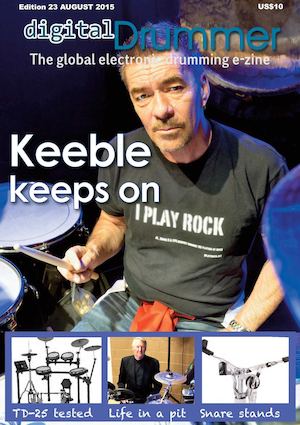
digitalDrummer August 2015
The August 2015 edition of digitalDrummer, the global online electronic drumming magazine.
Edition 23 AUGUST 2015 US$10 Keeble keeps on The global electronic drumming e-zine TD-25 tested Life in a pit Snare stands dd_aug_2015_Layout 3 26/07/15 12:33 PM Page 1
©2015 Avedis Zildjian Company YOUR NEIGHBORS WILL Coming this September is a new playing experience that delivers a quieter sound without losing the authentic feel of a Zildjian cymbal. The L80 Low Volume cymbal is up to 80% quieter than a traditional cymbal and is the perfect solution for practice spaces, small drum lesson rooms, low volume gigs or anywhere you want to play hard, but not loud. Learn more at zildjian.com/newfor2015 #NeighborLove THANK YOU
THINGS HAVE COME full circle in electronic drumming. This was evident when I recently caught up with John Keeble, the Spandau Ballet drummer who was the first to use Simmons drums back in the day. Back then, John used to mix and match, augmenting his Simmons gear with an acoustic snare and ‘real’ cymbals. Today, John is augmenting his acoustic snare and kick with electronics, thanks to Roland’s TM-2 mini-module – and the desk operators love the extra layering and effects that can be added to his solid acoustic sounds. You can read about the use of triggers to augment acoustics and other interesting aspects of John’s career in our profile this month. One fascinating detail is the story behind his use of two bass drums – but I’ll leave it to John to explain. Another intriguing item this month is Doug Reece’s explanation of his use of electronic percussion in the orchestra pit. Doug’s e-journey has taken a few twists and turns, but he’s ended up with a versatile, compact rig that provides plenty of scope for theatrical productions. Our artist input is rounded out with comments and advice from a smattering of drumming’s biggest names who give their views on snare stands – what they like, how to set them up and ensuring you make your investment in hardware count. Our gear reviews in this edition include a first look at Roland’s TD-25 module and the kit it powers. It’s been a while since we’ve seen a new module from the Japanese giant, and this one takes a refreshing less-is-more approach. Another new offering is 2box’s first foray into external triggers. We put the new TrigIt range to the test – not only with the module for which they’re designed, but with a bunch of brains. And speaking of a bunch, digitalDrummer’s quest for the ultimate mesh head continues, with three more offerings reviewed in this issue. The review co-incides with Billy Blast’s withdrawal of his three-ply heads under pressure from the patent holder. This is an interesting development, especially since most people thought the current patent covered only dual-ply heads or mesh heads fitted to electronic drums. Blast’s were the only multi-ply heads available in the US, although there are plenty of two- and three-ply offerings in Europe. And a reminder that digitalDrummer’s various Head2Head comparisons can be accessed for free in our back issues, but several have also been compiled into stand-alone publications that are available for download here. Hope you enjoy this edition. editor@digitaldrummermag.com is published by DigitalDrummer ABN: 61 833 620 984 30 Oldfield Place Brookfield Q 4069 AUSTRALIA editor@digitaldrummermag.com www.digitaldrummermag.com Editor & Publisher Allan Leibowitz Sub-Editor Solana da Silva Contributors Philip Dlugoss Scott Holder Tobi Hunke Doug Reece Cover Photo Allan Leibowitz Design and layout ‘talking business’ Support digitalDrummer If you like what you’re reading, please make a donation. Copyright or wrong: Forget the legalese and just play fair! We work hard to produce digitalDrummer. Please respect that and don’t rip off our content. In this age of electronic publishing, it’s obviously tempting to “borrow” other people’s work, and we are happy to share our stuff — but please ask first and be sure to include a link back to our website on anything published elsewhere. --from-the-editor-digitalDRUMMER, AUGUST 2015 3 dd_aug_2015_Layout 3 7/07/15 10:52 AM Page 3
Edition 23 August 2015 E-drums against bullying Drummer Johnny Misso has turned to e-drums to take his anti-bullying message to kids. Big offering for mid-range Roland’s mid-range TD-25 kits have been out for a few months, and Allan Leibowitz put one to the test. Head2Head: Take Five To date, digitalDrummer has tested 22 mesh head variants from around the globe. This month, we add two more production heads and a DIY model for good measure. Simmons rocks on Original Simmons kits remain popular today, but it often takes some effort to get them playing as they did in their heyday. Philip Dlugoss explains how he went about it. Snaring a great stand Snare stands are one of the key hardware upgrades for edrummers, so digitalDrummer checked out what the pros are using. 2box pulls the trigger 2box’s external triggers, first on show almost three years ago at NAMM, are now on sale, so Allan Leibowitz clipped ‘em on and let rip. Crash hot 682Drums offers two cymbals to round out its line of edrum products: the 12” EC12 and 14” EC14. Scott Holder reviews the bigger of the two. GEAR 6 8 14 20 22 32 34 The global electronic drumming e-zine 4 www.digitaldrummermag.com dd_aug_2015_Layout 3 7/07/15 10:53 AM Page 4
ws ... Get the latest e-drum news at www.digitaldrummermag.com/news ... Keeble keeps on John Keeble had one of the first Simmons kits ever built and did much to raise the profile of electronic drums through his fame as the drummer with ‘80s super-group Spandau Ballet. Allan Leibowitz caught up with Keeble who is back on the road with the band – sans Simmons.. Life in a pit The orchestra pit, the domain of kettle drums and xylophones, is not the traditional location of e-drums, but Doug Reece has come to rely on the versatility of electronic percussion. Look Ma, no hands As the iPad and the iPhone make themselves more indispensable to musicians, drummers sometimes miss out because they have their hands full. But a couple of products are providing hands-free access. Can you live without Ableton? As an Ableton instructor, Tobi Hunke is obviously biased toward the DAW. Here, he explains the reasons for his ongoing use of Ableton Live. Shutupayacymbals As drummers switch from tiny pads to full-size kits, there’s a growing move towards triggered acoustic cymbals. But volume control remains a challenge. My Monster Kit This month’s Monster kit has been assembled by Sheico (Pim) Pimenta of New York city. 36 42 42 46 50 52 digitalDRUMMER, AUGUST 2015 5 PERFORMANCE DIY VST MONSTER Profile IOS-DRUMMING dd_aug_2015_Layout 3 9/07/15 12:53 PM Page 5
WILLIAMSVILLE, NY DRUMMER and instructor Johnny Misso is using a new Pintech kit as a key part of his Kick It To Bullying program that is touring US schools and youth organisations. Misso, a victim of school bullying, developed the program to educate young people about the consequences of victimisation. “I almost took my life at a young age due to constant bullying when I switched schools as a kid,” Misso recalls. “Somehow, I found the drums just days before my suicide attempt and it was because of the drums I'm still alive today. “I've made it my mission in life to help anyone who's being bullied and to also help stop school violence.” Misso says drumming allowed him to achieve personal goals, and now he is using it for broader aims. “I've been playing drums for about 28 years (and) touring since 1999. I’ve been the opening band for many major acts like Three Days Grace, Brett Michaels, and a ton of major E-drums againstbullying Drummer Johnny Misso has turned to e-drums to take his message to kids, as he tells Allan Leibowitz. 6 www.digitaldrummermag.com --Gear-dd_aug_2015_Layout 3 7/07/15 11:40 AM Page 6
country acts. I was also the drum tech for Bob Dylan in 2009.” Having spent some time teaching drums, Misso developed a motivational and educational presentation that he has shared with students, church and community groups. He describes the act as “a gripping story in an entertaining and motivating musical production driven by my love of the drums”. Misso has been spreading the anti-bullying message with the program for about five years “and it's been one hell of a ride”. He had used an acoustic kit as the centrepiece of the presentation, but recently switched to electronics, with a custom Pintech set. “I've always used acoustic drums at my shows and found it was very difficult to control the noise levels, especially at schools, playing to tracks, etc. But now, my e-drums open up a whole new level of educational power. “I can control the volume, but with all the different sounds and samples I have at my disposal, it has really opened up a ton of new avenues.” The kit consists of a PHX14-B 14” dual-zone snare, three 10” CC102-B dual-zone toms, a CKv12-B 12″ kick drum, 13” visulite hi-hat, two 14” translucent red visulite dual-zone crashes and an 18” triple-zone visulite ride. The kit is powered by a Roland TD-30 module and housed on a custom rack. Pintech owner Ryan Guard says his company is always looking to help out the community in any way it can, especially when it involves children and furthering musical education. “We believe in what Johnny is doing, and it was an honour to be chosen by Johnny to help represent his message. “We know that he had a lot of choices when it came to his drum kit, and are excited that he chose Pintech to represent such an awesome endeavour." digitalDRUMMER, AUGUST 2015 7 Misso and a Kick It audience dd_aug_2015_Layout 3 7/07/15 10:53 AM Page 7
Big offering for mid-range Roland’s mid-range TD-25 kits have been out for a few months, and Allan Leibowitz put one to the test. 8 www.digitaldrummermag.com --Gear-dd_aug_2015_Layout 3 7/07/15 10:53 AM Page 8
THE NEW TD-25 module, around which the new kits are built, replaces the TD-15, combining the most used features of the flagship TD-30 with a compact, ergonomic interface. Street price for the Kv version of the kit is around $2,499 – roughly the price of the TD-15 kit it replaces. But the new kit packs a serious punch, especially for gigging drummers who want more of the serious grunt without the zany add-ons. What’s in the box The TD-25Kv, the higher-spec offering, adds current triggers in the form of two 10” and two 8” mesh pads, two 12” crash cymbals and a 13” ride, the one-piece vH-11 hi-hat, a KD-9 kick pad and a compact MDS-9SC rack to the new TD-25 module. The four-leg rack is compact, but big enough to accommodate the pads and cymbals – with some room for expansion. It has two cymbal rods encased in the uprights, with new adjustable mounts that offer flexibility without adding extra weight. The ball-joint snare mount offers versatile positioning options for arguably the most important drum in the kit. The playing surfaces include two dual-zone 10” PDX-100 mesh pads for snare and floor tom and two dual-zone PD-85 8” mesh hanging toms. The pads feature Roland’s tried and tested centre-mounted head triggers and separate rim triggers, clad in the patented dual-ply white mesh. The cymbal array features two 12” CY-12C dual-zone cymbals as crashes and the threezone 13” CY-13R ride. The kit ships with a stand-mountable vH-11 hi-hat and movable controller (the module is not compatible with the two-part vH-12 or 13 variants). The cloth-surfaced KD-9 provides the fire power down under for the kick. Also supplied is a wiring loom to connect the triggers to the module. Buyers need to use their own hi-hat stand and kick pedal. The more basic K version of the kit ships with smaller tom pads (two 6.5” and one 8”) and only one crash cymbal. In action Set-up is a breeze, with the MDS-9SC rack providing plenty of space for the module and triggers, and the ball-joints on the snare and cymbal fittings allowing enough flexibility to accommodate almost any ergonomic arrangement. I’m not a huge fan of the cable loom because cable failure is not unheard of with e-drums and, in this case, if one cable fails, you need to replace the whole loom - which is clearly a much more expensive exercise. That said, the loom does make it quick and easy to hook up all the triggers to the module in a single connection. The mesh pads provide very pleasing playing surfaces, with a realistic feel under the sticks. Sure, they are compact, but, with correct placement, they are easy to reach and feel realistic and comfortable. The CY cymbals feel good and play well, with the smaller sizes no impediment to realistic drumming. It had been a while since I played the vH-11 hihat arrangement (a single cymbal mounted on a controller on a regular hi-hat stand), and I was surprised at the realism of this solution and its fiddle-free set-up. I reviewed the KD-9 kick trigger when it was released and had no problems with the bass performance, although I am a convert to the KT-10, which would be among the first upgrades if I owned this kit. So, the front-end equipment represents a smattering of Roland’s existing mid-range hardware, combined into a compact but capable drumming rig. The brain: Roland TD-25 The real novelty comes in the form of the TD25 module, a notable departure from the large format of the TD-20/30 design or the compact TD-4/11/15 format. Any new brain, the first full module addition since 2012, is bound to polarise the market, but I think Roland has hit the sweet spot with this design that packs an easy-to-use interface in a compact box with just the right level of control. The mid-size box provides control over a large number of parameters with a surprisingly modest collection of buttons. I approached the module with gigging drummers in mind, and found it quick and easy to change kits and modify them on the fly, with a small number of clicks and turns. The dominant feature – and the one you’ll use most – is the central wheel used to select kits. digitalDRUMMER, AUGUST 2015 9 dd_aug_2015_Layout 3 7/07/15 10:53 AM Page 9
There are six choices on the dial, each representing a genre (rock, jazz, funk, etc.), and individual kits are then accessed by clicking the dial and cycling through the menu. This is much quicker than the previous up and down buttons for kit selection. Next up, you’ll be using the cluster of dials and buttons at the top right-hand side, where you can select instruments and tune them to your specifications. Again, this has been well planned, and Roland seems to have come up with maximum control for minimal button presses. Especially useful is the ability to adjust all the toms with a single action, rather than having to do them one by one. Best of all, there’s no need to search for a ‘save’ button – changes are automatically locked in and can be easily undone with a couple of clicks. While there are no individual volume sliders for each instrument, the audio controls at the bottom right allow you to adjust overall volume, backing levels and bass/treble. Unfortunately, there’s no separate headphone level, which may be an issue if you’re driving an amp and require different output levels for each, but it’s a compromise most of us can live with. The module has no inbuilt play-along tracks or sequencer, but the ability to import audio via USB and record back to the memory stick more than compensates for this. And both functions are very simple, and controlled from the bottom left-hand corner, where you’ll also find the metronome and training tools controls. In short, if you’re gigging, you can very quickly and easily switch kit patches and even make on-the-fly tweaks. Most changes require one or two clicks or dial turns and this module gives you much more control than any other I have seen to date. The sounds Roland has gone with a less-is-more philosophy, offering a pared-back selection of its latest generation sounds found on the flagship TD-30. Where the TD-30 has 100 kits and more than 1,300 sounds, the TD-25 has 18 stock kits and slots for another 18 user kits and fewer than 250 sounds. (Some extra kits have already been added since the review). 10 www.digitaldrummermag.com dd_aug_2015_Layout 3 7/07/15 10:53 AM Page 10
8 www.digitaldrummermag.com So, are buyers being short-changed? Absolutely not. While 36 kits may not seem overly generous, I can’t see any gigging situation that would require anywhere near that much choice, even for the most diverse covers band. And, if you did need more, you could easily save them on a USB stick beforehand and load them as required. And what about the missing 1,000-odd base sounds? Again, no big deal. Roland has provided the building blocks for an almost infinite instrument array. Let’s start, for example, with a 22” solid maple kick. This can be tuned up or down (240 steps each way) and then there are four types of muffling that can be applied. So, one “sound” can be dramatically modified using the tuning knobs. And that’s before we even get into the Kit menu, where one of seven types of reverb can be applied in addition to an impressive collection of effects, from echo to overdrive and pitch shift. Besides the drum and cymbal sounds, there is an adequate selection of percussion voices, including three cowbells, a few blocks, a tambourine, tree chimes, timbales, etc. – and all of these can be tuned and tweaked. What you won’t find is guitar sequences, keyboard sounds and barking dogs – which is no great loss. So, we’ve addressed the quantity issue. What about the quality side? The stock sounds certainly reflect their TD-30 origins. They are part of the new sonic treatment using Roland’s SuperNATURAL technology. There were some great sounding drums and cymbals, with plenty of articulations and variations to avoid the dreaded machinegunning. The bottom line is whether they would pass the gig test, and I’d have to say that any desk operator would be more than happy with the mix coming down the line from the TD-25. In action I found the TD-25Kv to be a no-nonsense kit. It was plug and play, with all the pads and cymbals – hi-hat included – performing perfectly in stock settings. The drum pads were sensitive and responsive with excellent triggering across the head. The snare has positional sensing, creating sonic variety that accurately emulates acoustic drumming. Rim shots and cross-stick triggering were great (you have to choose between these) – and both are adjustable to accommodate heavy hitters or those with a feature touch. The snare and toms were more than capable of producing realistic ghost notes and buzz rolls. The cymbals were responsive and realistic, with excellent bow and edge transitions for the ride and crashes, and a bell on the ride that didn’t require too much of a whack. Crash swells were extremely realistic and on par with the TD-30. The vH-11 hi-hat was easy to play and very realistic and responsive - so much so that I am really wondering if the vH-12 and 13 are worth the extra money. Besides playability, the module also shone for its ease of use, which was especially evident when playing backing tracks from the USB digitalDRUMMER, AUGUST 2015 11 dd_aug_2015_Layout 3 7/07/15 10:53 AM Page 11
stick. Recording was easy and intuitive and with a couple of clicks, you’re able to record yourself playing to a .wav or MP3 backing track – something you can’t even do on the TD-30. The onboard training tools include the nowubiquitous time check which tells you if you’re in the pocket, too fast or too slow, and a useful warm-up tool that takes you through different patterns at ever-increasing tempos. The difficulty levels can be adjusted for more or less proficient players and should provide some practice encouragement to players of any level. Experienced e-drummers may lament a lack of flexibility in assigning rim sounds since the head and rim instruments are locked in pairs. This means you can’t replace the rim sound with a cowbell, if you wanted to. Sure it would be nice to mix and match, but for the acoustic convert, this is a non-issue and it wouldn’t be a deal-breaker for most drummers. Bottom line The TD-25 represents a new benchmark in ease of use, with its well laid out, ergonomic knobs that provide maximum control with minimal effort. The less-is-more approach has been applied to every aspect of the module – and indeed the kits it powers. There are fewer sounds and kits than on the module it replaces, but they are better and more easily tweaked. And, more importantly for gigging drummers, everything is far easier to access and control on the fly. Sure, there are compromises. Some sounds have been sacrificed along with the built-in play-along songs, but they are replaced by easy-to-use USB playback and recording functionality. There’s no MIDI In, which will put off Zendrummers and keyboard drummers, but there is MIDI Out – and full In and Out functionality via USB. The KV kit is well considered and represents good value. It doesn’t contain Roland’s biggest pads and cymbals, but there’s no compromise on quality, and every component does its job perfectly. While the kit is pitched as a mid-level offering, the combination of its quality sounds, vast tuning capability and market-leading user interface makes this an excellent choice not just for the practice-at-home drummer, but even for the weekend warrior on the gig circuit. It’s tempting to nit-pick, but the TD-25KV is genuinely hard to fault and easy to recommend, especially when it’s priced at the same level as the model it has superseded. Specifications Drum sound module: TD-25 Drum rack: MDS-9SC Snare: PDX-100 Toms: PD-85 x 2 Tom 3: PDX-100 x 1 Hi-hat: VH-11 Crash: CY-12C x 2 Ride: CY-13R Kick pad: KD-9 12 www.digitaldrummermag.com The VH-11 hi-hat, PDX-100 and KD-9 triggers dd_aug_2015_Layout 3 26/07/15 9:21 PM Page 12
Real Sizes Real Sized and Soft Playing Pad Surfaces allow players to maintain the set-up and spacing of their acoustic kit while maintaining low ambient noise for quiet practice Patented Spider-Web Shaped Trigger produces superior dynamic tracking and timbre from the center to the edge, allowing the natural playing styles of an acoustic drum Multi-Zone Triggers enable drummers to play normally, without having to alter their technique for standard strokes, rim-shots, cross-sticks, cymbal chokes, and hi-hat foot motion. w w w . N F U Z D A U D I O . c o m Get S U M M E R 2 0 1 5 nfuzd_ad_features_FP_phase II_210x297mm.indd 3 4/9/15 3:51 PM
14 www.digitaldrummermag.com --Gear-To date, digitalDrummer has tested 22 mesh head variants from around the globe. This month, we add two more production heads and a DIY model for good measure. 2 Take five dd_aug_2015_Layout 3 7/07/15 10:53 AM Page 14
digitalDRUMMER, AUGUST 2015 15 Drum-tec Real Feel Germany’s drum-tec has widened its range, with a new three-ply head to augment its single- and dual-ply offerings. The Design dual-ply is popular in Europe and is characterised by relatively low noise and good rebound, with the added advantage of good opacity. The triple-ply performed even better, with a good natural feel and slightly quieter acoustic performance. Even the rebound was improved over the two-ply version. The additional layer has one significant effect – it eliminates the dreaded two-ply buzz, but the downside is that you get a rather dead “thwack” sound which is not as pleasing as the tone of most other heads. The three plies are quite tightly woven, with a good block-out effect that almost totally conceals anything under it, so if you want to hide your trigger mechanism, this is the way to go. Another advantage is sure to be durability, and if two heads are better than one, three plies will surely last longer than two. The head feels realistic under the sticks, but certainly not exactly like mylar, if that’s the intended meaning of “real feel”. In short, these heads are very similar to the Design models, but without the buzz. They’re also quieter and with improved rebound - at a higher price, of course. How we tested Mesh heads were fitted to a 12” shell and tightened to a tension of 75 on a DrumDial. A standard rig was employed to ensure that repeatable strikes are generated by a stick. These strikes were monitored with a sound meter (see Noise Level readings in the table). In addition, the trigger sensor was connected to an audio recorder and the resulting waveforms analysed. The duration in seconds between the initial hit and the end of the final wave was noted as the rebound. Before testing, the rig was calibrated with a designated mesh head which has been used in all the tests to date. dd_aug_2015_Layout 3 7/07/15 10:53 AM Page 15
Pintech Reaction Series (white) In response to customer demand, Pintech has expanded its range, now offering the revised Reaction mesh head in white. Like its black counterpart, this head also has rubberised reinforcing to prevent stretching and/or tearing – a unique feature. The hoop is generously sized – both in depth and diameter, which will be helpful on oversized drums. The mesh itself is also generous and quite loose in the hoop, meaning a bit more tightening is required to get to the desired tension. The head features the same tight weave as the black version and is very similar to RMV heads. The weave tightness makes the head semi-opaque, but it’s still possible to see the trigger set-up inside the head. The head performed well, maintaining its low impact noise profile and steady rebound, although the reinforcing seems to have dampened that very slightly, as it did with the black version. Again, the impact decay is very smooth and steady, which translates into a realistic playing sensation. Also worth noting: this is one of the few heads which actually comes with installation instructions – not that fitting a mesh head is rocket science! 16 www.digitaldrummermag.com How they scored dd_aug_2015_Layout 3 26/07/15 4:42 PM Page 16
simmonsdrums.net ADVANCED FEATURES... AMAZING PRICE The Simmons SD500KIT is truly taking electronic drums to an entirely new level of value! This full-size 5-piece electronic drum kit explodes with features, including all the professional benefits of larger kits — 4 drum pads, 3 cymbal pads, hi-hat controller and a radical, integrated kick pad & pedal — plus 352 exceptional drum sounds across 35 drum kits (25 preset/10 user). And its V.A.R. (Variable Attack Response) technology means better nuanced playability than any other kit in its price range. Test-drive the Simmons SD500KIT today and feel what you’ve been missing. New pads and cymbals feature stunning design and response. Module provides over 350 sounds and 35 kits. Breakthrough combination of radial integrated kick pad and pedal. Available exclusively at 5-Piece Electronic Drum Set 1508_DD_SIM_SD500.indd 1 7/2/15 10:07 AM
DIY dual-ply by Brian Wilburn There have been a few enquiries about the DIY mesh head which was explained in the August 2014 edition, so while we had the test rig set up, we put it through its paces. The absence of a metal hoop made it a bit tricky getting even tension, but with a bit of effort, it was possible to achieve a DrumDial reading of 75 at all the lugs. At that tension level, the head was very stiff, almost like hitting a rubber pad. However, it did not have the rebound of rubber and, in fact, recorded a rebound level lower than most other heads tested. This is probably due to the heavier gauge mesh which is more absorbent. Obviously, most players will ease up the tension a bit for a more yielding feel and indeed, with the lugs loosened a turn, a more ‘realistic’ feel was achieved. The head was noisier than most, both in controlled play and under heavy hits, with a dull thud sound. The heavy mesh also overcomes one of the hallmarks of dual-ply heads – the buzz, which is totally absent in this design. It’s hard to compare a home-made head to a factory product because of the obvious inconsistency in the way they are put together at home, but with the tension eased back, the example I tested felt similar to other mesh heads, if somewhat ‘deader’. On the plus side, they are cheap and look durable, but the complex ‘manufacture’ process may be beyond the scope of many drummers who would be better off buying an off-the-shelf product. Missed a review? To access all our mesh head reviews, get the Head2Head compilation. Click here to download. 18 www.digitaldrummermag.com dd_aug_2015_Layout 3 7/07/15 10:54 AM Page 18
The World’s Most Powerful T rigger T o MIDI Interface. Alternate Mode Complete Solutions and Systems for the Electronic Drummer and Percussionist M E N T I O N d i g i t a l D r u m m e r F O R A 1 0 % D I S C O U N T ! www.alternatemode.com 877-933-6237 scan for more information Pre-programmed to play with virtually every drum sound module on the market – DITI even recognizes your drum module’s kits! Completely customizable and compatible with: – single and multi-zone (dual trigger) piezo and membrane switches – rubber pads and mesh heads – 2 and 3 zone cymbals (including choke) – Continuous Control (CC) hi-hat inputs and NEW FSR trigger pads: – Aquarian inHEAD™, onHEAD™ and DITI DIRECT pads – altZONE™, jamKAT™ mini and PMCP pedals Create a mix of triggers that suits you and connect them via the DITI to your drum sound module or directly to your computer. The POWER of CONTROL is YOURS! 12 Stereo Inputs – converts up to 24 triggers 50 KIT storage each holding 50 presets = thousands of User and Factory Kits Perfect for all VST Plug-Ins and Sound Modules
12 www.digitaldrummermag.com 20 www.digitaldrummermag.com I’vE BEEN PLAYING drums since I was 17 and my first kit was a Simmons kit. I got into Simmons when I was in high school. I was really into a lot of ‘80s bands, but my fascination started when I saw bands like Talk Talk and King Crimson use electronic kits. I became especially intrigued when I saw Bill Bruford and the SDX. Just being surrounded by tons of pads seemed like the coolest thing in the world. I started on this kit about a year ago and just recently completed it after building it up piece by piece. That’s because all the completed kits I was finding for sale were in really bad shape and it seemed pads that were in better condition were selling separately. When I was tracking down parts, it seemed like everything I was finding was classic Simmons (early to mid-’80s), but I was more interested in their later period (late ‘80s onwards). My goal was to build a kit using stuff from that period. Everything in this kit took time – and lots of effort - to find. The three tom pads and the bass pad – all black SDS-9 pads - were relatively easy to find. They came from online auctions. The snare pad, which is a later SDS2000 model, was tricky to find and I sourced it from a collector. Two of the multihex pads and the Drum Hugger slaves came from Germany. These were the hardest to track down as multihexes are extremely rare. The Drum Hugger cymbal pads weren’t even on my radar as they, too, SIMMONS rocks on Original Simmons kits remain popular today, but it often takes some effort to get them playing as they did in their heyday. Philip Dlugoss explains how he went about it. --Gear-dd_aug_2015_Layout 3 7/07/15 10:54 AM Page 20
digitalDRUMMER, AUGUST 2015 21 The kit 4 black regular-sized pads (3 SDS-9 toms and 1 SDS-2000 snare) 1 black bass pad (SDS9) 3 multihex pads (crash cymbals) 2 Drum Hugger slave pads (hi-hat and ride) Coda drum bass pedal Alesis hi-hat pedal Alesis D4 module are very rare, but I found them from the same collector. I only recently acquired the third multihex from an auction. It was new old stock with the box and accessories, which was a terrific find. I did all of the refurbishing work myself. Two of the multihex pads and the Drum Huggers needed the most work, with all of the triggers and wiring replaced. The rubber was absolutely filthy and needed serious cleaning and rejuvenation. I also had to replace the underfoam on the minihexes. The refurbishment also required some custom parts, mainly for the Drum Huggers which were originally made to be mounted on the side of acoustic drums. The original mounting hardware was missing, so I had some custom arms made. The bass pad didn’t come with the original spurs, so I attached them with Pearl UX80 Clamp arms, which works really well. In action I am happy with how this kit plays. To me, the feel of playing an original Simmons kit is very different from playing modern electric kits. I have it connected to an Alesis D4 module and would happily use an SDX, but they’re almost impossible to find. I use the kit as a standalone with module sounds as well as to trigger drum plugins and samples and it’s recently been used extensively on the new material my band, The Symbolic Olives, has been working on for our next album. Phillip ‘Bon Lucas’ Dlugoss from Southgate, Michigan, USA is the principal songwriter, producer and drummer for the band The Symbolic Olives. dd_aug_2015_Layout 3 7/07/15 10:57 AM Page 21
--Gear-Snaring a great stand Snare stands are one of the key hardware upgrades for e-drummers, so digitalDrummer checked out what the pros are using. 18 www.digitaldrummermag.com 22 www.digitaldrummermag.com dd_aug_2015_Layout 3 7/07/15 10:57 AM Page 22
THE SNARE DRUM stand is seen as one of the greatest innovations in percussion, allowing one drummer to play two or more rhythms when combined with the other big innovation, the bass drum pedal. Before the snare stand, drummers would hang the drum from their shoulder with a strap or sling, or position the drum on a chair. Ulysses G. Leedy is generally acknowledged as the father of the snare stand, and it was this product that led to the creation of the Leedy drum brand. A mainstay of 20th century drum kits, the snare stand was one of the first accessories adopted by e-drummers. It provides more flexibility and placement options than rack-mounted arms and also ensures isolation from crosstalk. Today, even high-end e-kits tend to be supplied without a snare stand, acknowledging the importance of personal preference with this key piece of drum hardware. With so much choice and options starting below $50 and stretching into the hundreds, snare stands are a hot talking point, even among pro drummers. For maestro Peter Erskine, there’s no undervaluing the importance of the snare stand: “Snare stands are vERY important. I will often play cross-stick with my left hand resting on the drum (thus placing weight on the drum and stand); if the tilter adjustment is not sturdy, the drum moves. Not good!” Jon Atkinson points out that snare stands have one function: “to keep the snare drum where you put it when you set up”. “Stands which go for a little walk during the gig really annoy me, as do stands which have wing nuts which you need a pair of pliers to adjust.” Jerry Hawkins, drum tech for Spandau Ballet’s John Keeble, notes that even though snare stands are not as complex as other bits of drum hardware, it’s important to get the right one. “It must hold the snare drum in the desired position, preferably be of solid construction and not jump about when the snare is given a bloody good thrashing,” he says. His advice is to “get the right stand for your gig”. “If I was playing in a covers band and transporting my own equipment, I would go for a … lightweight option. I would always go for a ball tilter or the DW design as this gives the flexibility to get your drum at exactly the angle you feel comfortable with,” he says. digitalDrummer e-drummer of the year Michael Schack believes the snare stand is even “more important than the hi-hat pedal”. ”Kick and snare need to rule, so as kick cannot move, same for snare stand - especially when supporting lower weight v-drums pads. “When taking your hardware on the road, you can easily separate the ‘cool looking, multitechnology system’ marketing from the ‘always work’ and ultimately performing ones.” Also stressing the significance of the snare stand is Chris Fryar, who puts it right up there with the kick pedal, hi-hat stand and throne in importance. “Having a great snare stand is so important because we do so much playing on the snare drum.” Sekou Lumumba’s advice is not to skimp on quality gear. “Not to say that the only good gear is the expensive stuff, just that a moderately higher price point shouldn’t be a barrier to your peace of mind and comfort while you try to create. If you don’t have to think about a faulty or cheap stand, you can focus on what matters: making music.” Snare stands are just as important as any other stands for Seth Rausch because “if I’m able to feel my backbeat in a comfortable spot, it really helps the other aspects of my groove feel better”. He suggests finding a snare stand that allows you to get your snare in a good comfortable spot with a relatively small amount of effort. “Then you can just focus on grooving.” Fryar’s advice for choosing a great snare stand is to “look for the features that matter to you most”. “Look for a stand that will adjust to you and your playing, but will also be able to hold that position no matter how hard you hit. “You get what you pay for, so don’t worry if you have to spend a few extra dollars to get the right stand that will hold up for long periods of time”. Another aspect to consider, according to Davey Brozowski, is the mass of the stand: “If your stand moves while you play, it might not be the stand but the player which needs to make an adjustment”. digitalDRUMMER, AUGUST 2015 23 dd_aug_2015_Layout 3 7/07/15 10:57 AM Page 23
Jonathan Atkinson Favourite snare stand: Yamaha SS850 Key features: It’s heavy enough to withstand a beating, but not so crazily heavy as to make the traps case impossible to lift. I also use other Yamaha snare stands. I have a 900 series stand which is a genuinely beautiful piece of engineering, and I usually have a 700 series stand for my 12” tom. I also use the 700 series with my DTX950 kit (supporting a lighter snare pad), and it will also take my Yamaha DTX Multi 12, so it’s a good allrounder. The single most important feature is stability. It also needs to stay put where I set it. This includes the angle I set, but, most of all, it shouldn’t walk around the stage. The Yamaha stands have feet which grip very well to the carpet (and the 900 series also features spurs). Some brands use a very hard (almost plastic-type) foot which just slides over the carpet. That’s no use to me at all! The DW stands are also great in this regard. The Yamahas seem to be the most adjustable to me. The basket can open enough to take my 15” snares comfortably, but also take a 12” tom, or my Yamaha DTX12 pad. As with all Yamaha stands, they are beautifully built. It’s always telling when you get a rental kit which has seen lots of use that the Yamaha stands always still seem to function well. None of the problems of wing nuts being stiff, or needing to be overtightened to actually grip. Also, their chrome doesn’t flake off, leaving razor-sharp edges like some other brands! I think this level of durability puts Yamaha stands above all the others. Davey Brozowski (Modest Mouse) Favourite snare stand: DW CP3300 Key features: The 3000 series is my favourite snare stand. I opt for a stand that is single-braced or light double-braced with a toothless tilter and basket adjustment. No extra bells and whistles, just solid and reliable. 3000 fits those criteria. The 3000 series tilts forward and back, it’s easy to adjust and the footprint is not obtrusive. I can put a 35 lb Keplinger snare on it and it stays in one place or a ‘60s Ludwig six-lug Club Date and it doesn’t choke the delicateness of that shell. It’s hard to find the 3000, 7000 or 6000 series on the road. Those would be my go-tos when using rented gear. Your typical backline provider generally carries the 9000 series because it is believed to be more durable. Sometimes the more mass a stand has cuts into the resonance of your drum. It can choke it the same way overtightening the snare basket chokes a drum. 24 www.digitaldrummermag.com dd_aug_2015_Layout 3 7/07/15 10:57 AM Page 24
2014 digitalDrummer Readers’ Choice awards Product of the year “The head picks up every nuance – but only the intended hits. There’s no false triggering or crosstalk.” dd_aug_2015_Layout 3 7/07/15 10:59 AM Page 51
Dave Elitch (Antemasque) Favourite snare stand: DW CP3300 Key features: Having a toothless tilter for the angle of the snare drum. I need the drum to be exactly where I want it. I find that when there’s teeth, I sometimes want the drum to be “in between” and it’s very frustrating. It doesn’t really get simpler than the 3300, which is why I chose it. It’s light, compact and easy to use - a no-brainer. Snare stands are important to me, but it really just needs to work. Sometimes I use very heavy stands and hit extremely hard, so they absolutely cannot be failing on me. I believe you should always choose something that’s going to do the job well; you don’t need all of the extra bells and whistles. Peter Erskine Favourite snare stand: Tama Star stand Key features: I like the retro basket design with the lowprofile rubber claws. Adjustments are a breeze and it’s remarkably easy to set up a snare or change drums. The Omni-Ball tilter allows me to position the drum at any angle with its 360-degree design flexibility. The Star stand is infinitely adjustable, and each adjustment holds true. In addition to the Omni-Ball tilter, the entire basket slides if I want to position the drum off-axis from where the legs are positioned. The design is clever and elegant. The stand offers more durability than any other stand I’ve tried — durability without too much mass or hassle. It’s important to establish a rapport with all of your drumset including the hardware. For me, Tama hardware is pleasant to use, so much so that I would use the word “rewarding”. The Star snare stand might just be the ultimate expression of snare stand design, where form meets function. 26 www.digitaldrummermag.com dd_aug_2015_Layout 3 7/07/15 10:58 AM Page 26
GIBRALTAR JUST GAVE YOU A NEW REASON TO LOVE YOUR ELECTRONIC DRUM SET. Check out Gibraltar’s weekly YouTube Series for more information on E-Racks. GIBRALTARHARDWARE.COM THE NEW E-RACKS BY GIBRALTAR You’ve spent hours with your electronic kit, tweaking every drum and cymbal so it sounds exactly like you want. Isn’t it time you gave it the hardware upgrade it deserves? The two-tiered rack system gives you more flexibility in your set-up than ever before. Gibraltar E-Racks are built to the same rigid specifications as its professional drum set racks, giving you hundreds of mounting options and accessories to choose from. Gibraltar E-Racks reduce kit vibration, extending the life of your electronics and virtually putting an end to crosstalk. The Gibraltar E-Rack tears down in minutes and is easy to transport, allowing you to conveniently take your e-kit on the road. Heavy-duty Gibraltar clamps and memory locks ensure that components stay in position. Gibraltar’s secure cymbal arms provide reliable stability and precise positioning Some optional equipment shown. See your Gibraltar dealer for E-Rack Systems and options. Gibraltar Hardware distributed by Pro Music Australia. Phone 1 300 880 278 Australia wide for sales and information. www.promusicaustralia.com Gib_ERackRoland_DD.indd 1 7/8/15 1:49 PM
Chris Fryar Favourite snare stand: Gibraltar 9706UA-TP Key features: Important features that I look for in a snare are stability, sturdiness, and adjustability. The Gibraltar 9706UA-TP has everything I could ever ask for in a snare stand. I had used the same snare stand (a Gibraltar 9606) for three years and it held up night after night. It was the perfect stand in every regard, especially adjustability. I found the perfect angle for the drum and it locked down and held it with ease. I only replaced it recently with the new and improved version, the 9706UA-TP ... and not because I needed to. Usually I have my own gear for each show. Occasionally, I have to use backline gear because my normal hardware isn’t available - and it always makes me appreciate how rock-solid my Gibraltar hardware is. John Keeble Favourite snare stand: Gibraltar 9606 Key features: Most of my hardware is supplied by Premier, but stuff wears out and we recently replaced the Premier with a Gibraltar 9606 snare stand, which is very solid, adjustable and does the job. Stability is important because I am a very heavy hitter, striking the rim with big sticks. It would be no good to have a stand that bounced around as we use triggers and the snare mic placement is also pretty restricted, nestling as it does between two rack toms, so we need to avoid the chance of the snare bouncing around hitting all and sundry. Also, I play a deep (8”) snare, so the stand must go low enough to enable this drum to be adjusted to suit. I like the stands which have a ball and socket type arrangement as you can adjust the angle of the snare so it is “just right”. It’s not always possible to take our own due to weight/space issues. We will generally bring a snare, cymbals, throne and main pedal and use local gear for the rest of the hardware. If we get a loan kit from Premier, it will generally come with a Premier snare stand which is okay but very basic. If renting, then I will always spec the DW 9000, which are generally readily available. 28 www.digitaldrummermag.com dd_aug_2015_Layout 3 7/07/15 10:58 AM Page 28
Sekou Lumumba (Serena Ryder, Bedouin Soundclash) Favourite snare stand: DW CP9300AL Key features: This thing is a godsend as I have a few Edge, Super Solid Edge and deep maple snares. Having the extra support while lifting and adjusting their height is a real lifesaver. The most important feature of any snare stand to me is having full adjustability. I hate using stands that have ratcheted, toothed locks, as I inevitably need it angled in a position that’s in-between the ‘teeth’. DW snare stands are the best I’ve ever used. In terms of adjustability, I’m always able to get the precision degree that I need without fail. The only time I’ve ever had an issue with stability has been on those rare occasions that I didn’t properly tighten the basket and/or screws in the base of the stand. Barring my human error, the stands are rock solid every time. It works with any and all snares, has a fairly standard, unobtrusive footprint, and lasts forever. As to ease of set-up/tear-down, it’s not even a question: it’s far and away the easiest, most effortless snare stand I own. I play live/record about four to six times a week and all parts of my kit have to be something that I can put together and get comfortable with quickly. This stand is perfect for me for that very reason. Seth Rausch Favourite snare stand: Gibraltar 9706UA-TP Key features: For me, the most important features of this stand are the fact that it can be set at a really low height; the wide heavy rubber feet for stability; and being able to make fine adjustment to get it at just the right spot with the ultraadjust ball in the centre. This stand’s adjustability is pretty limitless. The smaller tripod feet are nice because the footprint is small, but having the wide rubber feet still keeps it stable. This stand works well with any type of snare I’ve ever put on it. I will typically always travel with my own gear, but on the occasions that we have to rent backline, I would say that about half the time I’m able to get that snare stand. I definitely miss it when I don’t have it, for sure! digitalDRUMMER, AUGUST 2015 29 dd_aug_2015_Layout 3 7/07/15 10:58 AM Page 29
Michael Schack Favourite snare stand: Tama HS-700 Road Pro Key features: I’ve been using the Tama HS-700 Road Pro for three years, after long testing of others including Sonor, Pearl, DW, etc. The key benefits are stability and angling possibilities of the snare drum or Roland PD-125 snare drum pad. You can adjust into any angle with no stability issues, which is a problem with many other stands. As I have specific positioning needs for this stand in between kick and hi-hat pedal, I don’t want to adjust the angle and adjust the leg positioning at the same time. Compatibility is 100% with the vDrums pad, smaller 10” or 12” snares and the bigger 14” x 6.5” I’m using, for instance. I always take my own stand on the tour bus or when going to gigs by car. When flying around, my choice is generally available through any backline company or local endorsement support. Matt Sorum Favourite snare stand: Gibraltar 9706UA-TP Key features: It has a ton of cool adjustments to get my snare in just the right spot.I hit pretty hard and I’m always down with durability, I like the leg length that I can adjust to get around stands and create more floor space and also work with deeper snare drums. When I get into something, I’m a creature of habit and need the security knowing I’m locked down, so I like to use this model on the road, where possible. When choosing a stand, think about how you’ll use it. If you’re carrying your gear every night, sometimes lighter stuff can be cool. When I’m on the big rock gig, I use the sturdy 9600 series, but I also have lighter Gibraltar flat stands that are awesome for casual gigs. digitalDrummer thanks the artists who took the time to share their experiences and the artist relations managers who helped hook us up with them. 30 www.digitaldrummermag.com dd_aug_2015_Layout 3 7/07/15 10:58 AM Page 30
Electronic, acoustic and hybrid drumming Electronic, acoustic and hybrid drumming The t-Rigg is a perfect solution for adding an additional trigger option to your electronic or acoustic drum kit. T-RIGG The 682Drums conversion kit will greatly improve the playability of your Alesis pads, or other kits with Medeli mylar pads, while reducing ambient sound (-20dB). Alesis mesh head conversion Drum mics for studio and stage. At these prices, no better choice. Drum mics from the specialist Stereo E-cymbals with choke. Available in 12 and 14 inch sizes. E-cymbals Top quality mesh heads with a perfect, natural bounce. Mesh Heads Improve your 2BOX with 682Drums mesh heads. How to improve a great kit The brand new E-kick is now available! E-kick The center placement gives perfect response and crosstalk is eliminated. Triggers 682Drums_A4-adv_digitalDrummer_v2.indd 1 10-10-2014 20:39:33
THE NEW TRIGIT external triggers are available in two versions: a dual-zone snare/tom trigger and a single-zone bass drum variant. The triggers are quite large compared to most of the products out there, but they are stylish and inconspicuous – unlike the drum pads from the same maker. The trigger design is a bit different, with the piezo stuck on the end of the column, and in contact with the drum head. The two-zone trigger comes in a brushed aluminium shell that fits over the hoop and is tightened with a drum key. It is supplied with a rubber spacer for narrow hoops. On a regular hoop, it attaches effortlessly and feels very secure when it’s in place. The TrigIts look solid and robust, and the sensitive bits are well protected by the metal shell. The stereo jack is sidemounted, which reduces the risk of accidental uncoupling. 32 www.digitaldrummermag.com 2box’s external triggers, first on show almost three years ago at NAMM, are now on sale, so Allan Leibowitz clipped ‘em on and let rip. 2box pulls the trigger --Gear-dd_aug_2015_Layout 3 7/07/15 10:58 AM Page 32
In action We tested the two-zone triggers on a 12” shell with both mesh and mylar heads, and attached a number of modules to test 2box’s claim that they “work with all types of drum modules”. First up, on the native 2box module, the trigger was plug and play, working in all three stock AcTr (acoustic trigger) settings without any need to tweak the parameters for a mylar head. The trigger delivered excellent triggering with good dynamics across the head and excellent rim response. With mesh, I found the AcTr settings less than optimal and actually got better results with the Pad12 settings and a few minor tweaks which delivered triggering on par with 2box pads and stock heads. On a Roland TD-30, excellent triggering was obtained in stock Pad2 settings for mesh and mylar, although most other drum pad settings could be easily adjusted for the triggers. The exception was Roland RT-10 settings, where the signals were just not strong enough for decent triggering – with either head type. Overall, performance was excellent and there were great dynamics with a range of stock settings. On the Roland TM-2, there was excellent triggering across the board for both mesh and mylar, even with the fussy RT-10 setting. In most trigger settings, it was plug and play, with great triggering across the whole head. On a Yamaha DTX700 via a tom input (because the snare input is not compatible with piezo-piezo designs), good triggering was obtained with mesh in various stock trigger settings. However, using mylar, sensitivity needed to be turned down significantly to avoid double triggering. Rim sensitivity was fine in most trigger settings. The Alesis DM Dock required the head sensitivity to be dialled right back for mylar, and the rim sensitivity raised almost to the top of the scale. Triggering was adequate, but not brilliant, once dialled in. With mesh, sensitivity had to be raised again and other tweaks were required, such as changing the curve to Log2. Again, triggering was adequate, not brilliant – but that is more a reflection of the module than the trigger. A footnote Often, timing is everything, and it’s unfortunate that 2box didn’t release its triggers a year earlier. That would have avoided a head-on competition with Roland’s new RT30K. As reported in the May 2015 digitalDrummer, that trigger is exceptional – both in performance and in its ability to accommodate almost any hoop size. While the TrigIt bass trigger was no slouch in performance (albeit without the crosstalk cancellation abilities of the Roland equivalent), it was certainly more fiddly to attach. I tried it on three different hoops and had to use the shim (2box misleadingly refers to it as a washer, which had me searching in vain in the package!) on all three. Even then, thinner hoops required additional spacers to ensure a snug fit. The bottom line With the growing move to hybrid drumming, external triggers designed for a module growing in popularity was a nobrainer. 2box has delivered some stylish clip-on triggers that work exceptionally well with its module and are easy to dial in for almost any other brain on the market. The snare/tom trigger is easy to fit, but the kick trigger less so. And in the value-for-money stakes, the triggers have European street prices of around €59 for the dual-zone version and €69 for the kick version – pricing that is in line with the Roland competitors. While Roland triggers are only available as single units, 2box does offer a five-trigger set for around €270. digitalDRUMMER, AUGUST 2015 33 dd_aug_2015_Layout 3 7/07/15 10:58 AM Page 33
--Gear-682Drums offers two cymbals to round out its line of e-drum products: the 12” EC12 and 14” EC14. Scott Holder reviews the bigger of the two. UPON OPENING THE package, I immediately thought of the quote by baseball great Yogi Berra: “It’s déjà vu all over again.” Why? Because I’ve been writing reviews of the various badging of this cymbal for three years. 682Drums joins Alesis, Simmons and KAT Percussion in selling rebadged cymbals made by Medeli in Hong Kong. The EC14 is identical to the 14” cymbal found in KAT’s KT3 kit while the EC12’s mirror images are sold by Alesis and Simmons. If nothing else, 682Drums now at least offers European buyers a budget-priced cymbal that will work quite well with the mentioned company’s modules, as well as with Roland. Although I just tested the EC14, based on my experience with the other incarnations, everything mentioned here will apply to the EC12. The trigger: 682Drums EC12/14 ($82.50/$95) Form and size: 12” or 14” diameter with rubber surface area covering two-thirds of the cymbal in a broad U-shaped pattern. Offset mounted with a circular ball mount that attaches to the cymbal arm which has a flange that fits into a slot on the underside to prevent rotation. Zones: Dual (bow and edge) with cymbal choke. Performance: It was responsive; literally the entire rubber surface area is a sweet spot. Choking was easy. Edge triggering was most reliable when striking higher on the edge with a low stick angle. How seamless the transition is from edge to bow will differ based on module capability and, as I noted in my KT3 review (dD, February 2015), what kit is selected. However, don’t expect any issues getting it dialed in on Alesis, Simmons or KAT modules. I tested it on my Roland TD-12 and Yamaha DTX502. As I expected, it worked flawlessly on the Roland, less so on the Yamaha, but then I’ve found the 502 module to be somewhat finicky when using any pad other than Yamaha’s. Allan Leibowitz tested the cymbal with a 2box and TD-30 and got excellent bow and edge triggering and an easy-to-use choke. On a DTX700, the cymbal worked well as a crash, with bow and edge sounds and choke, but as a ride, it had reversed zones, with the bell triggered when hitting the cymbal edge. What we liked: Response over entire strike area. Choke capability. Mostly plug and play on anything other than some Yamaha modules. Affordable, dual-zone, choking cymbal What we didn’t like: Offset mounting means swing is limited. Crash hot 34 www.digitaldrummermag.com dd_aug_2015_Layout 3 7/07/15 10:58 AM Page 34
4. Standard 1/4” stereo jack Ü no need for special XLR cables 3. Second built-in transducer (piezo) * Ü for 2-channel triggering Ü allows you to trigger the head and rim separately www.open-sound-system.com www.2BOX.se facebook.com/2BOXDrums NEW TM 5. Special foam controller with unique “memory” feature Ü guaranteed long-life use Ü steady pressure on the head for perfect detection 6. Long-life transducer (piezo) Ü consistent and unbeat- able trigger accuracy Ü fast detection Ü natural dynamic range 1. Sturdy metal casing Ü beautiful satin chrome finish reduces glare effects on stage Ü protects transducers from stray stick hits Ü secure mounting with plastic covered tension rod 2. Silicon-covered hooks Ü reduce sliding Ü avoid scratches on hoops Ü fit to all standard hoops Anzeige_220x307.indd 1 09.07.2015 12:23:59
Keeble keepson PHOTO: ALLAN LEIBOWITZ --Profile-36 www.digitaldrummermag.com dd_aug_2015_Layout 3 7/07/15 10:58 AM Page 36
digitalDrummer: Can we start with your drumming story? How did you get into playing the instrument? John Keeble: There’s a picture of me when I was four years old with a little drum kit and when I was about 10, I realised that I’d have to earn a living, so I boiled it down to three options: play football (soccer), keep wicket for England or play drums. Those were my only three choices. So at 11 or 12, I was making kits out of household items and playing along to records with my home-made kit. I played to Bad Company, Elton John, Roxy Music, Zeppelin (or tried to). When I was 15, I got a kit and took that £45 kit to the music room at school where I would play most afternoons after school. That’s where I bumped into Steve Norman (Steve, Gary Kemp and Tony Hadley were all at the same school as me, but a year below). Because the school had moved, we were sort of thrown together as London boys and started jamming a bit and formed a band. We first played together on December 8th, 1976 – that’s the first band I was ever in and I often characterise my career as nearly 40 years of looking at Tony Hadley’s arse on stage. dD: That’s amazing – that you have really only played in one band … JK: I’ve done other stuff subsequently, in the dark times and the bits in between, but if you’re going to form a band, it’s a pretty good example. So we played gigs at school and then went out into the big, wide world and played out and about. One night, we’d be at the Hope and Anchor with pub rock bands and then punk was happening at that point, so we played at the Roxy, supporting Screwdriver. We were slightly too young to be involved in the punk scene, but it was really interesting times and the circuit in London was very active and most pubs had live music, so we slotted in at various places, playing covers and power pop. Gary and Steve both started writing songs. Steve (who now plays sax and percussion) was playing guitar at the time. And then Martin Kemp (Gary’s brother) joined the band in 1978 – and that was the Spandau Ballet line-up. We were actually just saying the other day that it’s pretty unusual to have a band of this longevity who have only ever had five people in it. I think U2 was the only other one we came up with. Everyone else – Duran and whatever – has had someone replaced or someone die, so that sort of authenticity is kind of special really. dD: So what took you from playing clubs to stardom? JK: We played for a couple of years under various names like The Cut and The Makers. The way to break a band in those days was to keep doing these gigs and hope that the music press would take note and then everything would take off. Around 1979, we started going to a club called The Blitz, run by John Keeble had one of the first Simmons kits ever built and did much to raise the profile of electronic drums through his fame as the drummer with ‘80s super-group Spandau Ballet. Allan Leibowitz caught up with Keeble who is back on the road with the band – sans Simmons. digitalDRUMMER, AUGUST 2015 37 dd_aug_2015_Layout 3 7/07/15 10:58 AM Page 37
Steve Strange, and Rusty Egan was the DJ and they played a lot of electronica – Nina Hagen and Kraftwerk – and so we bought a synthesizer (a Yamaha CS-10) and wrote some more songs which were four-on-the-floor, dance-based with heavy synth riffs and that. And when we got a bunch of our friends down to rehearsal studio and played these songs, they really liked them. It was at that stage that we were in a pub and we were looking for a name and our friend Robert Elms (a journalist and broadcaster) had been to Berlin and had seen ‘Spandau Ballet’ written on a toilet wall. That’s how we became Spandau Ballet. We then had a documentary film made about us which was on Tv, and then we were like the next big thing and every record company wanted to sign us. The first single we released, To Cut A Long Story Short, sold 500,000 copies and went to number five (on the Top 20 charts). This was 1980 and people sort of thought we appeared out of nowhere, but actually, we’d been playing together for three or four years at that point, so we already had the stage craft and we’d grown up together in every way – musically, philosophically and socially – and that was the start of it. dD: You mentioned the synthesizer, but most of our readers will know you for your Simmons kit. You apparently had kit number three. How did that connection come about? JK: Absolutely. So our first two albums were produced by Richard James Burgess, and he had this mate called Dave Simmons. So I went up to this little shop in St Albans, and it was like a mad professor’s lab, with a lump of wood and some wires coming out of it. Every band was trying to be different and this was new world stuff. So I got the third kit to roll off – Dave kept the first one and I think Mike Oldfield got the second one. At that point, it weighed more than a Ludwig Super Classic because it was a chunk of wood with riot shield material on it. It looked exotic and exciting and it’s the reason I have two bass drums. Simply because a bass drum head gives a bit in the middle when you hit it, but these didn’t move at all, so I was breaking beaters and pedals were just shattering. I ended up getting a second bass drum so that I had something to play while the tech was fixing the pedal on the other. Interestingly, the only thing we recorded with Simmons was Chant No. 1. dD: So that’s the controversy: you were always pictured behind this white Simmons kit, but you didn’t actually play it on the recordings … PHOTO: ALLAN LEIBOWITZ Driver’s seat: Keeble uses Roland triggers and the TM-2 module with his Premier kit 38 www.digitaldrummermag.com dd_aug_2015_Layout 3 7/07/15 10:59 AM Page 38
JK: We did some shows in the early ‘80s with just Simmons, but quite quickly I went to a real snare and proper cymbals. Cymbals were one thing – then as now – that is impossible to recreate (electronically). Now, electronic drums sound fantastic, but cymbals are a very unusual instrument in that you can’t change it much. You can get a half-decent drum kit, put some nice heads on it, tune it nicely and you can make it better. But a crap cymbal is a crap cymbal. dD: When I spoke to (Bill) Bruford, he noted that the Simmons could be a nightmare live – liable to crash and hard to reboot. Was that part of the reason you didn’t use it live? JK: To be honest, that was later, with the SDX, which was a fantastically advanced machine and the best sampler around. With the earlier ones, the problem was voltage. We did shows in Portugal, for example, and their power supply wasn’t exactly perfect and the Simmons was so voltage-sensitive that suddenly it would just go “euuuuuwh”. And there would be voltage spikes which would set triggers off. It was new technology and you always expect that. But Bill is absolutely right. With the SDX, it was always a question of “is it going to start, is it going to stay on for the whole show?”. dD: Were you surprised at the collapse of Simmons? JK: It was probably ahead of its time and very pricey - the SDX was like £8,000 or something, which was a shitload of money. But it certainly opened the door. Nowadays, you take it for granted, the mesh heads and all that. It’s a bit like the electric guitar or the synthesizer. Suddenly, you had a new instrument and everyone goes ‘great, great’. It was a new sound and there was a spike in interest in it. But ultimately, electronic percussion isn’t drums. Yes, you play it with sticks. Yes, you might do the same stuff, but it’s not the same. digitalDRUMMER, AUGUST 2015 39 dd_aug_2015_Layout 3 7/07/15 10:59 AM Page 39
Are you ready to unlock your full potential on the drums? Successful Drumming is backed by a 90-day money-back guarantee Now, I’ve got a little Yamaha kit at home – really basic, rubber pads – and you can do everything on it. But it’s all right here [gestures close to his body], whereas with acoustics, there’s more physicality to moving 22” of metal. dD: Roger Taylor of Duran Duran told us in the last issue how he still uses electronic drums for practice and composition. And then there’s Bruford, who totally shuns electronic drums today. Where do you sit? JK: Ultimately, steam drums is where I’m at. I don’t have any philosophical problem with electronics. Electronic stuff is brilliant and we’re using some on this tour. But you listen to the samples that we’re using and they’re not complete drum sounds - they’re just accents to augment the bottom end or other bits. There’s stuff you can do on an electronic kit that you simply can’t do on a real drum kit. So, I think you have to use what you need. We’ve been around the block really. When you listen to ‘70s songs and you can hear the tempo going up and down. Pretty much everything I have recorded has been with click tracks. Click is my friend. And then we got into the perfect beat, with the LinnDrum and, unless you were really good, a lot of drummers went to the wall. And then, when sampling came along, people would put a sample over the perfect beat to give it that swing or humanise it. So now, yes, you can sit and program drums and quantise it, but why not just get a really good drummer in? Pro Tools is fantastic. Back in the day of 2” tape, there was the click and you’d have to play it perfectly all the way through, so it made you play safe. The thing about Pro Tools is that I can go in, play a beautiful intro, play a great first verse, then really guff up the bridge and play the rest of the song beautifully. Back then, that would be it. That take would have been dashed. So, for me, it’s more creative – and some people can take it too far. dD: On this tour, you’re using a Roland TM-2 with snare and kick triggers. How long have you been using those and how do you find them? JK: It’s just started on this tour. Steve on percussion uses some Roland gear and, in pre-production, we tried out the TM-2. It’s really for Robbie out front (on the mixing desk). The kit sounds great, but if you can get a little bit of added advantage, then why not? They have worked out really well. dd_aug_2015_Layout 3 7/07/15 4:00 PM Page 40
dD: A lot of our readers are focused on the gear – perhaps more than talent, practice or musicality. Can you succeed as a drummer just with great gear? JK: It’s all of that. If you’re a drummer, you should be able to get behind any kit in the back of a pub that’s seen better days and still make a good noise out of it. It’s not about the gear. It’s about playing. It’s about you. You know, you can sit behind a kit that has my exact spec or use samples with 128 MIDI velocities, but I’ve got more than 128 velocities. So yes, get the best gear you can, but you do find that some people are too obsessed with buying the next big thing, when what they should be doing is finding good people to play with. Drums is an ensemble instrument, so it doesn’t matter how good a player you are, you have to listen to the people around you and play with them. dD: You’ve been playing for a long time. Is it still enjoyable? JK: I have fun every night. It’s all fun. I mean I’m living the dream. Absolutely. When I had a £45 kit, I wanted one like this. I wanted to be playing big venues. This time around, Spandau is a lot looser. We’ve always been a very structured band and that’s good. Some bits have to go like that. But, there’s always bits in the shadows where you can surprise yourself. You have to keep learning. In any artistic endeavour, you have to keep pushing yourself. You can’t sit back and go: “that’s fine, I’m really good now”. And playing off people gives you that. The guitarist does something different – it may even be a mistake, and you go: “that’s interesting” and you play something else and it just kind of works. PHOTOS: SPANDAU BALLET digitalDRUMMER,AUGUST 2015 41 dd_aug_2015_Layout 3 7/07/15 10:59 AM Page 41
Life in a pit The orchestra pit, the domain of kettle drums and xylophones, is not the traditional location of e-drums, but Doug Reece has come to rely on the versatility of electronic percussion. 42 www.digitaldrummermag.com --Performance-dd_aug_2015_Layout 3 7/07/15 10:59 AM Page 42
I LIvE IN a rural village near Saint John, New Brunswick in Canada and play in the pit orchestras for local high school musical productions. The instrumental band programmes in local high schools have been reduced over recent years to a point where there are not enough capable student players available, so music directors often hire experienced players to supplement their pit orchestra. I also play in some Theatre New Brunswick musical productions. I began my career as a percussionist in 1962 at the Canadian Forces School of Music in victoria and I’ve lived and worked in Edmonton, Calgary, victoria, and Fredericton until retiring to my present location. I’ve performed as a member of three Canadian Forces Military bands, the Edmonton Symphony, Calgary Philharmonic, Symphony New Brunswick and have played in pit orchestras for many touring shows over the years. These performances were primarily as a timpanist and mallet percussionist. I have also played drum kits in ensembles of assorted music styles for parties and festivals over my 50-year career. At first, the switch from acoustic drums to electronic percussion happened out of necessity in search of gear that would fit gracefully in the narrow confines of high school pits. Since timpani and melodic percussion are very bulky, an attempt was made to replace those instruments with electronic sounds that could realistically cover the parts. The first attempt to move to electronic percussion was the purchase of a Yamaha DTXplorer to supplement an acoustic kit; however, it was soon apparent that the blend of electronic and acoustic drums created serious problems of control in both volume and timbre. Eventually, an all-electronic kit was put together and upgraded with a variety of brands and some do-it-yourself trigger pads to form a set-up that had unlimited capability. The goal in the evolution of what I now call my PitKit was to have enough triggers available that a large variety of percussion voices could be accessed without getting up from the drum throne. Mounting all pads and stands on the rack diminished the clutter underfoot and allowed graceful leg movement from kick pedal to sustain pedal. It also reduced the size of the PitKit’s overall footprint. The core of the PitKit is the Yamaha DTX900 module with its sampling capability. It quickly became obvious that the original DTXplorer module would not fill the voice requirements, so the first upgrade was to the top-of-the-line Yamaha module. A review of both Yamaha and Roland modules revealed the Yamaha AWM2 sound engine to have a much more realistic, less synthetic sound, particularly for the timpani voice. The biggest problem encountered in the initial PitKit assembly processes was finding a snare drum that responded comfortably to my playing technique. I tried a Yamaha TP120SD snare pad, but found it had a very hard and unresponsive feel that made a pressed roll difficult. I could live with that type of response on a tom tom pad, but for my snare, I required a playing surface that gave me a lot more active rebound. After an unsuccessful experiment in attempting to trigger an acoustic snare, a 14” shell was cut in half to create a DIY snare using a Pintech acoustic conversion kit and a Roland mesh batter head. After a few problems establishing the Yamaha rim trigger system, a two-zone snare drum pad was created that has proved ideal. Some Internet research provided the answer to the Yamaha rim trigger switch and it was overcome using a Keith Raper DTXpander circuit on the shell-mounted piezo. Since the goal was the maximum number of trigger surfaces in the minimum amount of space, a Pintech Dingbat was added to the kit. This trigger turned out to be a disappointment in both response and feel. The tube trigger concept was revived after the electronics of the Dingbat were removed from the steel shell and placed in a 1.5” plastic toy golf club handle. The soft plastic was considerably more sensitive with much less of a jolting sensation to play. A black rubber spray coating covered the flourescent colour of the toy handle and added a degree of durability. A second Dingbat-style bar trigger was created from a plastic flashlight casing with a piezo actuator in foam. These bar triggers make efficient use of space and work well when programmed for cowbell or wood block voices. A Roland BT-1 trigger bar was also added which, because of its slightly curved shape, nested nicely above and slightly behind the hihat. It is programmed to quickly advance the user kit. One might think that in an ongoing up-grade process, the rubber pads would be next on the hit list for replacement, but for work in tight digitalDRUMMER,AUGUST 2015 43 dd_aug_2015_Layout 3 7/07/15 10:59 AM Page 43
spaces, the light-weight, compact rubber pads are ideal. Playing in a pit hidden from audience view means appearance is not an issue, so the need to jazz up the look of the PitKit was secondary to spatial considerations. Since I had always practised on rubber practice pads, playing on the rubber e-drum pads wasn’t a big adjustment; however, one equipment change that helped with the concussive properties of rubber pads was conversion to soft-tipped sticks. Changing to vic Firth 5B Chop-Out hybrid stick/mallets negated the requirement to change mallets during a performance as they could be used on the MalletKat directly from a drum passage. The transition to soft rubber-tip mallets created a slight problem when playing a rhythmic ride cymbal passage, but that problem can be circumvented by programming a ride voice to a PCY65 wedge cymbal pad. As a bonus when using the Chop-Out mallets, they alleviated the need to drop hard-tip sticks for smooth cymbal rolls. Rubber cymbal pads have been one of the constant complaints of e-drummers. The pads work adequately for some percussion voices, but their feel has invariably failed to live up to an acoustic cymbal’s playability, especially that of the hi-hat. For my PitKit cymbals, a set of Zildjian Gen-16 AE was added which were supplemented with a matching 12” splash. I use the original AE system, and the cymbals require a careful positioning of the monitor to avoid feedback since they are actual cymbals that are miced, but they have a truly authentic playing feel. The AE cymbals also have a tendency to be on the quiet side, but that has not been a problem when performing under student voices on stage. In fact, it’s an asset. The most recent addition to round off the PitKit capability was access to mallet percussion voices with a two-octave MalletKat Express. At first, an M-Audio controller with a Ketron SD2 module was used, but it required setting down mallets when a melodic passage occurred. The MalletKat allowed movement from drums to melodic percussion within a beat. A consideration when choosing the two-octave MalletKat Express over the three-octave pro model was again space requirement. Unlike acoustic mallet percussion instruments, the MalletKat has proportionally spaced keys and the long footprint of the pro model would have put the controller pads beyond comfortable reach. Since the Ketron module was already part of my gear, it was employed as the sound module. Ketron is a bit lacking with its RCA output bus but the sound synthesis is good and more than adequate for my purposes. The most dynamic and impressive aspect of the PitKit is the timpani voices available through the DTX900 module’s tone generator. The timpani voices are played primarily through the three single-zone TP65 pads mounted above the cymbal wedge pads. If more than three timpani pitches are required in a continuous passage, then the tom pads may be programmed to timpani voices but this is not usually required since the primary timpani pad pitch can be changed by incrementing to the next user kit on the module. The ability to easily conclude a rhythmic drum passage with a powerful timpani roll, including cymbal crashes if required, greatly enhances a lone percussionist’s capability. The key to a decent e-drum sound is the amplification and speaker reproduction. It would be easy to “go off the deep end” in an attempt to supply a decent sound system, but 44 www.digitaldrummermag.com dd_aug_2015_Layout 3 7/07/15 10:59 AM Page 44
since the main goal is a modest sound pressure level with maximum clarity, a clean powered speaker seemed to be the logical choice. The first attempt was an underpowered piano amp which quickly proved inadequate. After considerable research, a Mackie SRM450 powered speaker was chosen which has a clean active crossover and a Mackie SRM150 personal monitor mounted on the rack supplemented the amplification close in. The SRM150 also gave a modest mixing capability to allow a line from the electronic piano for both personal monitoring and some extra piano amplification for the pit. Although the PitKit is capable of stereo reproduction, it was deemed unnecessary and going with mono sound reduced the requirement to carry a second speaker. As more modules were added to the PitKit, it became inconvenient to adjust volume balance and overall reverb with the various control surfaces on different modules, so to condense the master control in one piece of gear, everything is patched into a small Behringer Xenyx 1202 FX mixer which is mounted on the rack. This allows one overall master volume slider and one reverb FX control which condense the outputs of the Yamaha, Gen-16 cymbals and MalletKat into one console. It also provides a balanced line out to the house sound system, if required. For most modest musical productions in my locale, a single percussionist is all the space allotment and production budget will allow, although many shows have both a drum book and a percussion book with many essential musical passages in both books. The ability to combine the relevant percussion voices in one 5’ x 7’ compact set-up has become my primary goal and the best rationale for using electronic percussion. Combined with the fact that I can now transport any number of timpani, a xylophone, vibraphone, trap set, chimes, gong and every drum sound known to mankind in a Kia Rondo makes using an electronic PitKit an easy choice. The irony of the transition to electronic drums is that after several years of playing electronic kit with soft-tipped mallets, I feel quite uncomfortable when I now have occasion to sit at an acoustic set. I had switched from traditional grip to playing matched grip and adapted to the close-in playing surfaces of ekits, so sitting at an acoustic kit is akin to suddenly driving a dump truck instead of a compact car. I’ve concluded that e-drums are essentially a different instrument than an acoustic kit, requiring a very different approach. digitalDRUMMER, AUGUST 2015 45 dd_aug_2015_Layout 3 7/07/15 10:59 AM Page 45
46 www.digitaldrummermag.com --ios-drumming-Look Ma, no hands As the iPad and the iPhone make themselves more indispensable to musicians, drummers sometimes miss out because they have their hands full. But a couple of products are providing hands-free access. dd_aug_2015_Layout 3 7/07/15 10:59 AM Page 46
DELEGATES AT WINTER NAMM in Anaheim were among the first to see the latest handsfree controller from AirTurn. The PED is a footoperated, dual-zone Bluetooth controller that can be paired with computers and mobile devices to turn pages, operate slide shows or activate effects. It joins the TAP BT-106 model which is designed to be activated by drumsticks, so drummers now have a choice of controlling their app with hands or feet. How they work The first step is to ensure that your device uses the latest version of Bluetooth - Bluetooth 4.0. My technology was really showing its age, and neither my iPad 2, iPhone 4 nor MacBook Pro was actually up to the task. So, I needed a new iPad in order to connect to the hardware. In the case of the PED, it’s a compact wedge (15 cm x 11 cm) powered by compact watch batteries. You’ll also need the AirTurn app, available for free, to complete the set-up. The hands-free controller is mostly used with lyrics or tabs apps, the tools which are so useful to those of us who can no longer remember three hours’ worth of songs and need prompts to remind us. While the hardware works with a number of high-end apps, I tried it with OnSong, one of the few that actually has built-in AirTurn integration. For those unfamiliar with OnSong, its developers say it’s designed to “eliminate the need for messy and disorganised sheet music and (it) allows you to quickly and easily access your music for performances”. It’s way more than a text reader for lyrics and has a host of features that will really benefit guitarists and other musicians. Besides notation and song words, the app even allows you to trigger backing tracks and loops. But back to the hardware… I found both the AirTurn PED and the BT-106 relatively easy to pair with my iPad and a breeze to set up using the AirTurn app. It was even easier with the OnSong Foot Pedal Setup function with which you select the appropriate controller and assign actions to the zones. For example, you can make the right controller advance to the next song, while the left goes to the previous song. Alternatively, they can be assigned to scroll up or down – but you can only choose one action for each side. Then all it takes is slight pressure on the right place (or a strike with your stick in the case of the TAP) to perform the action. The controllers can also operate independently of the tablet’s Bluetooth set-up window in AppDirect mode which is supported by OnSong, but not by all other apps. This mode allows you to connect more than one controller to the iPad. Changing modes can be a bit fiddly because you have to hold buttons and count flashes of light before releasing them, but this is all well documented in the support documentation. Both controllers worked a treat with OnSong. They required only light touches and were quiet and unobtrusive. If you currently use a computer tablet or phone for lyrics and you’re tired of reaching for the screen, a keyboard or mouse, then either of these devices could make a big difference. But there are a couple of things you’ll need to check first. The key factor is your device’s Bluetooth capability. If it doesn’t have version 4.0, then forget it. Secondly, make sure your apps are compatible (AirTurn has a list) because many can’t currently handle this type of controller. No doubt, as foot controllers become more popular, more apps will be configured for them, but for now, OnSong seems to be the best equipped. I would guess that it’s just a matter of time before other apps, like the growing arsenal of drum and DAW apps, will also accommodate this type of controller, so you may soon be able to switch kits or start MIDI sequences with a tap on one. The new PED sells for $69, while the sticktriggered TAP is more expensive at $149. Part of the price difference must be due to the hardware on the TAP that enables it to be mounted on a mic or cymbal stand. For some drummers, these controllers will be worth their weight in gold while others will no doubt dispatch them to the gear-in-waiting pile – it really depends on how reliant you are on lyrics and notation prompts. digitalDRUMMER, AUGUST 2015 47 dd_aug_2015_Layout 3 7/07/15 10:59 AM Page 47
OF COURSE, THERE are many software solutions out there, and it all comes down to what you are planning to do. Ableton is my first choice because the software enables me to do numerous things like write and record music (audio and MIDI), create live audio effects or click tracks, trigger a bass melody with my kick pad or edit play-alongs for my drum students, to mention just a few of its uses. Ableton Live is one of the most widely used DAWs in the world for music production, recording, performing arts and especially for the live performance of (electronic) music. Even Depeche Mode uses Ableton Live for its massive shows to process the acoustic drum sounds and give them a more electronic touch. And seeing drummers like KJ Sawka using Ableton Live with his live act Destroid, running lots of his (as well as the band’s) sounds from Ableton, should win over anyone who might be sceptical about using a computer for playing music. Of course, electronic devices are delicate, and setting them up on stage with all the necessary leads and cables is a nightmare and not as easy as swapping a broken drumstick. But even if you are not planning to use a computer for live performances, you have lots of opportunities to use it for great projects at home or in production. Can you live without Ableton? 48 www.digitaldrummermag.com --VST-As an Ableton instructor, Tobi Hunke is obviously biased toward the DAW. Here, he explains the reasons for his ongoing use of Ableton Live. dd_aug_2015_Layout 3 7/07/15 10:59 AM Page 48
Using Ableton Here is how to start: First you need to send the MIDI from your e-drum module to your computer. Most e-drum modules have a MIDI Out socket or even a USB port for this purpose. A simple MIDI-to-USB converter will do the job as well, or maybe you already have an external sound card with a MIDI In socket, which you can just connect via a MIDI lead to your e-drum module. You can start with the free Ableton trial for Windows and OSX, which gives you 30 days to try out everything the software brings by default. After 30 days, you still will be able to run the software, but saving and exporting will be no longer possible. Ableton gives you a variety of sounds and sample packs - from natural acoustic to abstract electronic sounds, but you can get even more sound packs dedicated to drum sounds from Ableton, some for free and some paid. The three different priced versions of Ableton will have different sounds and instruments included. Editing your own sounds or dragging and dropping other audio files into one of the two dedicated drum samplers in Ableton gives you the freedom to create, save and recall your sounds on the fly. For example, Ableton’s Session Drum pack, which includes over 10 multi-mic recorded drum kits or around 32 GB of drum samples (around 30 different samples per sound for articulation and recreating natural sounding velocities), gives sophisticated sound control of each sound. However, handling big audio files at some point will test even the newest computer or MacBook Pro to its limits. If you are a fan of multi-layered sounds and audio effects, you will need quite a powerful computer to be able to use Ableton as a drum module, or you might face some latency issues, which won’t make you happy. To overcome this, an external sound card is highly recommended. But, as mentioned earlier, making a MIDI connection between your edrum and your computer isn’t that much of an investment, so just give it a try and see if it gives you some new ideas for your drumming, performing and creating music. This video will give you some indication of what is possible with Ableton Live. And, of course, to get the most out of the software, like anything, it’s important to explore its possibilities and, if necessary, seek out some training and instruction. Tobi Hunke is a musician, composer, Ableton instructor and drum teacher who has produced more than 10 physical/digital releases. He has released an online course dedicated to drumming and Ableton Live that can be found here. digitalDRUMMER, AUGUST 2015 49 dd_aug_2015_Layout 3 7/07/15 10:59 AM Page 49
50 www.digitaldrummermag.com TO DATE, THE options have been limited. Some DIYers have applied clear vinyl to the underside of the cymbal. While this is an effective dampener, it is costly and fiddly, as the vinyl must be cut to the shape of the cymbal and attached using industrial-strength double-sided tape. Now, there is another option. Cymgards were initially designed for silent home practice and to protect cymbals from edge damage, but are finding their way into the e-drum world. They are rubber edge protectors similar to e-drum rim protectors. They fit onto and around a cymbal’s perimeter. There are currently three versions: Standards, Lites (yellow label) and a version for hi-hats. The Standards are 2 cm wide, while the Lites are half the width, and the difference, according to the maker, is the added protection offered by the thicker rubber. We tested both versions on an 18” crash/ride. The naked cymbal registered around 90 dB under a controlled hit, and the thicker rubber brought that down to around 78 dB. This compares to a Roland CY 15R which came in at around 62 dB. The Lite version was only marginally less effective than its thick sibling – at around 80 dB. The rubber edges were even more effective for full-force strikes, really muffling the cymbal impact noise and resonance. The Cymgards are relatively easy to fit, although the thicker version takes a bit of stretching to apply. The Lite version is more elastic and easier to stretch over the perimeter of the cymbal. Unlike the vinyl solution, Cymgards are easy to remove if you ever need to revert the cymbal back to acoustic. Okay, so the rubber edging reduces cymbal noise to a dull ‘clack’, but does it affect triggering? The short answer is no. We applied a mono trigger box to the underside of our test cymbal using double-sided tape and got excellent triggering with both versions of the Cymgard. In fact, triggering was actually easier to dial in with the protective rubber because it flattened the response curve. Unmuted cymbals produced prolonged ringing and double-triggering which required some tweaking of both the mask time and sensitivity, but less fiddling was required with the Cymgards in place. Cymgards are easy-to-fit and effective noise controllers for acoustic cymbals. For the average e-drummer, the Lite version is more than adequate and there’s absolutely no reason to spend more on the heavy-duty model ($16.95 vs $20.95 for the 18” model). The hi-hat version currently comes only in the thicker Standard form ($19.95 per pair), but for e-drums, there’s no reason to splurge on these. The Lites are available in standard hat sizes, with a 14”, for example, selling for $13.95 – and that’s all you’ll need for e-hats. --DIY-Shutupayacymbals As drummers switch from tiny pads to full-size kits, there’s a growing move towards triggered acoustic cymbals. But volume control remains a challenge. dd_aug_2015_Layout 3 7/07/15 10:59 AM Page 50
You don’t have to look far to find back issues of digitalDrummer. Simply click on the Back Issues tab on our home page, and you’ll see all the covers, plus summaries of the contents. And, like the magazine, it’s totally free. Your definitive guide to e-drum gear Missed an issue? dd_aug_2015_Layout 3 11/07/15 10:53 AM Page 66
My MONSTER MONSTERkit The kit Drum pads: 3 x PD-128; 3 x PD-108; KD-140; KD-7 Cymbal pads: VH-13 hi-hat; CY-15R; 4 x CY-14C Modules: Roland TD-30; TD9; SPD-X Hardware: MDS-25 rack with additional Gibraltar central bar, Pearl Demon drive and DW 3000 pedals VSTs: BFD3, Superior Drummer 2, Steven Slate, Native Instruments Studio Drummer and Abbey Road packs, Addictive Drums Pim’s story I gigged in the late ‘80s/early ‘90s in a cover band, got married, moved to an apartment and quit drums for a while. I got back into it in 2002 with a Hart Mega Pro equipped with an Alesis DM Pro module. Next came a Roland TD-10based kit, followed by a TD20SX. I am really grateful for electronic drums and how they enabled me to be back playing! This month’s Monster kit has been assembled by Sheico (Pim) Pimenta of New York City. 52 www.digitaldrummermag.com --Gear-dd_aug_2015_Layout 3 7/07/15 12:22 PM Page 52
digitalDRUMMER, AUGUST 2015 53 Share your kit dd_aug_2015_Layout 3 7/07/15 11:00 AM Page 53
KIT SUBSTITUTES E-DRUM KITS gearGuide CONVERSION KITS DRUM WRAPS www.stealthdrums.com e e-C Co on nv ve er rs si io on n m ma ad de e e ea as sy y Stealth Drums turns acoustic cymbals and drums into responsive triggers which bring out the best of most modules. Carefully built components shipped with easy-to-follow instructions for the perfect e-cymbal or drum that looks and plays like the real thing. Now, also offering custom readyto-use 2BOX hi-hat kits. And Stealth Drums’ new memory expansion kits boost the 2BOX module to 32 Gb - enough to accommodate a range of hi-definition VST kits. Visit us online today digitalDRUMMER,AUGUST 2015 51 54 www.digitaldrummermag.com dd_aug_2015_Layout 3 7/07/15 11:00 AM Page 54
E-DRUM KITS DRUM TRAINING MESH HEADS CABLE MANAGEMENT gearGuide digitalDrummer cable label sheets are running out at just $5 each (including postage). www.digitaldrummermag.com G GE ET T O OR RG GA AN NI IS SE ED D The best heads for electronic drumming, made by Aquarian Drumheads, are now available in Australia. Featuring Hart’s proprietary heavy-duty mesh, providing virtually silent operation. It’s a noticeable difference that you can feel. To order in Australia, click here ONLY A FEW LEFT Hart Dynamics has stopped trading and its famed mesh heads, made by Aquarian, are fast disappearing. This is your last chance to grab these quality heads in Australia. X X $ 0 6 digitalDRUMMER, AUGUST 2015 55 DEALER www.diamondelectronicdrums.com Diamondʼs drums are hand-crafted to your exact specifications, using the best components and finishes. These kits are built to play - and to last. Affordable quality never looked so good. Uncompromising quality Uncompromising quality at a no-frills price at a no-frills price dd_aug_2015_Layout 3 7/07/15 11:00 AM Page 55
.. Get the latest e-drum news at www.digitaldrummermag.com/news ... Get the l Coming in November Ray Luzier David Silveria was a hard act to follow, but Korn has not looked back since Ray Luzier joined. Read about Ray’s e-drum experiences. Totally tubular digitalDrummer’s aux trigger comparison continues with two new models put through their paces. Plenty of gear reviews The digitalDrummer studio is bursting with gear, from triggers to vSTs, and we’re testing them to keep you up to date. All this and so much more in the next edition of dd_aug_2015_Layout 3 7/07/15 11:00 AM Page 56